Tourist sites globally: leave no trace
TL;DR
- Three habits do the damage at a heritage site: taking something, moving something, and leaving something behind.
- Moving an object within a site counts. Petrified Forest National Park asks visitors not to relocate objects at all, because it changes the context they were found in.
- Bins tend to be at the visitor centre, not along the path. Carry your rubbish out, fruit peel and cigarette butts included.
- This is not a rule India imported. Section 30 of the AMASR Act, 1958 has covered defacing or removing from a protected monument since 1958.
Contents
The moment
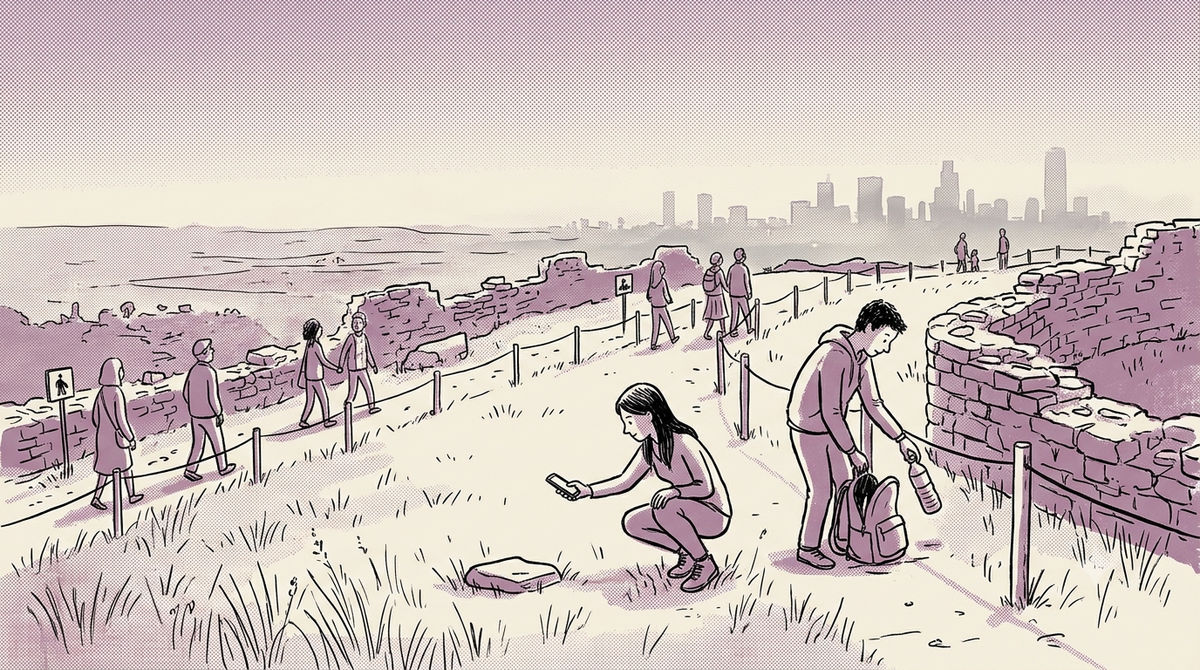
Half past four at a hilltop ruin, and the site closes at five. The light has finally gone gold. At your feet is a flat sand-coloured stone the size of a matchbox, one of ten thousand exactly like it. You pick it up and it weighs nothing. Your cousin stacks three more into a small tower for a photograph. Someone's water bottle is already parked in a gap in the wall. Nobody is watching. Nobody minds.
What's actually happening
Three small acts, one habit: taking, moving, leaving behind.
The middle one is the surprise. Petrified Forest National Park in Arizona asks visitors to leave objects alone, and also not to relocate them within the park. Its reason is that moving a thing "changes the context of the objects". Where a thing was found is part of what it is. A fragment shifted two metres into better light has quietly lost the information a researcher would have read from it.
The first act has arithmetic behind it. Take any busy site, say 8,000 visitors on a good day, and assume only one in a hundred pockets one small piece. That is 80 pieces a day, near enough 29,000 a year, from a place that is not making any more of them.
The third act is the easiest to fix. Bins, where they exist, tend to sit at the visitor centre rather than along the path, which is why Leave No Trace puts the job on you.
What works better
Photograph it, do not pocket it. Leave No Trace sums up its fourth principle, Leave What You Find, in five words: take photos, not souvenirs.
Leave things where they lie, including within the site. No stacking, no arranging, no moving a fragment for the shot.
Carry your rubbish out. Pack it in, pack it out covers food scraps and fruit peel. Cigarette butts are litter too, and the Petrified Forest rules say exactly that.
Keep your hands off old surfaces. At Petrified Forest, direct physical contact with rock art is prohibited outright, and visitors are asked to stay on trails and behind barricades. The park's line about its plants travels well: they grow by the inch and are destroyed by the foot.
Why it matters
Removing petrified wood, or any other natural or cultural feature, from that one park carries a minimum fine of $325. That is roughly ₹31,000 at current rates, before anyone asks what you took or why.
The more useful fact is at home. Section 30 of the Ancient Monuments and Archaeological Sites and Remains Act, 1958 covers anyone who destroys, removes, injures, defaces or misuses a protected monument. It also covers removing a carving or an inscription from one. The ceiling is two years, or a fine up to one lakh rupees, or both, raised to those levels by the 2010 amendment. India wrote this rule in 1958. Nobody needs to import it.
Try this next time
Before you walk out of any site, give yourself ten seconds. Look at the ground where you sat, and check the outside pockets of your bag. Anything that was not yours when you arrived either goes back exactly where it was, or leaves with you. That is the entire discipline, and it survives the flight home.
Quick check
1. You are leaving a US national park and your friend shows you a small piece of petrified wood in their palm. 'It was lying loose on the path, nobody will miss it.' What is the accurate response?
Select an answer.
2. Back in India, at a centrally protected monument, you notice a small carved fragment lying loose at the base of a wall, and a bag that would fit it. What is the legal position?
Select an answer.