Why straddling two lanes slows everyone (including you)
TL;DR
- Straddling two lanes feels like keeping your options open. It actually removes everyone else's.
- A 3-lane road with three straddling cars functions as two lanes in practice. The lost capacity compounds.
- The commitment is the point: when you are fully in a lane, drivers around you can predict your next move.
- Pick your lane 200 meters before a junction. Commit fully. Both tyres in one lane.
Contents
The moment
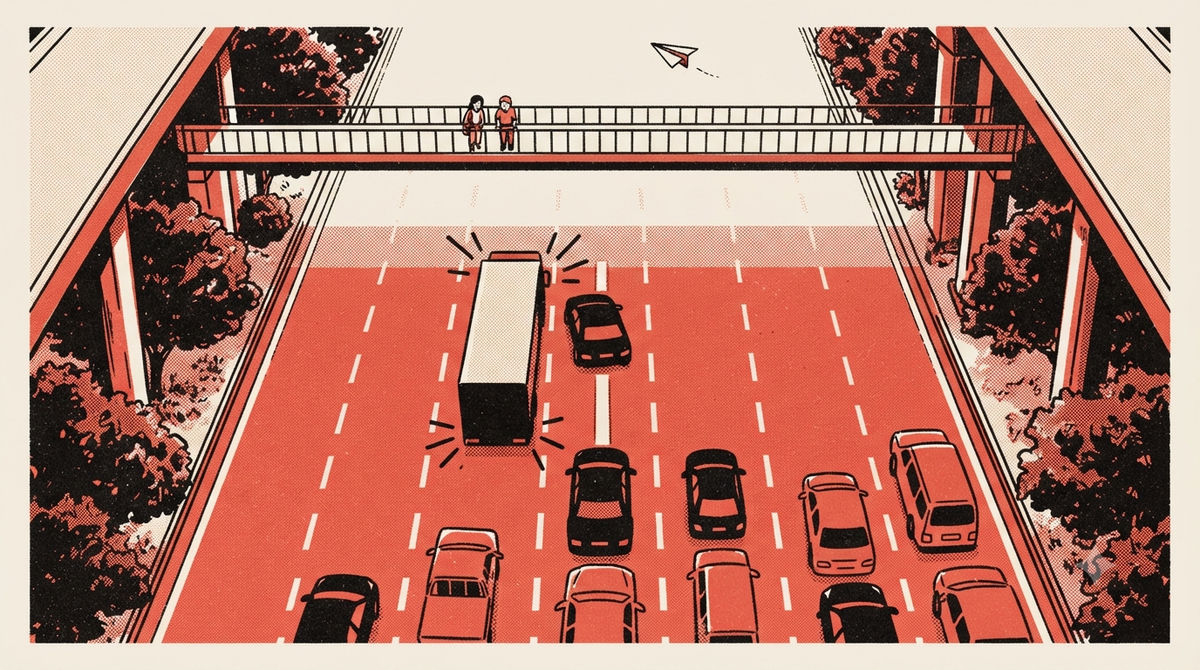
You're on the Western Express Highway at 8:45 am. Five lanes heading north. The car immediately ahead of you has settled onto the white line between lanes 2 and 3. Its left tyre is in lane 2, its right tyre in lane 3. The SUV to your right has done the same with lanes 3 and 4. Nobody seems bothered. Everyone found a strip of tarmac and planted themselves on it. Then a slow-moving truck in lane 2 starts signalling to merge into lane 3. It can't. The straddle car is in the way of both lanes simultaneously. Everything stacks up. Three minutes of commute time vaporize for the 20 cars behind.
What's actually happening
Lane straddling feels like flexibility. You're not committed to lane 2 or lane 3 yet, so you can go either way. This reasoning is backward. The commitment is the flexibility, for everyone around you.
When you're fully in lane 3, the driver behind you in lane 2 knows: that car goes forward, not toward me. When you straddle, nobody resolves anything. Every driver within 50 meters carries a small uncertainty about where you'll land. They drive slower, leave larger margins, and brake harder when you finally decide.
A 3-lane road with three straddling cars doesn't function as three lanes. The lanes are there; they're just not usable. Bottlenecks form whenever someone needs to change lanes and discovers they can't, because there's a car in both lanes at once.
The "including you" part: straddling also slows the straddler. The cars ahead of you are doing the same thing. The whole road flows at reduced capacity. You are not beating the system. You are the system slowing itself down.
What works better
Pick a lane. If you're between markings right now, choose the cleaner path, indicate if you need to move, and commit fully. Both tyres in one lane.
At a junction, pick your lane 200 meters before the turn. Not at 20 meters. Not at the stop line, where a late move forces every car behind you to reorganize in a space too tight for it.
Why it matters
The Ministry of Road Transport's Road Accidents in India 2023 report identifies improper lane change and uncontrolled overtaking as recurring contributory causes of multi-vehicle urban crashes. The straddling vehicle is the uncommitted vehicle. Uncommitted vehicles produce the hesitation cascade that precedes these crashes.
The Central Motor Vehicles Rules, 1989, Chapter VI, governs road-marking compliance and overtaking conduct. Erratic lateral movement that endangers other road users falls under Section 184 of the Motor Vehicles Act, 1988 (amended 2019), which covers dangerous driving. First-offence fine: ₹1,000-₹5,000, with possible imprisonment up to 6 months.
Try this next time
On your next multi-lane stretch, count how many cars are straddling and estimate the usable road width. It is almost always less than the marked lanes suggest. Then pick your lane and hold it to the next junction. Notice whether your pace changes. In most cases it doesn't. But every driver behind you has one fewer uncertainty to manage, and the road moves a little better for it.
Quick check
1. You're on a 3-lane urban road at 50 kph. The car directly ahead is straddling lanes 2 and 3. You want to pass. What do you do?
Select an answer.
2. You're approaching a busy junction on a 3-lane road, 150 meters out. You need to go straight. You're currently straddling lanes 2 and 3. What's the right move?
Select an answer.