The lane is not a suggestion
TL;DR
- Lane markings are a coordination system, not a suggestion. When you straddle two lanes, neither driver next to you can predict where you will go.
- A 3-lane road run without lane discipline effectively becomes 2.5 lanes. The lost capacity compounds at every junction.
- Pick your lane early, 100-200 meters before a junction. Commit fully. Indicate before you move.
- The civic contribution is predictability: when you are fully in a lane, drivers around you can plan.
Contents
The moment
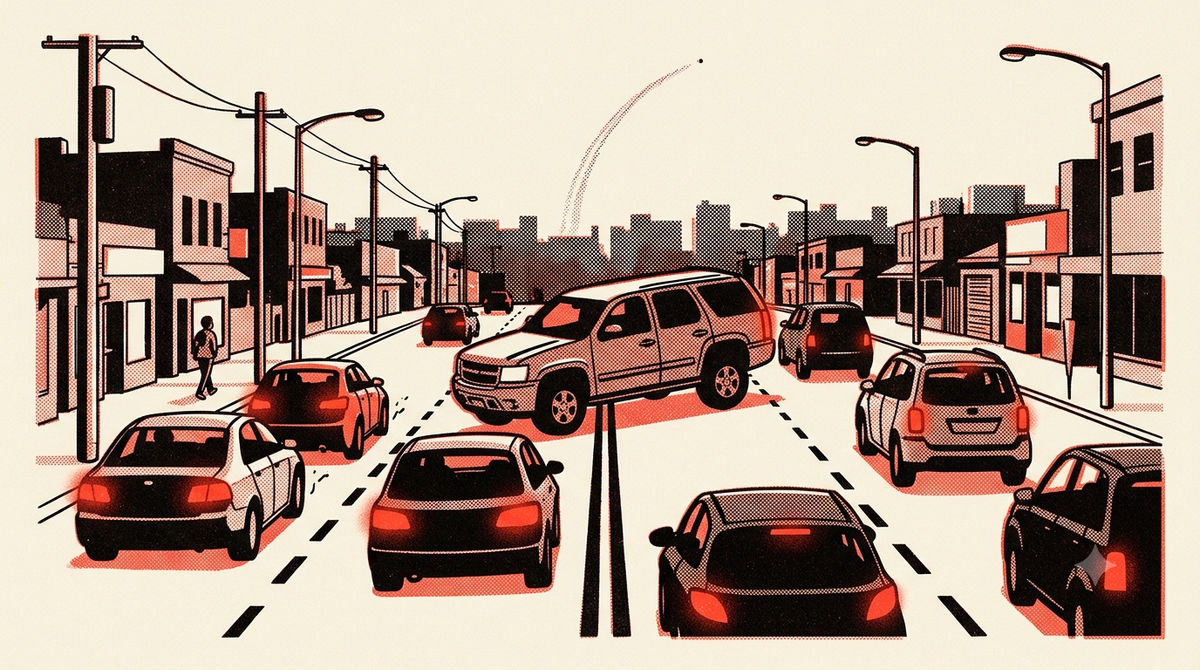
You're on Sarjapur Road in Bengaluru at 5:30 pm. Three lanes. Technically. The cars ahead are arranged like fingers spread slightly too wide: the leftmost car is half in the shoulder, half in lane 1. The middle car straddles lanes 1 and 2. The SUV on the right has its left side in lane 2 and its right somewhere near lane 3. None of this is malicious. Everyone found a sliver of space and stayed in it. Then the SUV ahead decides it needs the left lane. It begins a slow diagonal cut across not one lane but one and a half. Everyone brakes. Nobody saw it coming, because nobody knew where that SUV was going.
What's actually happening
Lane markings are a coordination system. Their job is not decorative. They exist so every driver on a road can predict where every other driver will be 3 seconds from now. When you're fully in lane 2, the driver in lane 3 knows: that car goes forward, not toward me. When you're halfway between lanes, neither driver next to you can make that calculation. Every interaction becomes a negotiation that should be a prediction.
The structural context matters here. Many Indian urban roads have lane markings that don't match the space cars actually need. Many roads have no markings at all for long stretches. Drivers who learned on these roads never built the habit of committing fully to a lane. The system failed to teach it.
But the structural explanation doesn't resolve what's happening between your car and the three others around you right now. You can pick a lane even when others haven't.
What works better
Pick a lane. Commit to it fully, not halfway. The full width of the lane belongs to you when you're in it. When you need to change lanes, indicate for at least 3 seconds, check the mirror, and move cleanly into the next lane. Not partway. All the way.
At an intersection, decide your lane 100-200 meters before the junction. If you need the right lane and you're in center, move now with the indicator running. Not at the last 20 meters, where a late move forces everyone behind you to brake without warning.
When you see a gap in the next lane, check the mirror, indicate, wait 2-3 seconds for the driver behind to register it, then move cleanly.
Why it matters
The Ministry of Road Transport's Road Accidents in India 2023 report identifies improper lane changes and uncontrolled overtaking as recurring contributory causes of multi-vehicle crashes at urban intersections. These are not freak incidents. They are predictable consequences of drivers whose next move cannot be predicted by the people around them.
Legally, erratic lane changes that create danger fall under Section 184 of the Motor Vehicles Act, 1988 (amended 2019), which covers dangerous driving. The first-offence fine is ₹1,000-₹5,000, with possible imprisonment up to 6 months. The Central Motor Vehicles Rules, 1989 (Chapter VI) carries the traffic control obligations that include road marking adherence and overtaking procedure.
Try this next time
On the next multi-lane stretch you drive, pick your lane before the 200-meter mark. Stay in it until you clear the junction. Notice which vehicles move fully with an indicator and which ones drift. The drift is the problem. The indicator is the solution.
Be the driver whose next move the person behind you could have predicted 5 seconds ago.
Quick check
1. You're approaching a busy intersection on a 3-lane road. You need to go straight, but you're currently halfway between lanes 1 and 2. The intersection is 80 meters ahead. What's the right move?
Select an answer.
2. The SUV in front of you has been straddling lanes 2 and 3 for the past 300 meters. You want to pass. What's the right move?
Select an answer.