Why parking on a footpath is its own kind of violence
TL;DR
- Parking on a footpath transfers your parking problem onto someone else's body.
- A blocked footpath forces pedestrians onto the road: people with prams, canes, and wheelchairs go first.
- When you have no road-side parking, park on the road, not the footpath. The road can absorb a parked car; the footpath cannot.
- Footpath obstruction is a fineable offense under traffic regulations in every major Indian city.
Contents
The moment
You are on 5th Main in Koramangala, running into a pharmacy. Ten minutes, maybe less. Your car goes up on the footpath. It is what everyone does on this stretch.
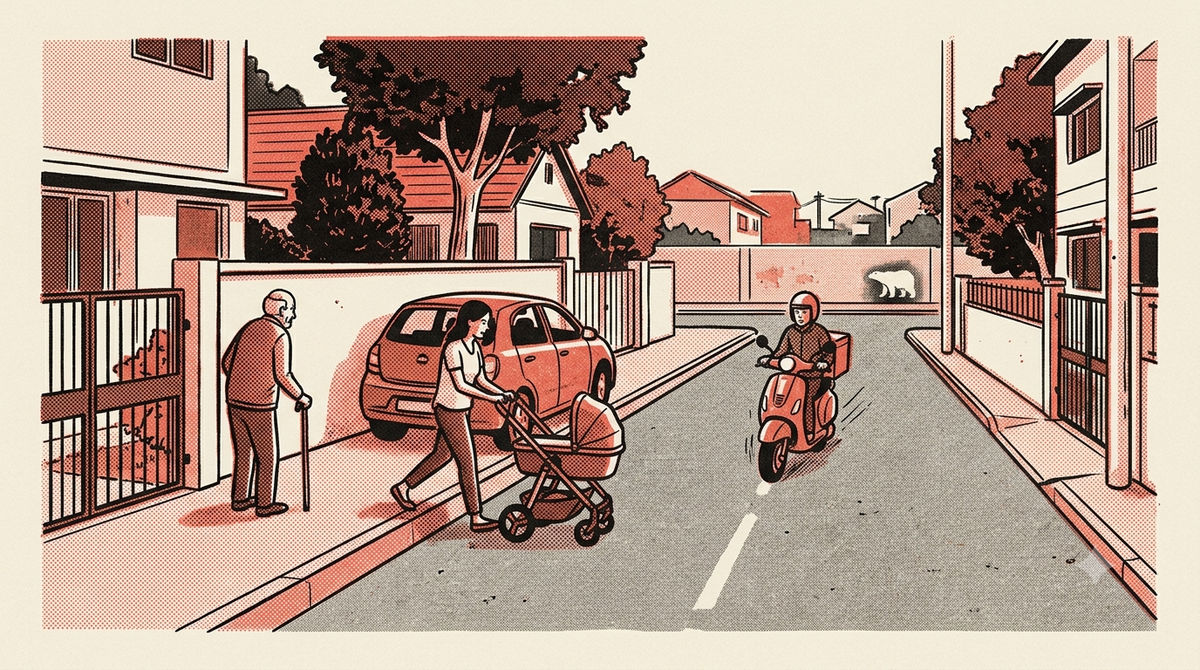
Behind you, a woman is pushing a pram along the footpath. She reaches your car. There is a gap of perhaps 25 centimeters between your front bumper and the compound wall. The pram does not fit. She steps into the road. A delivery scooter coming around the bend does not expect a pedestrian in the road at that point. He brakes hard. Both of them are fine. This time.
What's actually happening
Parking on the footpath is a transfer of risk. You move the risk from your schedule onto someone else's body. The time you save by not finding a road-side spot is borrowed from the pedestrian who now has to navigate traffic on foot.
The person who pays is not abstract. It is the woman with the pram. The elderly man whose knee makes road camber painful. The blind pedestrian whose cane does not detect a bumper 40 centimeters above the ground. The school student who expects the footpath to be a footpath.
IRC 103-2012 sets minimum footpath widths at 1.5 to 2 meters for residential streets and 2 to 3 meters for commercial corridors. A standard car is 1.8 meters wide. When your car occupies the footpath, you are not leaving a partial obstruction. You are ending the footpath for every person who reaches your bumper.
What works better
When there is no legal parking space, park on the road rather than the footpath. This sounds counterintuitive. But a car on the road is in a space built for vehicles. A car on the footpath is in a space built for people.
Three specific moves:
Park parallel to the road on the road itself, not with two wheels up on the kerb and two on the road. The footpath stays passable. The road loses one car-width of space, which it can absorb.
For a brief stop or pick-up, pull fully into the road, switch hazard lights on, and keep it under two minutes. You are using road space, not footpath space.
If the only available spot on a stretch would block the footpath, drive to the next junction. There is no version of footpath parking that works for the pedestrians behind you.
Why it matters
Around 35,000 pedestrians died on Indian roads in 2023 (MoRTH). A significant share of pedestrian fatalities occur when pedestrians are forced onto carriageways because footpaths are obstructed. The footpath is the only safe walking infrastructure most Indian pedestrians have. Blocking it removes that infrastructure.
Parking on the footpath is also a fineable offense under traffic regulations in every major Indian city, with penalties collected under the Motor Vehicles Act, 1988 and state-level rules. The actual cost of the behavior, however, is borne by people with no vehicle to protect them.
Try this next time
Before you pull up onto the kerb, look at who is walking that footpath and ask where they will go when they reach your car. If the answer is "into the road," find a different spot. The search usually takes 90 seconds.
Quick check
1. You park with two wheels on a narrow footpath to run a quick errand. A man using a wheelchair reaches your car. He cannot get past. What happened?
Select an answer.
2. You need to stop briefly to drop a passenger on a busy commercial street. There is no visible road-side parking. What is the correct move?
Select an answer.