What school-zone signs require of you
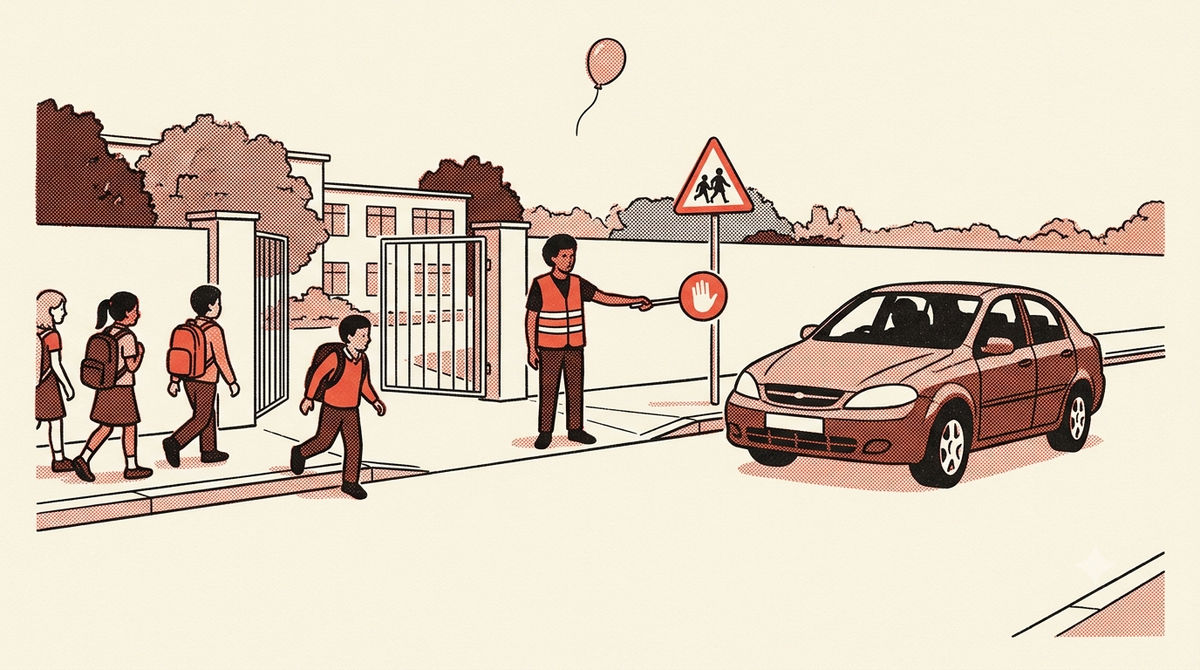
TL;DR
- A School Zone or School Ahead sign requires you to slow down, not just notice it.
- The standard school-vicinity speed limit is 25 km/h, in force during school hours.
- No Parking near school gates is a Motor Vehicles Act provision, not a school's request.
- Speeding in a school zone falls under Section 183 of the MVA, fines starting at Rs. 1,000.
Contents
The rule
When you see a School Zone or School Ahead sign, reduce speed to 25 km/h. This limit is in force during school operating hours, typically 7 am to 4 pm on school days. You must also observe any No Parking signs in the school vicinity.
Why this rule exists
Children walking to or from school are not experienced road-users. They step off footpaths without checking. They run between parked cars. They cluster at gates in a group, then scatter. A vehicle at 50 km/h on a dry road needs roughly 25 to 30 meters to stop. At 25 km/h, that distance drops to under 10 meters. The difference matters most when a child appears from behind a parked vehicle four meters ahead of you.
School zones also have high pedestrian density in short windows. The danger periods are roughly 7:45 to 8:15 am and 2:00 to 3:30 pm on most school days. A vehicle moving at city speed through either window increases the probability of a collision that a slower vehicle would avoid.
No-parking zones near school gates serve a different function: sightlines. A vehicle parked at a school gate blocks the view of a child who steps onto the road from behind it. Removing the parked car restores the line of sight for both the driver and the child. This is why the restriction exists and why it is an MV Act provision rather than a school preference.
What happens if you don't follow it
Speeding in a school zone falls under Section 183 of the Motor Vehicles Act, 1988. For light vehicles, the first-offence fine is Rs. 1,000. A repeat offence draws Rs. 2,000. Enforcement cameras near schools operate independently of traffic warden presence.
Parking violations near school gates are covered under Section 122 of the same Act, with state-level fines varying by state and enforcement authority.
The civic cost is separate from the legal one. MoRTH's Road Accidents in India 2023 report documents pedestrians, including children, as a large share of urban road fatalities. School-area speed compliance is one of the few individual actions that directly changes that number.
Quick reference
- School Ahead (triangular, red border): Warning sign. Begin slowing. 25 km/h applies ahead.
- School Zone speed board (white rectangle): Regulatory. 25 km/h in force for this stretch. Applies during school hours.
- No Parking near school gate: MVA Section 122 provision. Parking here creates a sightline hazard for children crossing.
- Pedestrian crossing near school: Stop and yield. Children have right of way. Do not inch forward. (See traffic-009.)
- Traffic warden at gate: Follow their instructions exactly. A warden's directive supersedes normal signal logic.
Quick check
1. You are driving at 45 km/h on a wide road at 8:05 am on a Wednesday. You pass a School Zone sign with a 25 km/h board. The road looks clear. What do you do?
Select an answer.
2. You drop your child at school. The gate area has a No Parking sign. You pull up 35 m from the gate, stop briefly with hazard lights on, and your child steps out. You then drive away immediately. Have you violated the No Parking rule?
Select an answer.