The zebra crossing is not optional
TL;DR
- At a marked zebra crossing, the pedestrian has right of way, whatever the signal phase.
- Yield order: pedestrian already on the road, then pedestrian at the kerb, then you.
- Around 35,000 pedestrians died on Indian roads in 2023, more than a fifth of all road deaths (MoRTH).
- Treat every crossing as stop-and-yield. The few seconds cost you nothing.
Contents
The moment
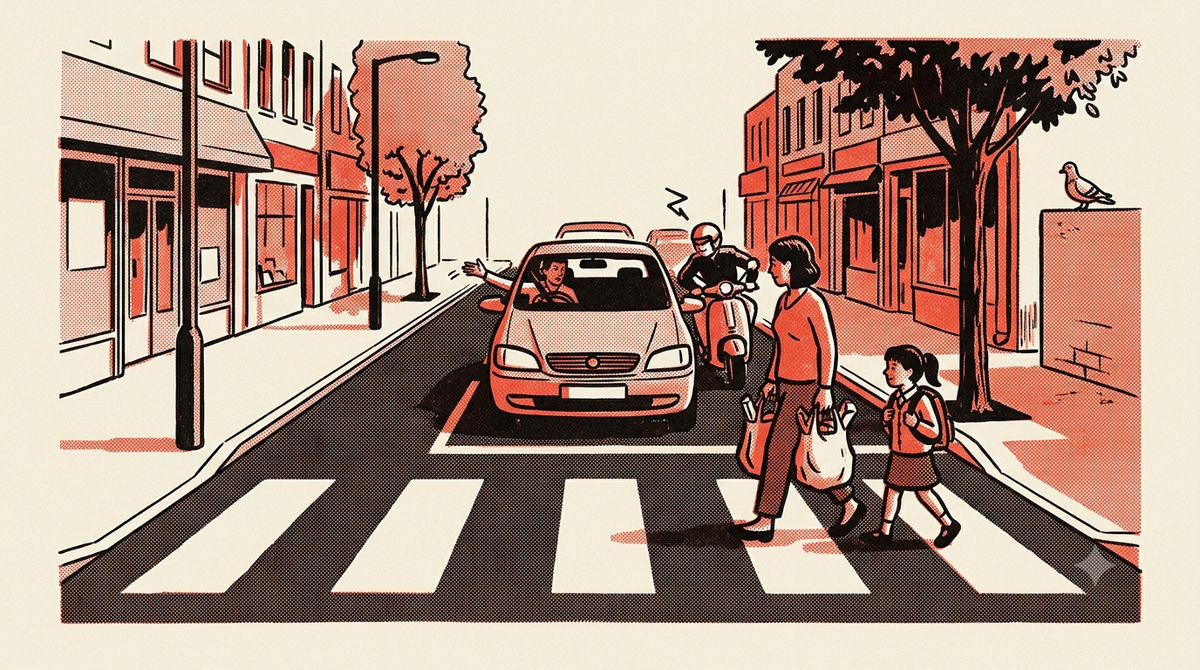
You're driving down 100 Feet Road in Indiranagar at 4:50 pm. A woman with two grocery bags is at the zebra crossing, waiting. Behind her, a school child. The light turned green for you 4 seconds ago. The zebra is clearly painted, the crossing is signalled. You roll through. So does the auto behind you. So do the next six vehicles. The woman waits for a 50-second gap that never comes. Eventually she steps in anyway. A scooter swerves around her with a horn. She makes it. Maybe.
What's actually happening
In the driver's seat, the calculation feels neutral. The light is green. The pedestrian is on the side. You have momentum, she doesn't. You go.
But the calculation is wrong. At a marked zebra crossing, the pedestrian has the right of way regardless of signal phase, in most Indian jurisdictions and in IRC's design guidelines. We have just collectively decided not to honor it.
Two structural problems compound the behavior. The first is that most Indian zebra crossings sit on the wrong side of the signal cycle. The driver's green and the pedestrian green run at the same time, which makes "yield to pedestrian" hard to operationalize. The second is that pedestrian crossings often lack pedestrian-actuated signals, so the woman with bags has no way to claim her phase.
Neither structural problem changes what you, in the driver's seat, can do.
What works better
When you see a person at a marked zebra crossing, slow down. If they've stepped onto the crossing, stop. Wait. Let them clear. Then go.
The car behind you may honk. The car behind that may honk. Let them. The pedestrian crosses in 6-9 seconds. Your delay is small, the pedestrian's safety is large.
At a signal where pedestrian and driver phases overlap (most Indian intersections), follow a simple priority order. First the pedestrian who has stepped onto the road, then the pedestrian waiting at the kerb, then you.
Two specific moves to add to your driving:
When approaching a known crossing, ease off the accelerator early. You arrive 0.5 seconds later, you arrive prepared.
When turning into a road, look right then forward. Pedestrians on the side road's crossing are the most missed.
Why it matters
In 2023, around 35,000 pedestrians died on Indian roads, more than a fifth of all road fatalities, according to MoRTH. By WHO's regional road-safety data, India's pedestrian fatality burden is among the highest anywhere. A large share of these deaths happens at or near crossings.
The Indian Roads Congress guideline IRC:103-2012 treats the marked zebra crossing as a space where pedestrians have priority. The fact that it is not enforced does not change what it is.
Try this next time
For one week, treat every zebra crossing as if it were a stop sign with a "yield to person" condition. Slow down on approach. If anyone is at the kerb looking like they might cross, stop. Wave them across.
Notice two things: how often this changes your trip time (it won't), and how many people look surprised. The surprise tells you everything about how rare the courtesy is. Be the rare driver.
Quick check
1. You're at a green light, turning right. A pedestrian is halfway across the zebra crossing on your right-turn path, walking on her white-walk signal. What's the right move?
Select an answer.
2. You're on Linking Road in Bandra. The intersection has no signal but the zebra crossing is clearly painted on the road. A man pushing a stroller starts to step onto the crossing. The car behind you taps the horn. What's the right move?
Select an answer.