Three on a bike, and why it ends badly
TL;DR
- Section 128 of the Motor Vehicles Act prohibits carrying more than one pillion on a two-wheeler.
- A standard 110cc scooter is designed for two people. A third person changes its braking and handling in ways the rider does not expect.
- A child seated between the rider and the handlebars has nothing in front of them in a frontal impact.
- The alternative to triple-loading usually costs ₹80 and 10 minutes, not a second vehicle.
Contents
The moment
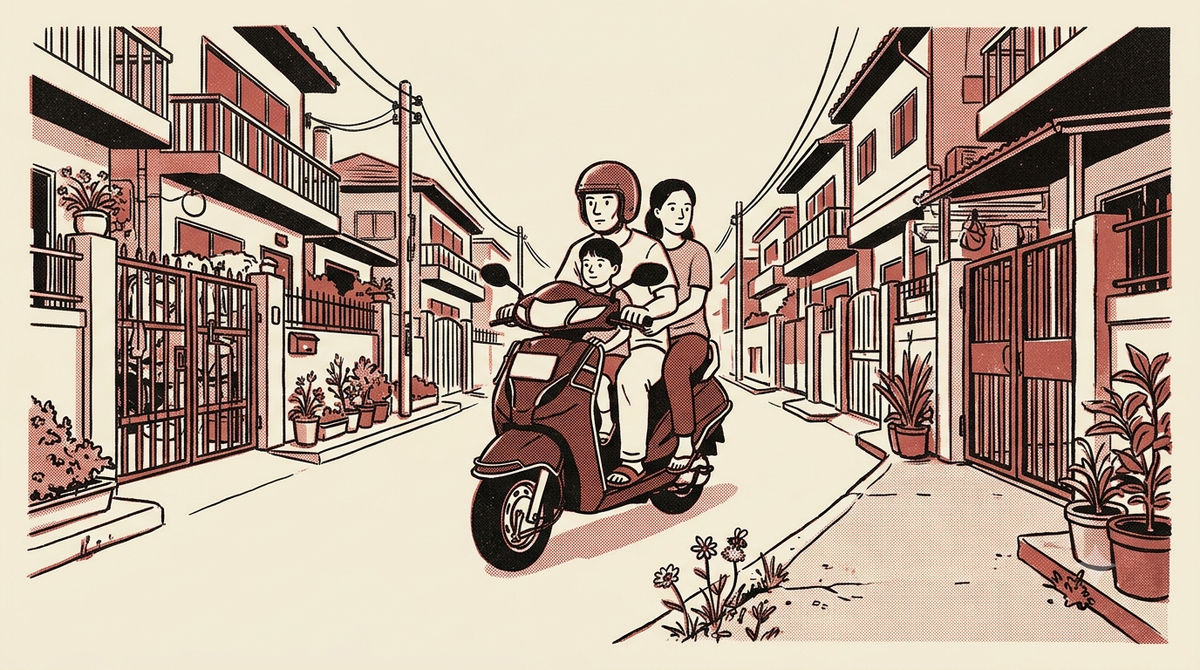
Sunday morning on a Jaipur gali. A scooter pulls out. A man at the handles. His wife behind him. Between them, pressed against the speedometer cluster, a child of about six. The child's feet dangle. No helmet on the child. No helmet on the wife. The scooter joins traffic.
Nobody stops them. The trip probably ends fine. Most trips do, until one doesn't.
What's actually happening
This is not a careless choice. This is one scooter, one family, three places to be. The alternative, in many households, is a second trip, or an auto that costs ₹80 each way, or a departure time that nobody can manage. The scooter is practical, it has worked before, and nothing has gone wrong yet.
The mechanics are less sympathetic. A standard 110cc scooter is rated for a combined load of around 150 kg, covering rider, pillion, and the vehicle's operating systems. Two adults of average weight come close to that limit. A third person, even a child, pushes the vehicle past its designed handling envelope. Braking distances increase with load. Suspension geometry shifts. Steering becomes heavier. At the exact moment you need the scooter to respond as expected, it is less likely to.
Section 128 of the Motor Vehicles Act, 1988, is direct: no driver of a two-wheeled motor cycle shall carry more than one person in addition to themselves. The fine is up to ₹2,000. More consequentially, if a crash occurs on an overloaded vehicle, most two-wheeler insurance policies treat the violation as grounds to dispute the claim.
The child between the handlebars is worth naming separately. In a frontal impact, that child has nothing between them and the obstacle. The rider's instinct to reach for the child during a fall often means neither is protected. There is no safe geometry here.
What works better
For the school run: two trips, or a shared auto with a neighbor who has the same school. The second trip adds 15 minutes. It does not add the other risk.
For adult passengers: one pillion. One helmet on each. Two people on the bike, not three.
If you triple-load regularly because of schedule pressure, identify the specific trip. "Every weekday I do this at 7:50 am." Now ask what single change removes it. Departing 10 minutes earlier. Splitting the drop. Using the school bus. A shared auto with one other family. The answer is usually smaller than the problem seems.
Why it matters
Two-wheelers account for the single largest share of road fatalities in India (MoRTH, Road Accidents in India 2023). More than half of all road deaths globally are among vulnerable road users, including motorcyclists (WHO). The child in front of the handlebars is in the least protected position on the most vulnerable vehicle type on one of the world's most dangerous road networks.
The system has failed here too. Scooter ownership outpaced public transport options in many cities, and school-bus coverage is uneven. That does not change what triple-loading does to braking distance.
Try this next time
If you regularly triple-load for a specific trip, name that trip to yourself. Then find the one change that removes it. Sometimes it is a ₹100 auto. Sometimes it is a conversation with a neighbor. Sometimes it is a 10-minute earlier departure.
Name the trip. Find the change. Make the change once. See if it holds. That is the civic upgrade available to you, without waiting for the road to improve.
Quick check
1. You are on a 110cc scooter with your spouse as pillion. Your 7-year-old needs to come too. You seat the child in front between you and the handlebars. What has changed about your vehicle's behavior?
Select an answer.
2. Your neighbor says: 'I have been triple-riding for 8 years and nothing has happened.' What does this tell you about the risk?
Select an answer.