Indicators are free, please use them
TL;DR
- The indicator is not a request for permission. It is information: 'I will be in that space in 3 seconds.'
- Without the indicator, drivers behind you react after the move, not before. Reaction takes more braking distance.
- The sequence is: mirror, indicator, check blind spot, move. In that order, every time.
- Indicate even in slow city traffic. The pedestrian on the footpath also uses that information.
Contents
The moment
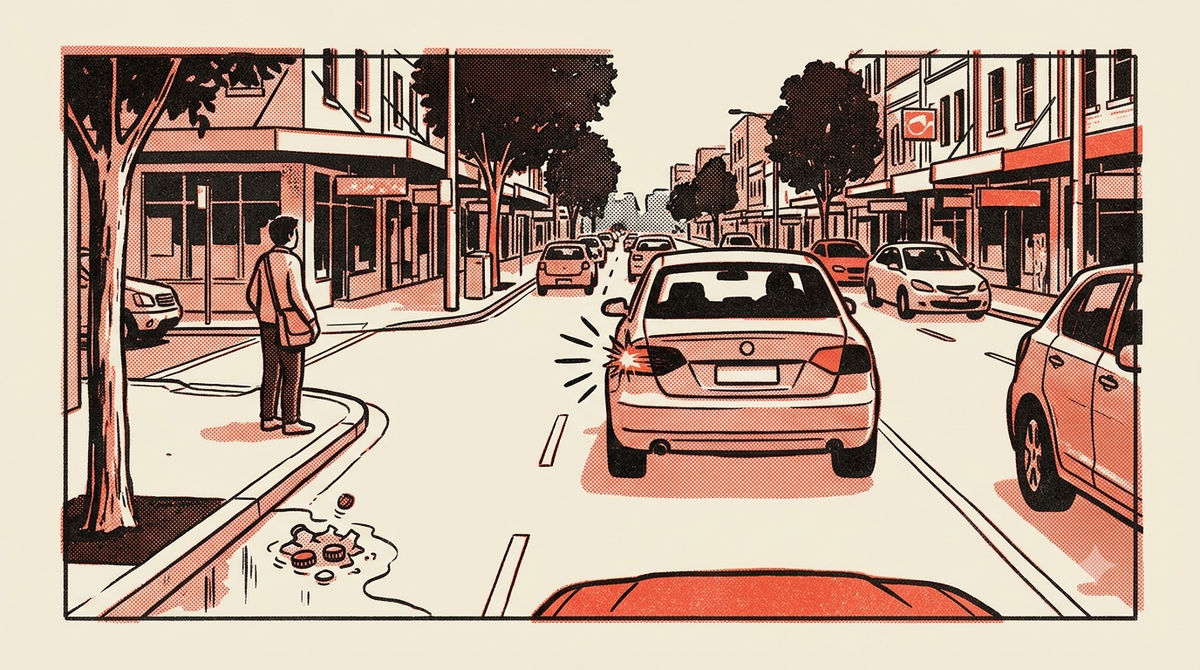
You're on MG Road, Bengaluru, in lane 2 at 45 kph. The car in front swings left into lane 1 without warning. You brake. The car behind you brakes. The auto behind that brakes. Three vehicles adjust their speed because one driver didn't push a lever already in their hand. The indicator stalk takes half a second and the force of one finger. It was not used.
What's actually happening
The turn indicator is not a permission slip. When you indicate left, you're not asking the driver next to you whether you may enter the lane. You're telling every driver around you: "I will be in that space in approximately 3 seconds."
Those 3 seconds give the car behind you time to adjust speed. They give the driver in lane 1 time to let you in cleanly. They give the driver four cars back the warning they need to avoid a braking cascade they can't see the source of.
Without the indicator, everyone reacts after the move happens. Reaction time is slower than anticipation. Reaction at 45 kph needs more braking distance than anticipation at the same speed. More braking distance means more disruption to the cars behind, multiplied through each vehicle in the chain. Three cars brake because one driver didn't indicate. That's the math of it.
A version of this argument runs: if I indicate, the driver in the gap will close it. Sometimes that happens. But a driver who closes gaps does it at the first sign of movement anyway. The indicator doesn't help or harm with that driver. It helps the four drivers behind the gap who need those 3 seconds of warning.
What works better
Indicate before the move, not during it, not after. The sequence is: mirror, indicator, check blind spot, move. In that order. If you indicate and nobody lets you in for 4 seconds, you may move if the gap is clear. The indicator is information, not negotiation.
In slow city traffic, indicate even when it feels unnecessary. At a signal, if you're in lane 2 and turning right, your right indicator should be running while you wait. The pedestrian at the crossing reads this information too, and adjusts.
When turning into a side road, indicate 30 meters before, not at the mouth of the turn. At the mouth, the driver behind is already committed to the speed that your turn will disrupt.
Why it matters
Rule 21 of the Central Motor Vehicles Rules, 1989 governs the use of direction indicators. Failure to signal before changing direction violates the conduct rules in Chapter VI and carries a fine under Section 177 of the Motor Vehicles Act, 1988. First offence: ₹500. Second offence: ₹1,500.
The practical consequence is more immediate. MoRTH's Road Accidents in India 2023 report records improper lane change without warning as a recurring contributory cause of urban multi-vehicle crashes. The crash does not start with the car that failed to indicate. It starts with the car that couldn't anticipate the move and ran out of braking room.
Try this next time
For one commute, commit to indicating every lane change and every turn, regardless of traffic density. Notice how often you catch yourself reaching for the lever late, or after the move. The habit is in the sequence: mirror, indicator, check, move. In that order, every time.
The lever is already in your hand. Use it.
Quick check
1. You want to move from lane 2 to lane 1. You indicate. The car in lane 1 speeds up slightly to close the gap. What do you do?
Select an answer.
2. You're at a signal in lane 2, waiting to turn right. The light is still red. Should your indicator be running?
Select an answer.