The three-honk rule (and why one is usually enough)
TL;DR
- One tap alerts. A second tap gives the driver ahead no new information they don't already have.
- After the first honk, the other driver has heard you. If they haven't moved, they have a reason you cannot see.
- A standard car horn at 3 meters delivers 90-100 dB. The WHO urban daytime health limit is 55 dB.
- Try the 8-count rule: tap once, count to 8, then ask whether a second tap would add anything.
Contents
The moment
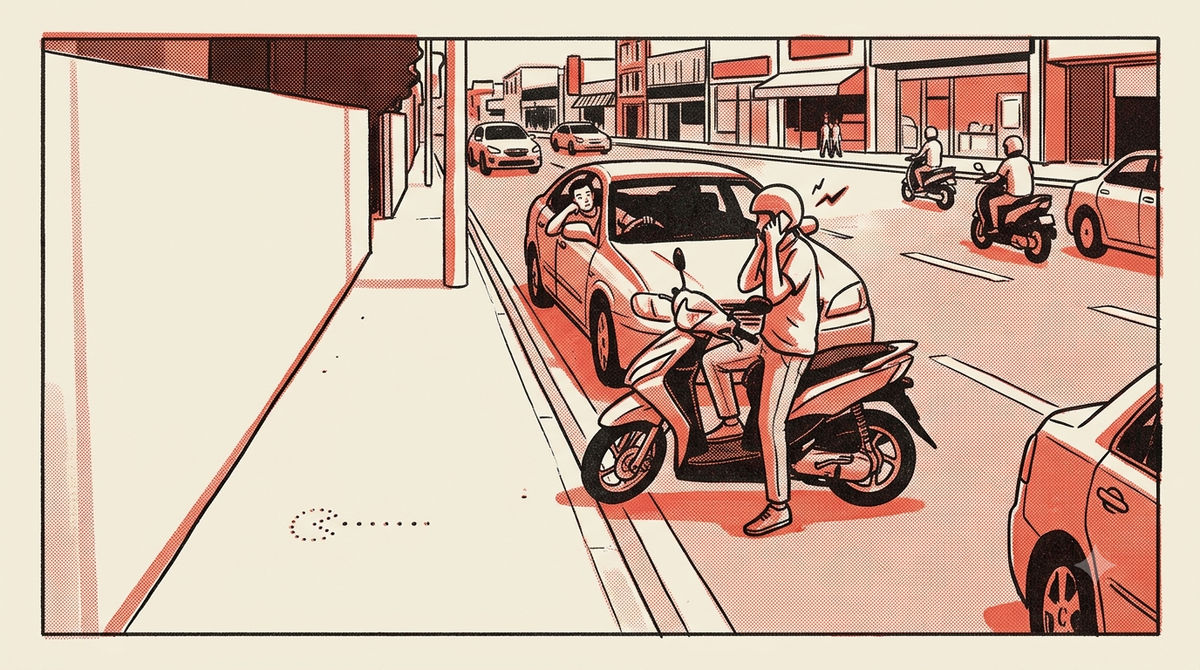
You're behind an Activa on Linking Road in Bandra at 9:10 am. The scooter has stopped at an odd angle, half in traffic. The rider appears to be on a call. You tap once. Nothing. You tap again, sharper. Nothing. Your thumb finds the horn center and stays there for three seconds. The rider looks up, waves you off irritably, and still does not move.
What's actually happening
That sequence of three signals communicated three different things.
The first tap was information: the driver might not know you're there. The second was impatience: you think they heard you and chose to ignore you. The long press was something closer to anger than to information.
The rider registered all three signals after the first one. He heard the tap, made a judgment you couldn't see from your seat, and stayed where he was. Your second and third signals did not give him new information. They confirmed that you are now angry, which is not the same as clearing the road.
None of those signals moved the Activa. They did push ambient noise past 90 decibels at that stretch, raise cortisol levels in both of you, and give every driver within 30 meters a slightly worse morning.
What works better
One tap. Then nothing for at least 5-8 seconds.
After that first tap, the other driver knows you're there. If they haven't responded, they either cannot, or they have information you don't have from your position. A second tap gives them nothing new. It gives them the same alert, louder, with the addition of your impatience.
The exception is real danger: a vehicle drifting into your lane without seeing you, a pedestrian stepping into a blind spot. In those cases, a firm tap is exactly what the horn is for. The distinction is whether you're warning of a risk or commenting on someone else's pace.
In defensive driving instruction, this is sometimes framed as a simple check: is there a risk the other driver doesn't know about? If yes, use the horn. If the answer is "they're just slow" or "I'm late," the horn has nothing useful to add.
Why it matters
A standard car horn at 3 meters delivers 90-100 decibels. At a busy urban junction during morning peak, cumulative horn use holds ambient levels at 85-90 dB. CPCB's real-time noise monitoring data from major city intersections confirms this range. The WHO urban daytime health threshold is 55 dB. Sustained exposure above 70 dB is associated with elevated cortisol, sleep disruption, and cardiovascular strain.
Section 194F of the Motor Vehicles Act, 1988 (amended 2019) restricts unnecessary horn use and prohibits modified pressure horns. The fine is ₹1,000 for a first offence, ₹2,000 for repeats. The law does not define "unnecessary" in measured decibels. The intent is clear: the horn is a warning device, not a tool for expressing frustration.
Try this next time
After the first tap, count to 8 silently. If the situation hasn't resolved, ask yourself one question: would a second tap give the driver ahead any information they don't already have? Almost always, the answer is no. Let the 8 count be your answer.
Quick check
1. You tap the horn once at a stopped auto-rickshaw on a busy street. Eight seconds pass. The auto hasn't moved. What's the right move?
Select an answer.
2. Which of these is the horn genuinely useful for?
Select all that apply.