The footpath is not a shortcut
TL;DR
- A footpath exists for one mode: walking. Two-wheelers on it remove infrastructure from people who have no alternative.
- The logic of 'the footpath is empty' fails the moment a pedestrian appears, and they will.
- In 2023, two-wheelers were involved in around 44 percent of all road accident deaths in India (MoRTH).
- Default to the road. Wait in lane. The jam almost always breaks.
Contents
The moment
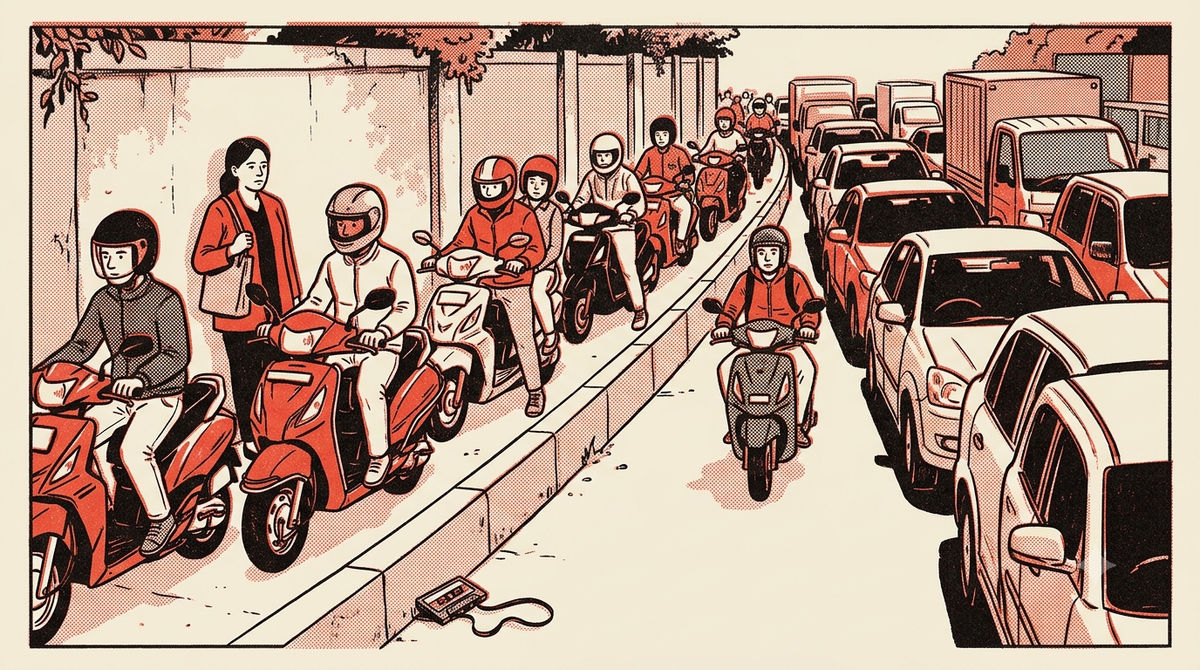
You are on Sardar Vallabhbhai Patel Road in Pune at 8:50 am. The junction ahead has stopped. Two lanes are locked, the signal keeps cycling, nothing moves. The two-wheeler in front of you bumps up the kerb and onto the footpath. Then another. Then five more.
The footpath is about 1.5 meters wide. There is a woman walking toward the junction with a bag. The bikes ride around her without slowing.
She presses herself against the compound wall. The bikes pass. She keeps walking. She does not say anything.
What's actually happening
The logic inside the helmet is straightforward. The road is not moving. The footpath is clear. You need 40 meters. Nobody gets hurt.
The logic holds on an empty footpath at 7 am. It fails at 9 am on a populated stretch because the footpath is serving the same junction as the road. The woman with the bag is also a commuter trying to reach the same corner. You are not getting around traffic. You are introducing traffic to the pedestrian track.
A footpath is not overflow capacity for road congestion. It is infrastructure built for one mode. Two-wheelers on it are, in effect, removing the only surface available to people who cannot use the jammed road at all.
The system is partly responsible. Many Indian roads lack footpaths, or the footpaths are occupied by parked vehicles, vendors, and utility equipment. Where no footpath exists, there is no choice. But where one exists and is usable, riding on it is a choice, not a necessity.
What works better
Wait in lane. The junction is 40 meters away. The jam will break.
If the road has a marked two-wheeler lane, use it. Where none exists, the standard informal practice is lane-splitting between stationary cars. That keeps you on the road surface, where you belong.
If the jam is genuinely gridlocked, the practical answer is an alternate route, not an alternate surface. Even a one-block detour onto a parallel street is better than the footpath.
Why it matters
In 2023, two-wheelers were involved in approximately 44 percent of all road accident fatalities in India, the largest share of any vehicle category, according to MoRTH data. Two-wheelers on footpaths transfer risk from a congested road to pedestrians who have no other surface to walk on.
Section 184 of the Motor Vehicles Act, 1988 covers driving in a manner dangerous to the public. Riding on a pedestrian footpath qualifies. State traffic authorities treat it as a challan-able offense; fines vary by state, typically between 500 and 2,000 rupees.
The woman pressed against the compound wall is not a hypothetical. She appears on every busy footpath in every Indian city, every morning. She has learned not to say anything, because she knows the bikes will not stop.
Try this next time
Before moving onto a footpath, look at who is on it. If anyone is there, the calculation is clear: you cannot go. If no one is there now, someone will be there before you are through.
The footpath belongs to someone else's commute. Default to the road.
Quick check
1. You are on a two-wheeler at a gridlocked junction. The footpath beside you is currently empty. You need 35 meters to clear the jam. What is the correct assessment of this situation?
Select an answer.
2. According to the Ministry of Road Transport and Highways' Road Accidents in India 2023 report, approximately what share of all road accident fatalities involved two-wheelers?
Select an answer.