The ambulance behind you: the 6 seconds that matter
TL;DR
- When you hear a siren behind you, check your mirrors, pull left within the carriageway, and stop.
- Section 194E of the Motor Vehicles Act makes failure to give way to an emergency vehicle a punishable offense. Fine: ₹10,000.
- Cardiac arrest and major trauma are time-critical. Every minute of delayed care changes outcomes.
- If you move left by 1.5 metres, the cars behind you follow. The lane appears in under 30 seconds.
Contents
The moment
You are in a single lane on Andheri-Kurla Road at 6:15 pm. Traffic has not moved in four minutes. A siren starts somewhere behind you. Faint, then closer.
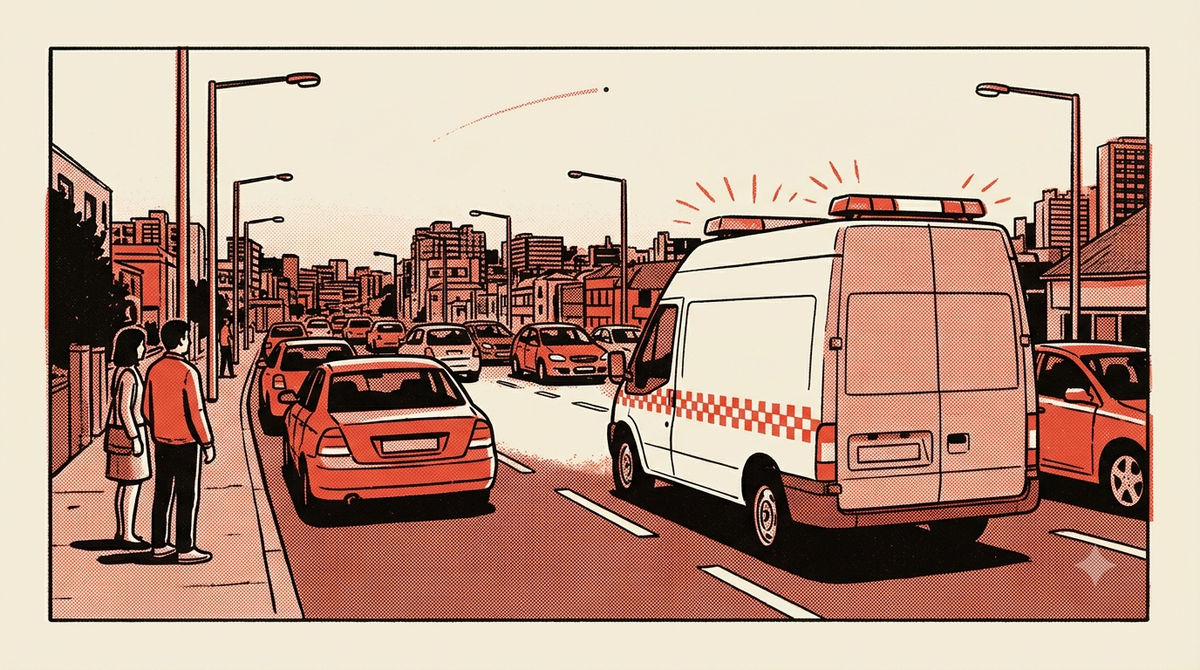
It takes you a few seconds to locate it in the mirrors: an ambulance three cars back, blue light flashing, trying to thread through. Nobody moves. The auto to your left does not move. The cab ahead does not move. The ambulance closes to one car behind you. Still stuck.
The siren has been going for 40 seconds. The ambulance has travelled roughly 8 metres.
What's actually happening
The reasoning in every car around you is: "I cannot move because the car next to me is not moving." That is true of every driver simultaneously. It is also the logic that produces a lane that never opens.
Movement works in the other direction too. If you pull left by 1.5 metres, the car behind you has a signal that space has appeared and does the same. If four cars do this in sequence, an ambulance corridor appears in under 30 seconds.
The 6 seconds are yours. The time from first hearing the siren to moving your wheel. Nobody can do that for you. The ambulance cannot create the gap. The traffic police officer at the junction ahead cannot create the gap from there. The driver whose first 6 seconds become movement is the one who starts the sequence.
What works better
Check your mirrors as soon as you hear a siren. Locate the vehicle. Is it behind you, beside you, or crossing ahead? For an ambulance approaching from behind:
Pull left as far as your lane allows. The kerb is your target, not the footpath. Stop short of the footpath. Stay on the carriageway.
Stop the vehicle. Not a slow roll. Stop.
If the car in front of you has not moved yet, that is not your problem. You have created your gap. The ambulance will find the corridor.
After the ambulance passes, wait two seconds before pulling back in. Emergency vehicles often travel in convoy.
If there is genuinely no space on your left because vehicles are packed on all sides, hold position and do not reverse or move unpredictably. The ambulance crew is experienced in threading a gap from your stationary position. Erratic movement makes it harder.
Why it matters
Cardiac arrest and major trauma are both time-sensitive. For these conditions, the window between arrival at care and a good outcome closes quickly. The ambulance is not transporting a deadline for paperwork. It is transporting a person on a physiological clock.
Indian law captures this urgency. Section 194E of the Motor Vehicles Act, 1988, inserted by the 2019 amendment, makes failure to give way to any vehicle on emergency duty a punishable offense. The fine is ₹10,000.
The fine is not the reason to move. The reason to move is the same reason the law exists.
Try this next time
On any commute, run a quick check: if a siren came right now, could I pull left in 6 seconds? What is to my left? Is there a kerb? Is there a footpath I should not mount? How far would I need to move to open a lane?
Knowing this in advance means you do not have to figure it out when the siren is directly behind you and the pressure is real.
Be the driver who moves first. The cars behind will follow. The lane appears.
Quick check
1. An ambulance is approaching from behind on a two-lane road. There is a narrow footpath to your left separated by a low kerb. The lane is tightly packed. What is the correct move?
Select an answer.
2. You have just given way to an ambulance and resumed driving. Fifteen seconds later, a second siren approaches the same junction from a perpendicular road to your right. What should you do?
Select an answer.