Silence zones and the law you didn't know existed
TL;DR
- Silence zones exist within 100 meters of hospitals, schools, courts, and religious sites. Horn use is prohibited.
- Most Indian drivers pass through multiple silence zones every day without knowing it.
- The fine is ₹1,000 for a first offense under the Motor Vehicles Act, 1988.
- No map required. When you see a hospital gate ahead, keep the horn down for those 200 meters.
Contents
The moment
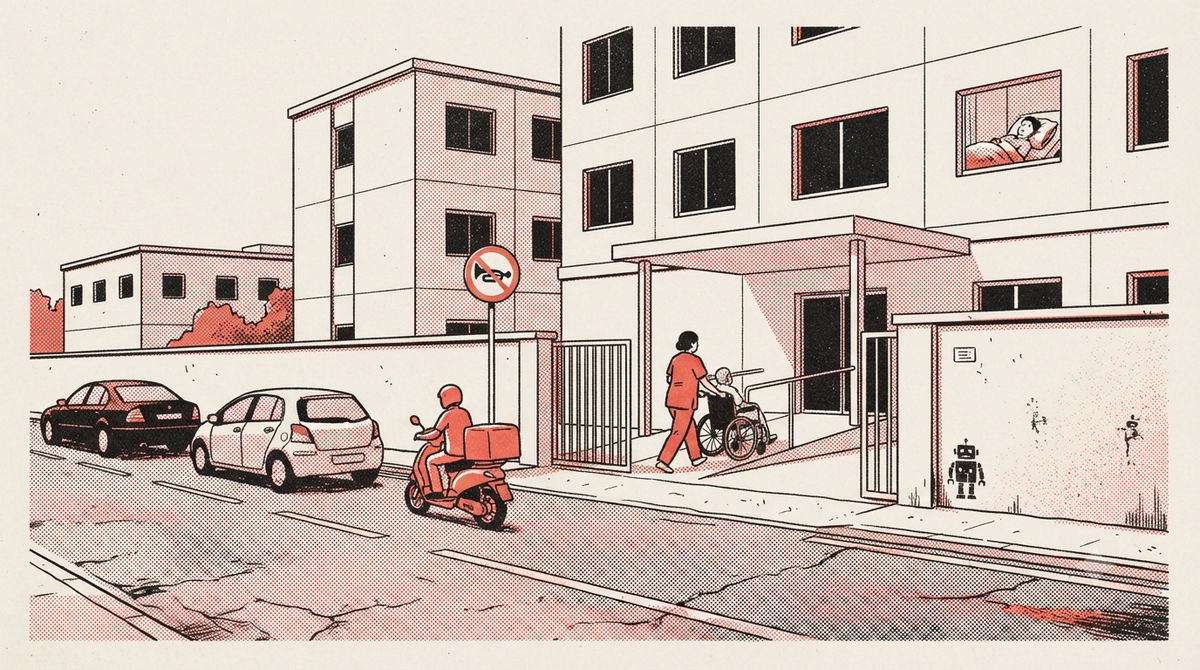
You're turning onto Hospital Road, Secunderabad, at 9:30 am. The signal turns green. The cab ahead moves slowly. A delivery bike behind you leans on its horn: two full seconds, 20 meters from the main entrance of a government hospital.
The rider doesn't know this is a silence zone. Almost no driver does.
What's actually happening
Under the Noise Pollution (Regulation and Control) Rules, 2000, any area within 100 meters of a hospital, educational institution, court, or religious site is a silence zone. Within a silence zone, using a vehicle horn is prohibited except in a genuine emergency. Section 194F of the Motor Vehicles Act, 1988 (amended 2019) enforces this: ₹1,000 first offense, ₹2,000 repeat.
These are not hypothetical designations. Every hospital on your commute has a 100-meter radius where the law prohibits the horn. Every school. Every court. Most urban commutes in India pass through several of them.
Most silence zones have no visible signage. Some have worn boards the size of a number plate, faded into the wall. The absence of a sign does not vacate the law.
What works better
You don't need a map. The trigger is visual. When you see a hospital gate, a school entrance, a court complex, or a religious site ahead, take your hand off the horn. Stay quiet through that block and for 100 meters on the other side.
That's a stretch of road you can complete without a horn on any commute. The car that drifted out of a gate without indicating is still the car that drifted. A short tap from 15 meters outside a hospital is still a tap inside the silence zone.
Why it matters
Hospital noise is not a comfort issue. The WHO's environmental noise research documents how noise above 50-55 dB disrupts patient recovery, affects ICU staff communication, and interferes with monitoring equipment. The silence zone limit is 50 dB during the day, 40 dB at night. A vehicle horn at any useful distance easily exceeds that limit. A person who had surgery that morning can hear it through a window.
The silence zone rule is the civic contract in its clearest form: the people inside those buildings cannot come out and ask you to stop. The law asks on their behalf.
Try this next time
On your regular commute, identify one silence zone you pass through. A hospital gate. A school entrance. A court complex. Mark it in your memory. For one week, no horn in that zone.
Notice two things: whether it changes your trip time (it won't), and whether you miss the horn when you don't have it. If you don't miss it, the habit is already changing.
Quick check
1. Your regular commute takes you past a large private hospital. Under the Noise Pollution Rules, 2000, where does the silence zone begin?
Select an answer.
2. You're driving on a road parallel to a school. No signage is visible. The school boundary is about 70 meters to your left. A cycle rickshaw ahead slows suddenly. What is the correct move?
Select an answer.