School pickup chaos and how not to be it
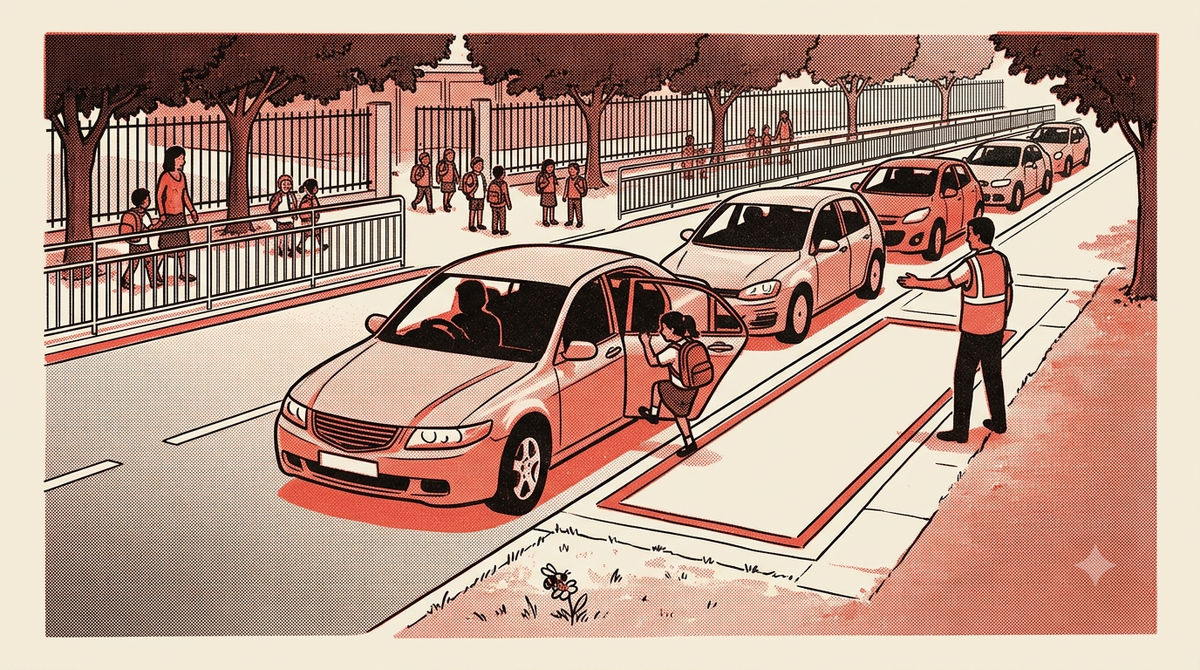
TL;DR
- Pull all the way to the front of the pickup zone before stopping. Not partway. All the way.
- Load or unload in one efficient move, then leave. The stop is not a waiting spot.
- Never double-park or leave your car unattended at the school gate.
- A pickup queue that follows the rules clears in 8 minutes. One that doesn't can run for 40.
Contents
The rule
At school pickup or drop-off, three things apply. Pull all the way to the front of the designated pickup zone before stopping. Load or unload the child in one efficient move. Then leave immediately. Do not stop partway down the zone, do not park and wait for the child to appear, and do not double-park.
Why this rule exists
School pickup queues fail because each driver optimizes individually instead of following the zone logic.
You stop 20 meters short of the front because pulling all the way up feels like effort. The car behind you stops behind you. The next car stops behind that. The queue now extends out of the school lane and into the main road. It blocks other traffic and the pedestrians trying to cross at the same time.
The math is worth knowing. A school with 400 children dispersing over 30 minutes has roughly 250 cars. If each car takes 20 seconds to stop, load, and move, the lane runs well within the window. If each car takes 60 seconds because the driver stopped short and waited for the child to run from the building, the last car in the queue waits 25 minutes. That 60-second stop usually involves stopping early, waiting for the child, scanning a phone while waiting, and then sorting a bag.
Double-parking compounds this differently. A double-parked car on a two-lane school road narrows it to one lane. At the gate, where children are crossing in both directions, it creates a blind corner on the side the child is walking toward. This is the geometry of most school-gate pedestrian near-misses.
What happens if you don't follow it
Double parking and blocking the road are obstruction violations under Section 122 of the Motor Vehicles Act, 1988. Traffic police in most cities issue challans at school gates during the pickup window. In congested school zones in Bengaluru, Chennai, and Pune, towing is also used in enforcement drives.
A blocked school gate is also a delayed emergency response. An ambulance that cannot reach a school in the first minutes of a medical event faces a different outcome from one that can.
Quick reference
- Pull all the way forward: Keep moving until the car ahead has left. Stop only at the frontmost open spot.
- Load or unload, then go: The stop is for one action. When it is done, leave.
- Do not double-park: Your one saved minute creates 12 cars' delay.
- Do not idle and wait: Have your child ready to walk to the car. You are going to them.
- Follow the warden or school marshal: Their instructions override your judgment about where to stop.
- Leaving the car unattended at the gate: This is a parking violation and a blocked-gate scenario. Use the car park or pick up from a legal spot down the road.
Quick check
1. You arrive at school pickup at 2:50 pm. The pickup zone has open space at the front, but reaching it means pulling 25 m past the gate. Stopping where you are is more convenient. What do you do?
Select an answer.
2. A parent has left their car unattended at the school gate, engine off, and gone inside to collect their child from a classroom. Eight minutes later the car is still there. Cars behind cannot move. What is the practical resolution?
Select an answer.