No-parking zones exist for reasons that aren't conspiracy
TL;DR
- No-parking zones each have a specific functional reason: bus stop clearance, intersection sight lines, fire hydrant access, or loading zone windows.
- When a bus cannot pull into its stop, it stops in the moving lane and backs up every vehicle behind it.
- A car parked near an intersection removes a turning driver's view of cyclists and pedestrians crossing the side road.
- Parking in designated no-parking zones is prohibited under the Motor Vehicles Act, 1988. The actual cost is usually someone else's emergency being slower.
Contents
The moment
You are on Linking Road in Bandra on a Saturday afternoon. Every kerb-side spot is taken. There is a gap right in front of the bus stop. The sign says no-parking. You need eight minutes. You park.
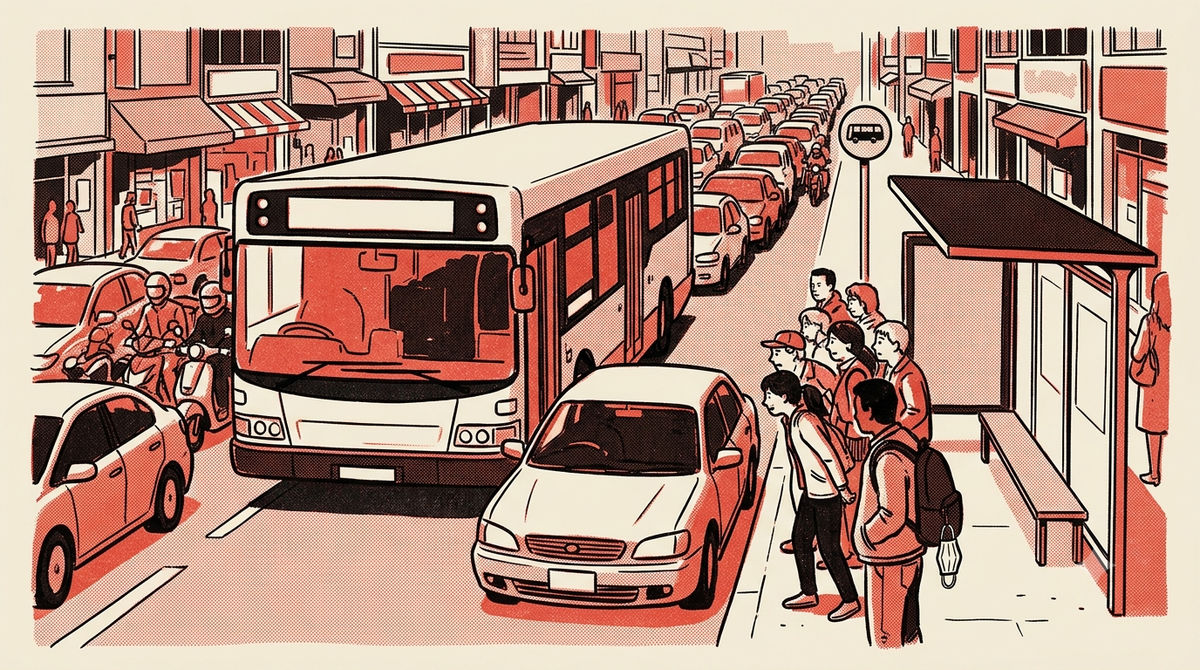
The BEST bus arrives two minutes later. The driver cannot pull into the stop: your car is in the clearance zone. The bus stops in the moving lane. The auto behind it stops. The cars behind the auto stop. By the time the bus moves on, twelve vehicles are queued in a lane that was flowing freely before you arrived.
You are back in eight minutes. You saw none of this.
What's actually happening
No-parking zones are not random. Each type marks the exact point where a parked car causes a failure in the system around it.
Bus stop clearance zones exist so buses can pull fully out of the moving lane. When a bus cannot clear the lane, it stops in traffic. In busy corridors, one blocked bus stop in peak hour backs up vehicles 150 meters in under three minutes.
Intersection clearance zones, the ones painted within a few meters of a junction, exist for sight distance. A parked car on the approach removes a turning driver's view of cyclists and pedestrians crossing the side road. The pedestrian does not appear in the driver's field of vision until the car is alongside them. IRC pedestrian facility guidelines treat clear sight lines at intersections as a minimum safety requirement, not a design preference.
Fire hydrant and emergency vehicle bays exist because a fire engine with a blocked hydrant must find the next connection point and pull hose across the extra distance. In a residential building fire, that is not a marginal delay.
Loading zones are time-limited commercial access windows. A truck bay blocked during its window means the delivery vehicle stops in the road lane instead.
The sign is marking a failure mode. It is not making an administrative point.
What works better
Before you park in a no-parking zone, identify which category it falls into, then calculate what happens if you are still inside at the fifteen-minute mark.
For bus-stop zones: the next legal space is rarely more than 100 meters away. The walk costs 90 seconds.
For intersection zones: park on the far side of the junction, not the approach. The sight-distance problem is on the approach side, not beyond it.
For fire or emergency bays: do not park there at any duration. This is the one category where your parking directly affects whether someone else's emergency gets the response time it needs.
Why it matters
Stopping or parking in designated no-parking zones is prohibited under the Motor Vehicles Act, 1988, and attracts fines under state traffic rules. The actual cost is paid by other people. The passengers waiting while the bus is stuck in the lane. The driver who cannot see the cyclist at the junction. The fire crew that arrived with a blocked hydrant.
Indian cities have a genuine parking deficit, especially in older commercial areas. That is real. It does not make the no-parking zone optional.
Try this next time
The next time you see a no-parking sign, spend three seconds identifying the reason before you decide to ignore it. Bus stop. Intersection. Fire bay. Loading zone. Once the reason is visible, the choice to park there becomes harder to make.
Be the driver who parks 80 meters away and walks.
Quick check
1. You park in a bus-stop clearance zone for 8 minutes. The bus arrives while you are inside. What most likely happens?
Select an answer.
2. You park within a few meters of a junction because it is the nearest available space. Why is that specific location a no-parking zone?
Select an answer.