How to parallel park without occupying two slots
TL;DR
- A centered parallel park in a two-car gap wastes one slot for every driver behind you.
- Tight to the rear vehicle, clearance in front: that is where the next driver's space comes from.
- The technique takes under two minutes: alongside, reverse at 45 degrees, straighten, pull to 30 cm clearance.
- Before walking away, check your front clearance. More than 60 cm? Pull forward and return that slot to circulation.
Contents
The moment
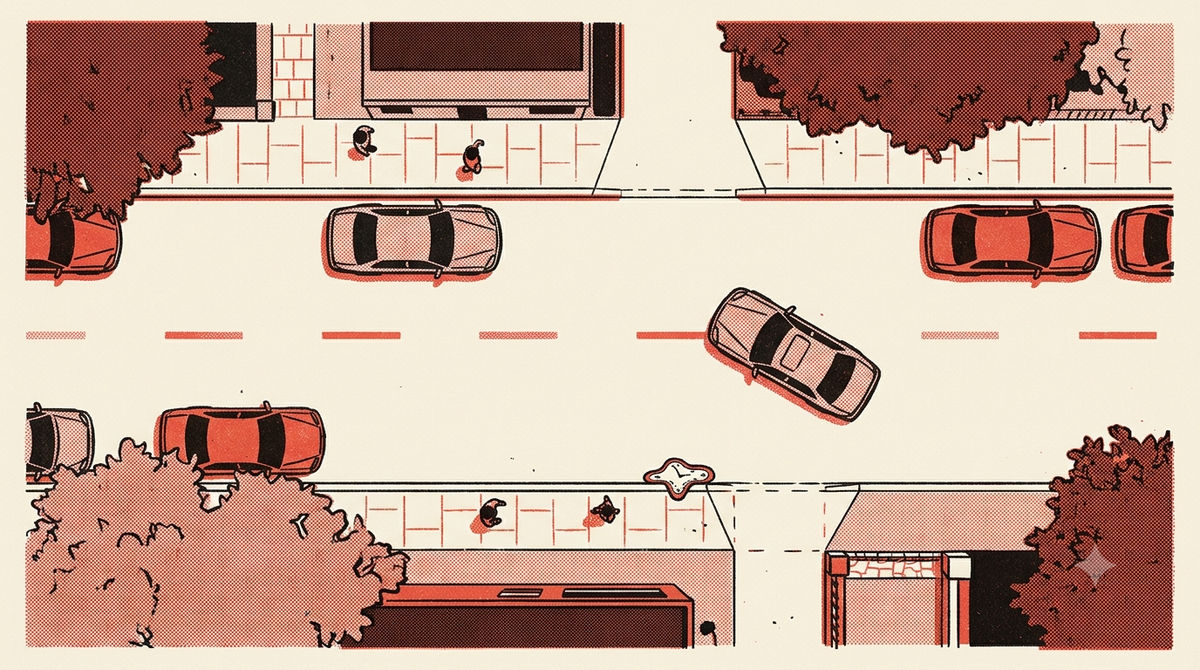
You have been looking for parking on Vivekananda Road in Kolkata for nine minutes. A gap appears between two parked cars. It should hold two vehicles with room to spare. The car already in the gap is centered, 80 cm from the car behind it and a meter in front of the car ahead. There is no way to fit behind or in front without blocking someone.
You keep looking.
What's actually happening
The driver who parked there was not trying to take two slots. They parked, the car stopped moving, and they walked away. Nobody told them where in the gap to land.
The math, though, is exact. A standard sedan needs about 4.8 meters of kerb space. A gap after a departing car typically runs 6 to 7 meters. That fits two vehicles if both park tight to one end. It fits one vehicle if the first driver parks in the center, leaving 60 to 90 cm of unusable dead space on each side. No one behind or ahead can use those margins.
In a street with 30 parking gaps, if eight of them are center-parked, the street has lost eight spots. Those cars are circling. Or they are double-parked.
What works better
Parallel parking correctly takes under two minutes.
Pull alongside the car in front of your space, matching your rear bumper to its rear bumper. Leave half a meter of side clearance. Signal.
Reverse slowly. As your front clears the car beside you, steer toward the kerb at about 45 degrees.
When you are angled in and your rear is near the kerb, straighten the wheel. Reverse until your rear bumper is 30 to 40 cm from the car behind you.
Steer away from the kerb, pull forward, and center yourself. Both bumpers: 30 to 40 cm of clearance.
If you arrive in a long gap with no one else parked in it, park tight to the rear vehicle. Leave the front portion of the gap open. The next driver can reverse in behind the car ahead of you.
Why it matters
The Motor Vehicles Act, 1988 prohibits parking in a way that obstructs the free passage of other vehicles. A center-parked car that wastes the gap on both ends is a lighter version of the same problem. No formal enforcement mechanism, but the same cascade: the blocked space forces other drivers to circulate longer, double-park, or park on footpaths. Each of those creates its own problem down the block.
Urban parking in Indian cities is a shortage that everyone is making worse or better with each individual choice.
Try this next time
Before you lock the car and walk away, check your clearances. Rear bumper: can the car behind you exit without touching you? Front bumper: is there more than 60 cm of unused kerb ahead of you?
If the front gap is over 60 cm, pull forward until your rear has 30 to 40 cm of clearance. You've just returned a usable slot to the street.
This takes 20 seconds. Default to tight.
Quick check
1. You arrive in a parallel parking gap long enough for two cars. You are first in. No other car is yet parked in the space. Where should you position your car?
Select an answer.
2. After parallel parking, you check and find your front bumper is 1.1 meters from the car ahead of you. Your rear bumper is 35 cm from the car behind. What should you do?
Select an answer.