Honking at red lights and what it costs everyone
TL;DR
- Honking at a red light accomplishes nothing. The signal timer has no horn input.
- Every horn press at a red light is an invitation for the next driver to join the chorus.
- Ten cars honking push intersection noise well past the WHO threshold linked to cardiovascular risk.
- The civic upgrade: be the quiet car. Silence at one signal sometimes spreads.
Contents
The moment
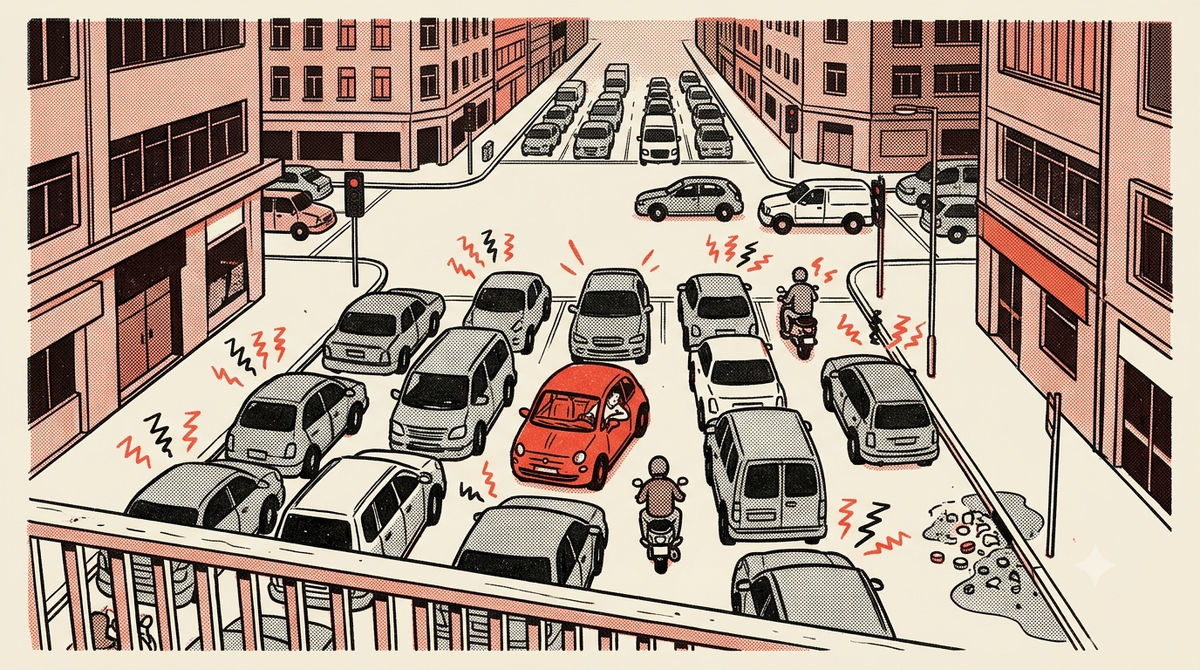
It's 8:45 am, Koramangala signal, Bengaluru. The light goes red. The Innova two cars back presses its horn once. The auto behind you joins. Then two bikes. The light has been red for 6 seconds. No car has moved. No car will move for the next 48 seconds. The signal timer is fixed. None of the horns have access to it.
What's actually happening
The psychology is chain reaction. The first horn sends one message: I'm impatient. Every horn after it sends the same message. None are addressed to anyone who can do anything about it.
Here is the math no one runs in the moment. At a typical Indian city intersection, between 8 and 20 vehicles queue at a red. If 8 of them press their horns once every 5 seconds through a 45-second cycle, that's 72 horn blasts in 45 seconds. The intersection already sits at 80-95 dB in peak traffic, according to CPCB's ambient noise monitoring. The WHO links sustained exposure above 70 dB to elevated cortisol, disrupted sleep, and cardiovascular risk in urban populations.
The system fails here too. Most Indian signals lack countdown timers. When you don't know how long the red lasts, the horn becomes a nervous tick, an attempt to fill a pause that has no information in it. A countdown display showing 38 seconds, 37, 36 gives the horn less to do. But even with a countdown, the timer isn't listening. Neither is the car in front of you.
What works better
When the light is red and nobody can move, your horn has one output: a reason for the car behind you to honk too.
The practical moves are simple. See the red light, ease off the accelerator, stop. Keep your hands in your lap, not on the horn. If the light has turned green and the car ahead has not moved after 2 seconds, a single brief tap is reasonable. One tap, while green. Not while red.
Why it matters
Section 194F of the Motor Vehicles Act, 1988 (amended 2019) prohibits horn use that is "unnecessary or persistent." Red-light honking fails both tests. No warning is being given, and the presses accumulate. The first-offense fine is ₹1,000; repeat offenses draw ₹2,000. Enforcement is rare. The prohibition is not.
The civic argument is simpler than the legal one. Every horn you don't press is one fewer reason for the next driver to honk back. A chorus starts with someone's first note. The driver who doesn't press starts a silence instead.
Try this next time
At your next red light, count the cars honking. Then count the cars that aren't. The signal ends the same way for both groups.
Try being the quiet car for one full week. Notice whether you arrive later. You won't. Notice whether it affects you to stay quiet while others honk. That's where the real work is.
Quick check
1. The light has been red for 15 seconds. The auto behind you taps its horn. The bike in the next lane revs. What's the right move?
Select an answer.
2. Under Section 194F of the Motor Vehicles Act, 1988, using a vehicle horn at a red light when no one is in immediate danger is best described as:
Select an answer.