Highway driving: the things city instinct gets wrong
TL;DR
- City driving rewards weaving and short gaps. Highway speeds make both lethal.
- Keep left, overtake only from the right, then move back left. Use indicators, not the horn.
- Leave a 2 to 3 second gap. At 90 km/h your braking distance is several times longer than in city traffic.
- Overspeeding is the single largest contributor to road accident deaths in India (MoRTH).
Contents
The moment
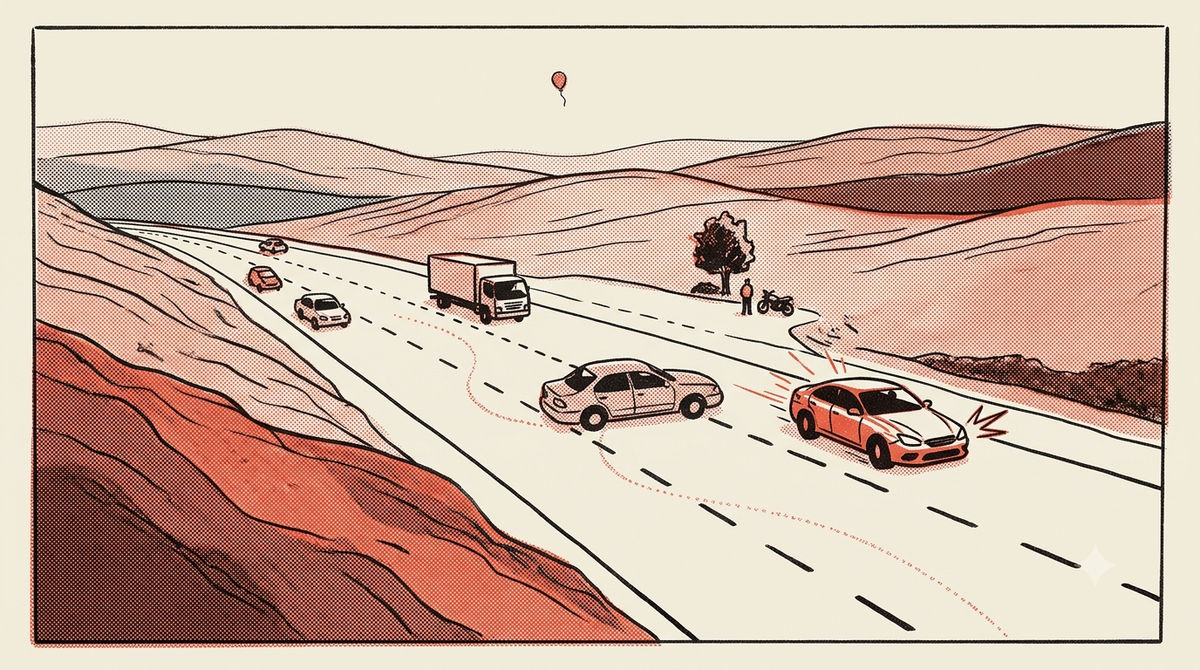
You have driven in the city for ten years. Today you are on the Mumbai-Pune Expressway for the first time, doing 90, and it feels easy. A truck ahead sits in the middle lane. You drift right to pass, then back left, then right again to slip past a slower car, the way you thread through Andheri at 9 am. Behind you a sedan doing 110 brakes hard and flashes its lights. You never saw it coming. At city speeds this would have been a non-event. At expressway speeds it was nearly a crash.
What's actually happening
City driving teaches a specific set of reflexes. Fill every gap. Overtake on whichever side is open. Keep half a car-length so the next scooter cannot slip in. Use the horn to say "I am here." These work at 20 to 30 km/h because everything is slow and close together.
The highway runs on the opposite logic. Speeds are three to four times higher, gaps close in a second, and the car you cannot see is doing 110 in the lane you are drifting into. The instinct that kept you safe in the city is the same instinct that gets you hurt here.
What works better
Pick a lane and hold it. The right lane is for overtaking, not for cruising. Stay left, move right only to pass, then come back left.
Overtake on the right, never the left. A car being overtaken expects the pass on its right side. Slipping past on the left is where blind-spot crashes happen.
Leave a real gap. Pick a fixed marker ahead, a sign or a tree. When the car in front passes it, you should reach it no sooner than two to three seconds later. At 90 km/h your stopping distance is several times what it was in city traffic.
Use indicators, not the horn. At highway speed the horn changes nothing. Your indicator, switched on three seconds early, tells the car behind what you are about to do.
The shoulder is not a spare lane. It is for breakdowns and emergencies only. Never stop on the carriageway to take a call or check a map. If you must stop, pull onto the shoulder, put on hazard lights, and step away from the traffic side.
Why it matters
Overspeeding is the single largest contributor to road accident deaths in India, year after year, in the Ministry of Road Transport's annual Road Accidents in India report. Highways carry explicit limits for exactly this reason. The 2018 MoRTH notification caps cars at 120 km/h on expressways and lower on most national highways, and states can set a lower limit on any stretch.
Dangerous driving, which includes rash overtaking and tailgating, is an offence under Section 184 of the Motor Vehicles Act. The fine is the small cost. The closing speed is the real one.
Try this next time
Before your next highway trip, fix one number in your head: a two to three second following gap. On the road, count it out once against a marker ("one thousand one, one thousand two"). If you reach the marker before you finish counting, ease off and drop back until you do not.
Be the driver who holds a lane and a gap. The road behind you gets calmer, and the closing speed stops being your problem.
Quick check
1. You're on a three-lane expressway at 90 km/h. A car ahead in your lane is slower, the middle lane has a truck, and the right lane is clear with a car approaching fast from behind in it. What's the safe way to overtake?
Select an answer.
2. You're on a national highway and need to answer an urgent call. There's a paved shoulder to your left. What do you do?
Select an answer.