Double parking and the math of one block at a time
TL;DR
- Double parking means parking alongside another parked car and blocking that driver in until you return.
- If you block two cars for 12 minutes each, you have borrowed 24 minutes of other people's time without asking.
- A double-parked car also narrows a two-lane road to one moving lane, queuing every vehicle behind it.
- The legal alternative: pull into the road lane with hazard lights on, complete the stop in under 2 minutes, and move.
Contents
The moment
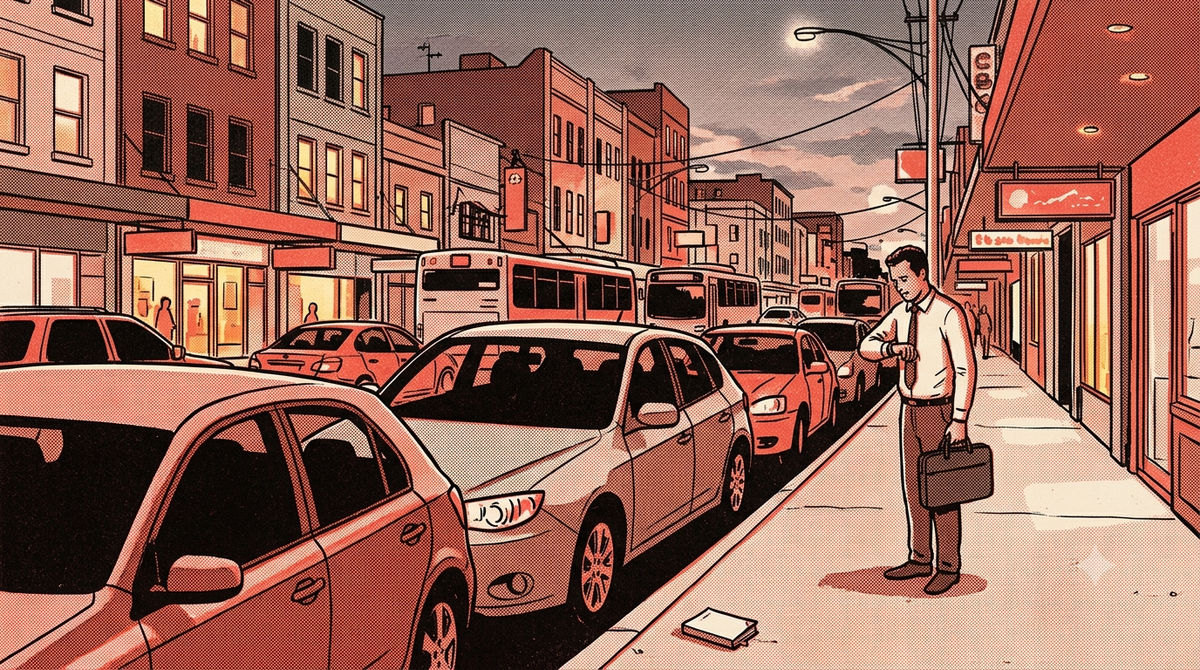
You are on 80 Feet Road in Koramangala at 6:30 pm. Every legal space is taken. You have one parcel to deliver. You park alongside a car already at the kerb: two wheels in the road lane, two alongside the parked car.
You are inside for fourteen minutes.
When you return, the driver of the blocked car is at your door. She has been there for nine minutes. She has a meeting. She cannot call you. She cannot move her car until you move yours.
You pull out. The maneuver takes four minutes in the tight space with passing traffic. She is twenty minutes late.
What's actually happening
Double parking is a debt you take out on another driver's time without asking.
When you park alongside a parked car, the driver of that car can no longer exit independently. If they are not present, the car is locked in until you return. If they are present, they wait, or they honk, or they ask strangers to help locate you. In either case, the duration of the loan is determined entirely by how long you decide to stay inside.
The maneuver to exit a double-park in a tight urban lane takes 3 to 5 minutes under ideal conditions. With passing traffic or a narrow gap, it takes longer.
The math scales fast. If you block two cars for 12 minutes each, that is 24 minutes of other people's time borrowed without asking. Each car maneuvering to exit briefly narrows the through lane. The vehicles behind stop too. One debt gets distributed down the block.
Indian cities have more cars than legal parking spaces. That is real. It does not create an exemption for double parking.
What works better
When no legal space is available, the alternative to double parking is a road-lane stop, not a different violation.
Pull fully into the moving lane. Switch hazard lights on. Complete the stop in under two minutes. Pull away when done. The lane behind you can see the hazard lights and anticipate the brief pause. A car maneuvering out of a double-park provides no such signal and takes far longer.
Two minutes is the threshold. If the errand takes longer, it is not a drop-off. It is a stop. A stop requires a legal space, or the decision to come back later.
If double parking is truly unavoidable, leave your phone number visible on the dashboard. It costs 30 seconds and gives the blocked driver an exit.
Why it matters
Obstructing the free passage of another vehicle is a violation under the Motor Vehicles Act, 1988, and attracts fines under state traffic rules. The fine is secondary. The primary cost is the blocked driver's time and the narrowed lane behind your car.
A double-parked car on a two-lane road reduces it to one moving lane. In evening peak traffic, that narrows to a single thread. The vehicles backed up behind it are not a hypothetical. They are there every time someone decides that their fourteen minutes are worth more than everyone else's.
Try this next time
For one week, count your double-parks and estimate how long each blocked driver waited. Then try the two-minute rule: under two minutes, road-lane stop with hazards; over two minutes, find a legal space first.
Before you double-park, ask whether the driver of the car next to you would agree to the arrangement if you asked them first.
Quick check
1. You double-park for 12 minutes. The driver of the blocked car is present and has been waiting for 8 minutes. What is her situation?
Select an answer.
2. No legal parking space is available and you need to stop for 90 seconds to drop a passenger. What is the correct move?
Select an answer.