The government counter: token systems, paper queues, and shoulder taps
TL;DR
- When the counter has no enforced queue, the loudest person wins. You can be the one who builds the queue instead.
- Use the token if a machine or register exists, even when others ignore it. Hold your number.
- Do not shoulder-tap. Your 'just one signature' is the clerk's twentieth interruption and someone else's lost turn.
- Track your application through official channels, including the RTI Act, instead of buying speed at the counter.
Contents
The moment
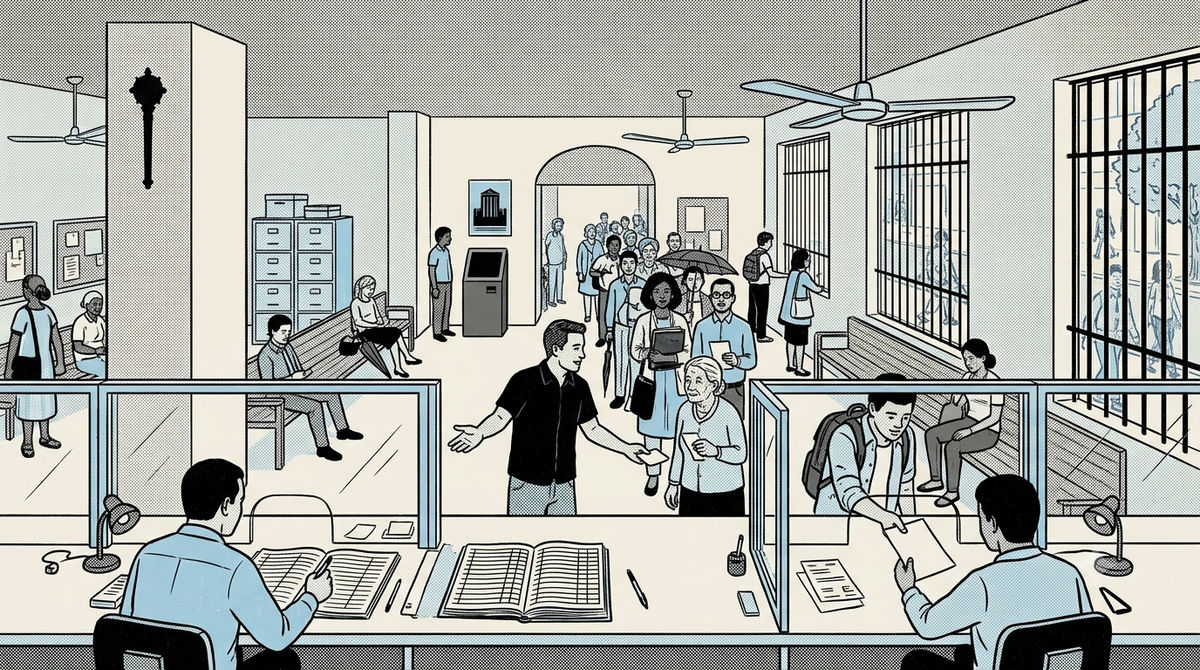
It is 11:20 am at a municipal office. You are here to correct a name on a certificate. There is a token machine by the door, switched off. A handwritten register sits at counter 4. Twelve people stand in a loose cluster, not a queue. Every two minutes someone leans past the person at the counter: "bhaiya, ek minute, bas ek signature." The clerk signs. The cluster tightens. The woman who arrived at 10:40, first by arrival, has now watched four people go ahead of her.
What's actually happening
This is the shoulder-tap economy. The counter has no enforced queue, so a vacuum opens, and the vacuum rewards whoever is loudest and closest.
Most shoulder-tappers are not villains. They have learned that the counter responds to the assertive, and they have a real task to finish. The clerk, overloaded and unsupported, processes whoever is in front of them. The system has genuinely failed here: the token machine is off, no queue is displayed, nobody enforces order.
But the vacuum is filled by us. That also means we can fill it differently. Three things keep the cluster a cluster. There is no working system. There is the belief that "just a small thing" is not really cutting. And there is the clerk taking the path of least resistance.
What works better
If a token machine works, take a number, even if others ignore it. Hold it.
If it is a paper register, write your name and arrival time. Then ask the person nearest the counter who is last in line. Saying the order out loud is the whole job. A cluster becomes a queue the moment someone names it.
Do not shoulder-tap. Your "one signature" is the clerk's twentieth interruption of the hour. If you genuinely have a 10-second question, ask the people in line, not the clerk: "could you confirm which counter, I won't take your turn."
When you are at the counter and someone leans in, a calm "they are behind me, one moment" protects the order without a fight.
Here is the math. A clerk who serves 30 people, interrupted four times each, loses two minutes per interruption. That is four hours of counter time dissolved into shoulder-taps. The queue you protect is the clerk's working day too.
Why it matters
The government counter is where a citizen meets the state. Service standards do exist on paper: the Sevottam model and departmental Citizens Charters commit offices to defined timelines (Source: DARPG). You also have the right to track your application through official channels, including the Right to Information Act, 2005, rather than buying speed at the counter (Source: RTI Act, 2005). When the queue holds, the slowest and least assertive person, often elderly, often a first-timer, gets served fairly. That is the entire point of a queue.
Try this next time
At your next government office, do one thing: establish the order out loud. "Bhaiya, aapke baad main hoon?" Confirm who stands behind whom. You will feel slightly silly the first time. You will also watch a loose cluster turn into a queue, because someone finally named it. Be the person who names the queue.
Quick check
1. You reach a government counter where there is no token machine working and no clear line, just a loose cluster of eight people. You have a quick correction to make. What is the move that keeps things fair?
Select an answer.
2. Your certificate correction is taking weeks and you are tempted to keep going back to lean on the clerk for faster service. What is the better channel?
Select an answer.