Security and immigration: prep, bin, walk
TL;DR
- Prep in the queue, not at the tray: laptop and power bank on top, pockets emptied into one pouch, belt ready to come off.
- Liquids: each container 100ml or less, all of them together in one clear resealable bag.
- Power banks travel in your cabin bag, never in checked baggage.
- Re-pack at the bench past the scanner, not at the scanner mouth where you block the next person.
Contents
The moment
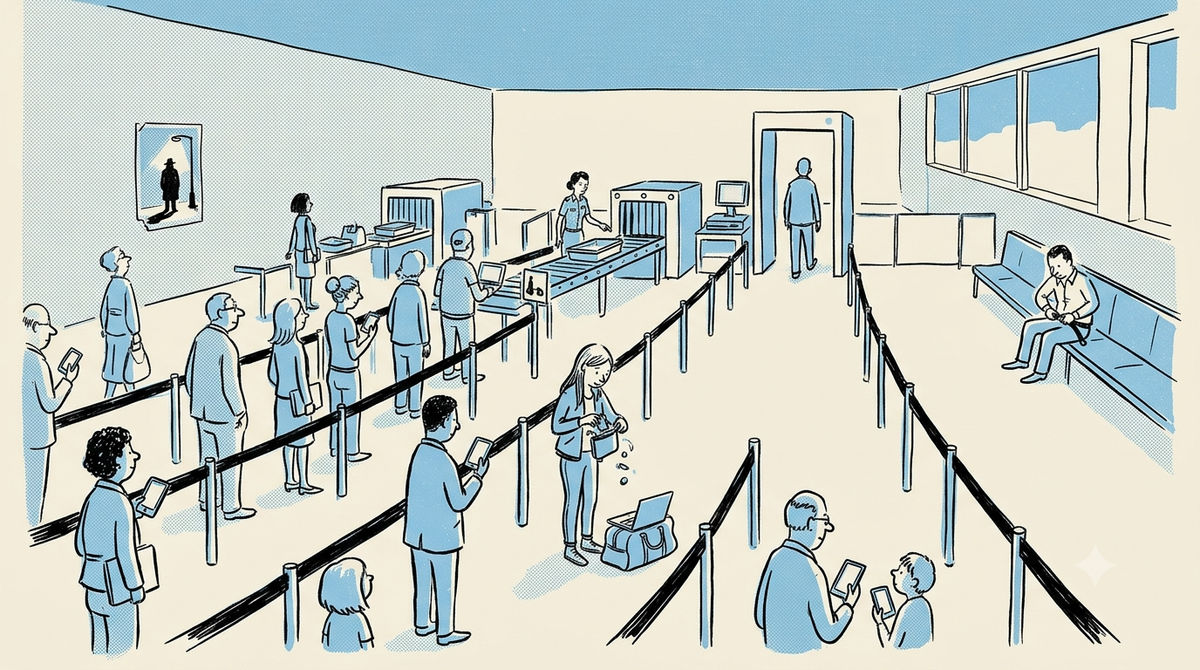
The security queue is moving, and you reach the front completely unready. Your laptop is buried at the bottom of your bag. Your belt is on, your phone and keys and coins are still in your pockets, and your water bottle is full. The tray is in front of you, and now you are doing six things at once while twenty people wait behind you. The officer waits. Everyone waits. The bin walk, that smooth move where you arrive ready and clear the scanner in thirty seconds, was always available to you. You just did not prepare for it.
What's actually happening
Airport security is a conveyor belt with a fixed bottleneck: the X-ray and the body scanner. The line moves only as fast as the slowest person at the tray. When you arrive unprepared, you are that person, and the cost is paid by everyone behind you, multiplied by the size of the queue.
Most of the delay is avoidable and predictable. The rules are stable, and the same at every Indian airport. Laptops and large electronics come out and go in a tray of their own. Liquids over 100ml do not fly in your cabin bag. Belts, metal, and the contents of your pockets set off the scanner. None of this is sprung on you at the front. You just met it there instead of preparing for it in the queue.
What works better
Prep in the queue, not at the tray. While you wait, you have several minutes of dead time. Use them. Bring your laptop and tablet to the top of your bag. Move your power bank there too, since it must travel in your cabin bag, never in check-in. Empty your pockets into a jacket pocket or a pouch so the whole lot drops into the tray in one motion.
Sort your liquids before you ever reach the airport. Each container 100ml or less, all of them together in one clear resealable bag. If you carry medication or baby food above that limit, keep the prescription handy and tell the officer.
At the belt, load trays in order: bag, then laptop in its own tray, then the pouch and belt. Walk through when waved, not before. Then move to the re-pack bench to put yourself back together. Do not re-dress at the scanner mouth while the next person waits.
For immigration, have the one document the counter needs ready in your hand. Passport open to the photo page, boarding pass if asked. Not buried, not somewhere in a bag.
Why it matters
Security and immigration are shared bottlenecks. A single unprepared traveller at the tray adds thirty to sixty seconds, and at a busy terminal that compounds across the whole queue into real collective minutes lost. The prepared traveller is not just faster. They keep the whole line moving.
The rules are not obstacles invented to annoy you. The 100ml liquids limit and the separate electronics check exist for screening reasons that apply to every passenger equally. Working with them, prepared, is the cheapest courtesy you can offer a queue of strangers.
Try this next time
Before you join the security queue, run a ten-second check: laptop and power bank on top, liquids bagged, pockets emptied into one pouch, belt ready to come off. Then when you reach the tray, you do it all in one smooth motion. Prep, bin, walk. The queue behind you will never know your name, but it will move because of you.
Quick check
1. You're in the security queue with a 250ml bottle of contact-lens solution, a laptop, and a power bank. What gets you through cleanly?
Select an answer.
2. You clear the body scanner, but your belt, phone, and laptop are still in the trays at the mouth of the scanner. What now?
Select an answer.