RTOs, passport offices, and the patience economy
TL;DR
- An agent economy grew around RTOs and passport offices because the official process used to be opaque. That has changed.
- Book your own appointment. Passport Seva runs on online slots and many RTO services are now online via Sarathi.
- Most agent value is just knowing which paper goes where. A ten-minute checklist read removes most of it.
- Keeping your scheduled slot, and not buying a jump, is what makes the next person's appointment time actually mean something.
Contents
The moment
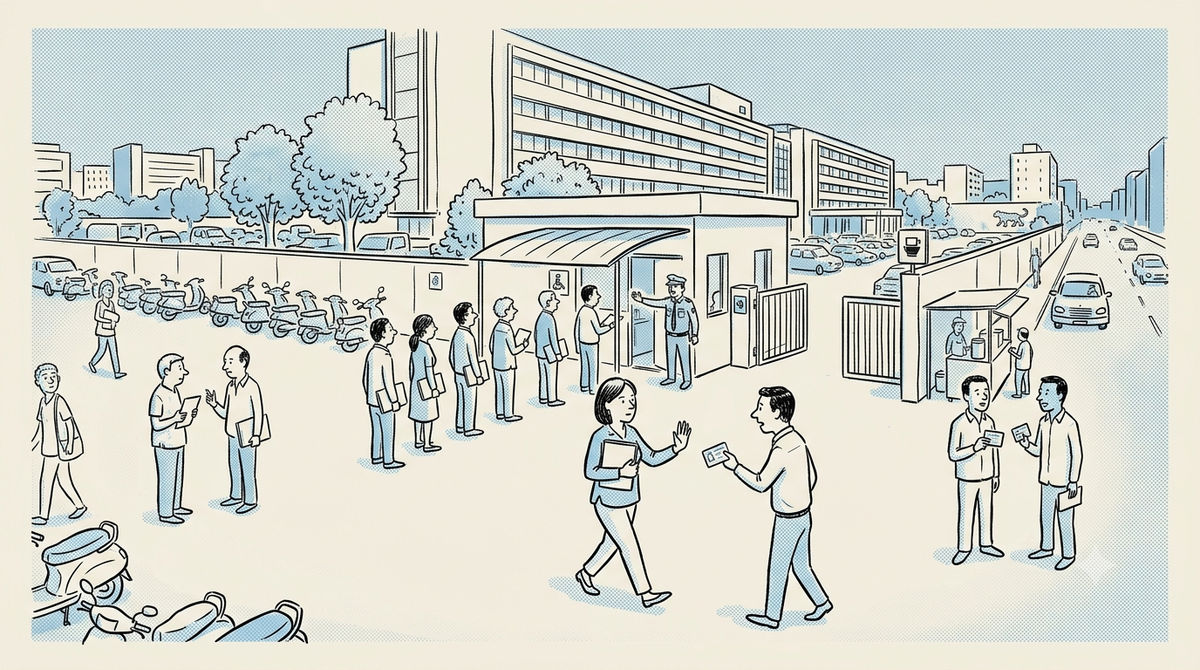
It is 9:50 am outside a passport office. Your appointment is for 10:00. A man approaches with a laminated card and a soft voice: "sir, token ka tension mat lo, 500 mein sab ho jayega."
Inside, the office runs on appointment slots and screen-called token numbers. Outside, a parallel system runs on cash and confidence. Both queues exist at once, and you are standing between them.
What's actually happening
This is the patience economy. Around every RTO and passport office, an ecosystem grew to sell two things: speed and certainty. Agents, touts, "consultants."
This ecosystem did not appear from nowhere. The official process used to be genuinely opaque. The forms were confusing, the offices were far, the rules kept changing. People paid someone to absorb that friction. Many still use agents for honest reasons: an unfamiliar language, difficulty with forms, a long journey, a day's wage they cannot afford to lose. None of that is a failing.
But two things have shifted. The official systems got much better. And the parallel queue, when you feed it, quietly makes the official queue worse for everyone scheduled behind you.
What works better
Book the official appointment yourself. Passport applications run on online slots through Passport Seva, so the queue inside is scheduled, not a first-come scramble (Source: Passport Seva). Many RTO services, including learner's licence and renewals, are now online through the Sarathi portal, which means the physical queue is shorter than its legend (Source: Sarathi, MoRTH).
Carry your own documents in order. Most agent value is simply knowing which paper goes where. Ten minutes with the official checklist removes most of it.
Inside, follow the token screen. When your number shows, walk up. Do not crowd the counter before your turn.
If an agent offers to jump you ahead, remember that the jump comes out of someone else's slot. Decline, not for sainthood, but because the scheduled queue only works while people keep their slots.
Here is the math. An appointment slot is a 15-minute promise. Twenty people who each keep their slot clear in one calm morning. One person who buys a jump turns twenty steady appointments back into a cluster.
Why it matters
The patience economy runs on one belief: that the official queue does not work. Every time the official queue holds, that belief weakens a little. The appointment you book yourself, the slot you neither sell nor buy, is what makes the next person's 10:00 actually mean 10:00 (Source: Passport Seva). Trust in the system is not given to it. It is built, one kept slot at a time.
Try this next time
Before your next RTO or passport visit, spend ten minutes on the official portal. Book your own slot. Print the document checklist. You may still feel the pull of "let me just call someone who knows someone." Resist it once. The official queue is better than its reputation, and it improves every time one more person trusts it. Be the rare citizen who keeps the slot.
Quick check
1. You have a confirmed 10:00 appointment at a passport office. At the gate, an agent offers to get you processed faster for a fee. What is the move that keeps the scheduled queue working?
Select an answer.
2. You need a learner's licence and assume it means a long day of queueing at the RTO with an agent. What is worth checking first?
Select an answer.