The bag-drop line: the things you should already have done
TL;DR
- Bag drop is not check-in. It is a fast lane for people who already have a boarding pass and a correctly packed bag.
- Weigh the bag at home. The domestic free allowance is about 15 kg, and counter excess costs more per kilo than pre-booking online.
- Move power banks and spare lithium batteries into your cabin bag before you leave home. They fly cabin only, never checked.
- Reach the belt with boarding pass and ID already in hand, and bag drop takes ninety seconds, not five minutes.
Contents
The moment
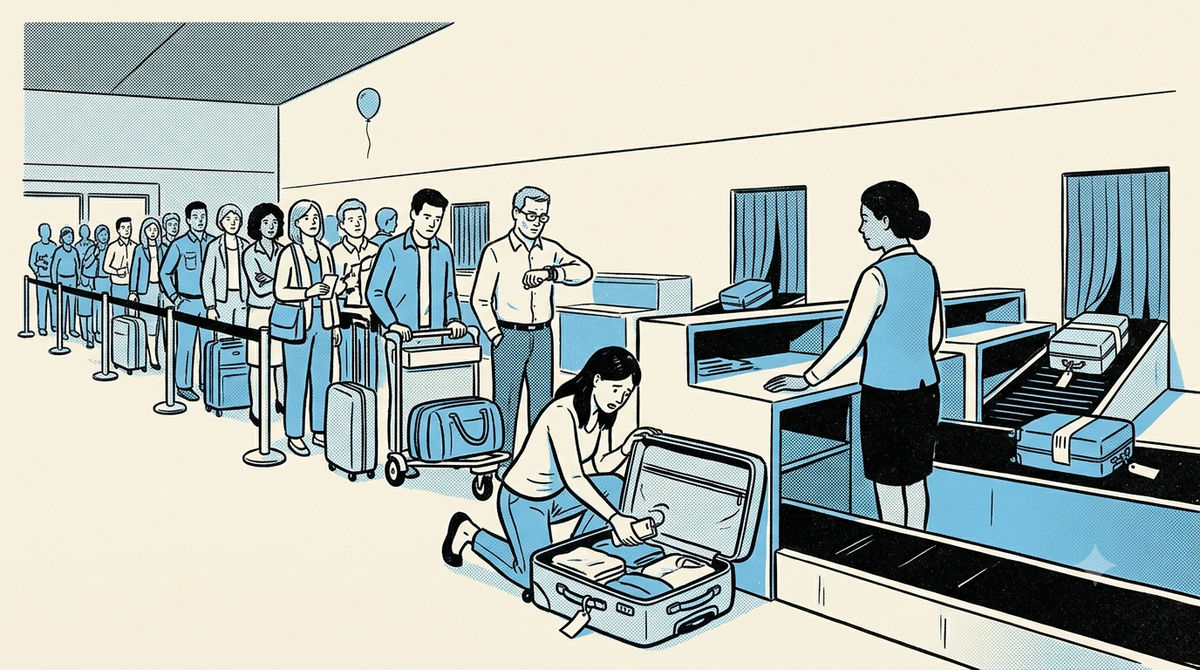
You are third in the bag-drop queue for a 7 am flight. The person at the front is not ready. They are still doing web check-in on their phone at the counter, thumb hovering over the seat map. Their suitcase sits on the belt reading three kilos over the free limit, so now there is a card payment for excess. Then the staff member points at the screen: a power bank is showing up inside the checked bag, and it has to come out. The traveller kneels, unzips, and starts digging. Four minutes have passed and the belt has not moved. Behind you, the queue is now fifteen deep, and boarding for their flight starts in twenty minutes.
What's actually happening
Bag drop is not check-in. It is the fast lane for people who arrive already checked in, with a boarding pass and a correctly packed bag. Treated that way, it takes under two minutes. Treated as a place to finish everything you skipped, it becomes the slowest step in the terminal.
Four things should already be done before you join this queue. Your web check-in is complete and the boarding pass is on your phone (see air-002). Your bag is within the free allowance, about 15 kg on domestic flights, or the excess is pre-paid online. Your power banks and spare lithium batteries are in your cabin bag, not the checked one, because they fly cabin only. And your ID is out and in your hand.
None of these can be fixed quickly at the belt. Each one, done there, holds up everyone behind you.
What works better
Weigh the bag at home. A luggage scale costs about 300 rupees and removes the single most common bag-drop delay. If you are over, pre-book the excess online, where it is cheaper per kilo than the counter rate.
Before you leave the house, move every power bank, spare battery, and loose charger from the suitcase into your cabin bag. This also protects you at security, where a power bank in a checked bag gets the whole bag pulled.
Keep your ID and boarding pass in one hand from the terminal door onward. When the belt is free, lift the bag on, show the pass, take the tag, and go.
Why it matters
Bag drop is a shared bottleneck with a hard clock behind it. The counter closes 45 to 60 minutes before departure. A queue full of unprepared travellers does not just cost patience. It can push the people at the back past their own cutoff.
The cost of one unready bag is real. Re-weighing, paying excess, and pulling a power bank runs two to four minutes. Multiply that across a full flight and the counter that should clear 180 people in an hour clears far fewer. The traveller who arrives ready is doing the whole queue a quiet favour.
Try this next time
The night before, do three things: web check-in, weigh the bag, and move all power banks into your cabin bag. In the morning, walk in with your ID already out.
Then be the traveller whose bag is tagged and gone before the person behind has finished reading the weight display.
Quick check
1. You reach the bag-drop counter and the staff member says a power bank is showing inside your checked suitcase and must come out. What should have happened before you left home?
Select an answer.
2. Your checked bag weighs 18 kg for a domestic flight with a 15 kg free allowance. When is the cheapest and fastest time to deal with the extra 3 kg?
Select an answer.