Overhead bins are not personal storage
TL;DR
- One bag in the overhead bin, per person, within a row of your seat.
- Your second bag (laptop bag, handbag) goes under the seat in front of you, not in the bin.
- Pack the cabin bag wheels facing in, so the bin holds more.
- If the bin near you is full, check a row or two either side, or ask the crew.
Contents
The moment
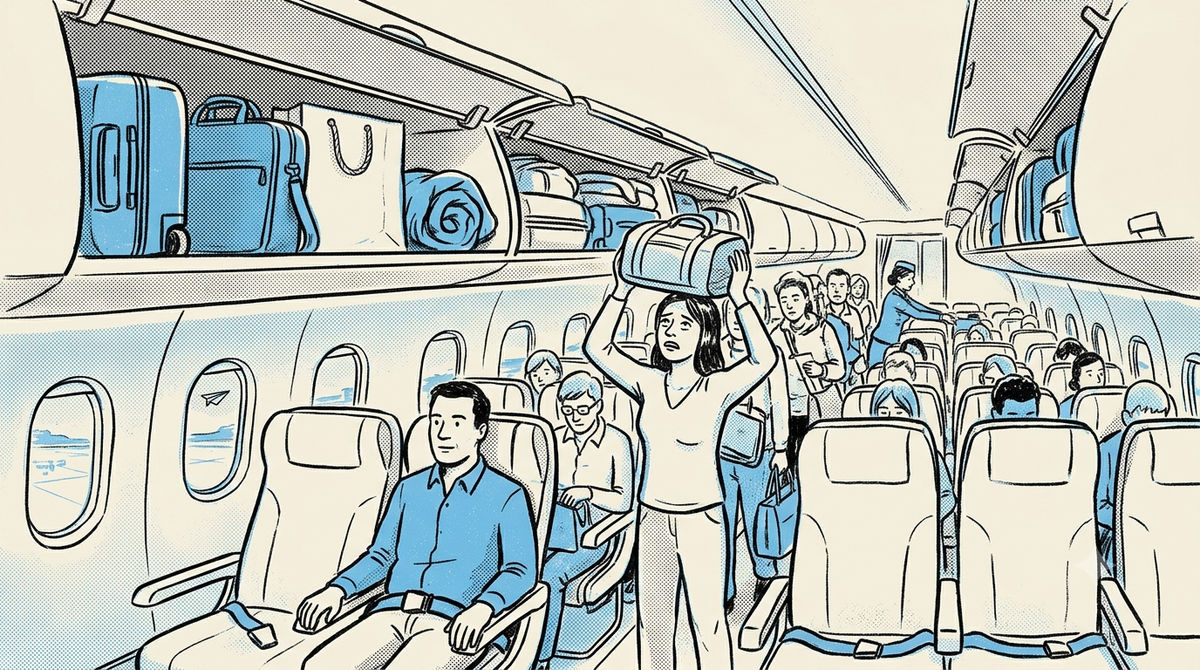
You're on an IndiGo flight to Goa, row 18, boarded with Group 4. You reach your row and the bin above 18 is full. So is 19. But the bin above row 17 is 80% empty. The man in 17B has loaded his cabin bag, his laptop bag, his shopping bag, and a rolled-up jacket up there. One person, four items. The flight attendant is busy. You think about walking your bag two rows back, where there's still space. Then someone from row 22 comes up and starts loading their bag above row 18. The aisle jams. The plane is half-loaded and already eight minutes late.
What's actually happening
Overhead bins are a shared resource with one rule: one cabin bag per passenger, in the bin above or near your assigned row. Every major carrier (IndiGo, Air India Express, SpiceJet, Akasa) says this in its cabin baggage policy, and DGCA's Civil Aviation Requirements echo it.
The man in 17B isn't a villain. He did what most flyers do when nobody pushes back: spread his things across the easiest space, which happened to be the bin above his own head.
The cost lands on row 19. They can't fit their one bag above their own seat, so they stuff it two rows away. At deplaning they walk that extra distance to fetch it, the aisle backs up, and the plane is delayed.
What works better
Three rules, most to least important.
One bag overhead, per person, within a row of your seat. Your second bag (laptop bag, handbag) goes under the seat in front of you. That under-seat space is a separate allowance, not optional storage you can skip in favour of the bin.
Pack wheels facing in. A bin where everyone packs wheels-in holds six to eight bags. Packed wheels-out, the same bin holds four or five.
Soft bags compress, hard bags don't. A soft duffel can fill a leftover gap. A hard roller needs full upright space. Pack for the bin you'll actually meet.
If your row's bin is full, check one or two rows either side. If everything is full, ask the flight attendant; they will relocate it or gate-check it. If you see someone loading a second bag while the bins are tight, a direct "would you mind keeping the second one under your seat? I'm in 19 and the bin is filling up" works most of the time.
Why it matters
Cabin baggage discipline is one of the smallest civic acts on a plane and one of the most visible. A full plane with disciplined bins boards and deplanes five to seven minutes faster than the same plane without it. Across 200 passengers and four flights a day, that adds up.
Beyond the time, it is the fairness layer of a flight. The bin above your seat is yours. The bin above the next person's seat is theirs. Spreading your things across several bins is the cabin version of taking up two seats on a metro.
Try this next time
When you board, put exactly one bag overhead within a row of your seat, and your second bag under the seat in front of you. Then watch the boarding flow.
If you fly often, downgrade to a smaller cabin bag once. The bin politics simply disappear: you fit anywhere, anytime, with no negotiation.
Quick check
1. You board the plane with one cabin roller and one laptop bag. Your assigned seat is 24A. Where does each go?
Select an answer.
2. You're seated. The plane is filling up. The man in row 14 puts a third bag (his blazer, folded into a cube) into the bin above row 14. The bin's now full. You're in row 16 with one cabin bag and there's no space within 2 rows of you. What do you do?
Select an answer.