Aisle seat aisle blocker: the 60-second clearance
TL;DR
- The aisle seat comes with a job: stand all the way out when your row-mates arrive.
- The knee swivel is slower than standing. Climb-overs stall the whole aisle behind you.
- Stay light until the row fills: loose items in the seat pocket, nothing hard to move.
- From "excuse me" to a clear aisle in under 60 seconds. That's the entire skill.
Contents
The moment
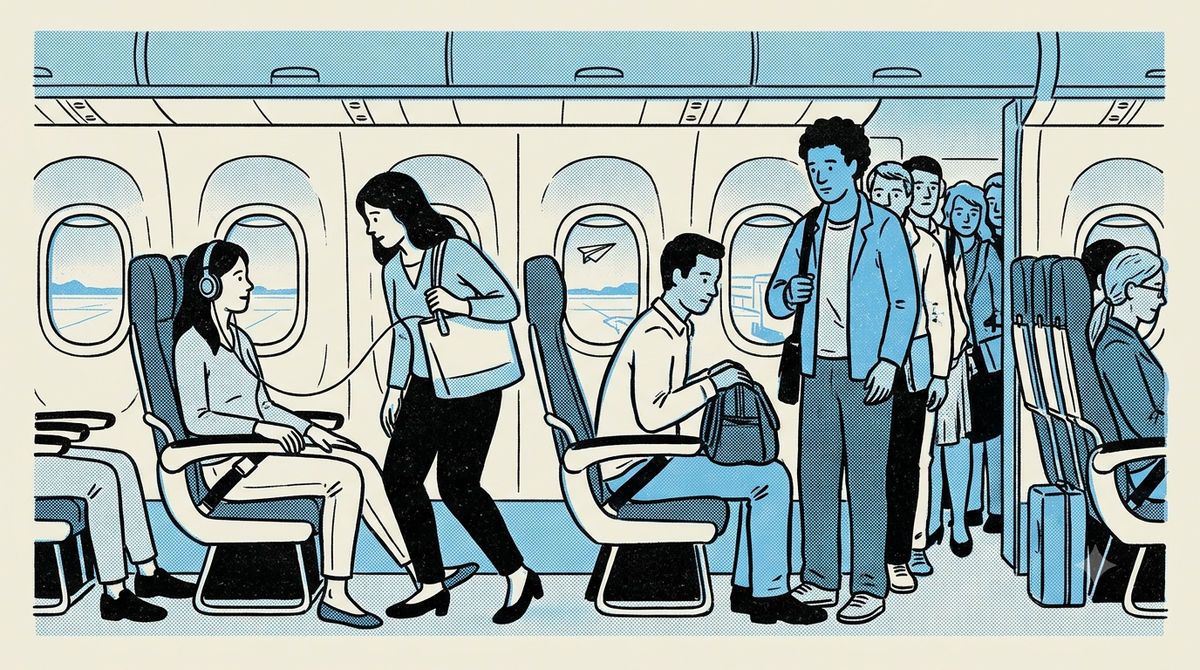
Row 14, a 7:10 am flight out of Delhi. You're in 14C, the aisle seat, boarded with Zone 2, and you've settled in properly. Seatbelt clicked, headphones in, book open to page 40. Then a voice says "excuse me, window seat." You look at everything you've arranged and choose the half-move: knees swivelled two inches, feet anchored. The window passenger starts the climb. Her tote catches your headphone wire, her elbow finds the seatback, and behind her the middle passenger waits. Behind him, eleven people stand still in the aisle.
What's actually happening
The aisle seat comes with a clause nobody reads out. You sit down first, you get up first, and until the doors close you are the doorman for your row.
Boarding research calls the climb-over a seat interference (Source: Steffen and Hotchkiss, 2012). A passenger in an outer seat has to clear the way for someone headed to an inner one, and the aisle behind them stops. Alongside slow bag-stowing, these interferences are what actually burn boarding time.
The knee swivel feels like cooperation. It isn't. Climbing over swivelled knees is slower than a clean exchange, usually needs a second attempt, and turns two strangers into obstacles before the seatbelt sign is on. The person doing it isn't rude. Nobody teaches the choreography, and the safety card doesn't cover it.
What works better
Treat the arrival as a 60-second drill: from "excuse me" to a clear aisle in under a minute.
Stand all the way out. Unclip, step into the aisle, and stand level with the row behind you, facing the seats. Your row-mates walk in upright instead of doing a limbo. Then sit back and re-clip.
Stay light until the row fills. Bag stowed, phone and book in the seat pocket, nothing on your lap that can't move in two seconds. The full nest (laptop out, shoes off, snack unwrapped) can wait for the doors.
Take your loose things with you. When you stand, the phone and the book travel in one hand. Nothing to rebalance, nothing to drop, nothing to catch.
And if you're the one arriving at a full row, give the aisle passenger a second to stand rather than starting the climb. The exchange is faster when it's an exchange.
Why it matters
Zones board a plane in whatever order the system spits out, so most rows fill in two or three visits, not one. A full single-aisle flight runs through dozens of these exchanges. Done as clean stand-and-sit clearances, each costs about fifteen seconds. Done as knee-swivel climbs, each costs closer to forty, plus the retries. The research on boarding methods keeps landing on the same point: the minutes live in these small clearances, not at the gate (Source: Steffen, 2008).
Try this next time
When you hear "excuse me," close the book mid-sentence, stand all the way out, and be back in your seat inside the minute. Be the rare aisle passenger whose row loads in one visit.
The window seat gets the view, the middle seat gets the armrests, and the aisle seat gets the job. Do the job.
Quick check
1. You're settled in 32C with your seatbelt on and headphones in. The window passenger for 32A arrives, boarding is in full flow, and the aisle behind her is filling. What's the move?
Select an answer.
2. You board early and reach your aisle seat 21C. The rows around you are still empty. How do you settle?
Select an answer.