Laptop, liquids, belt, watch: the 5-second tray dance
TL;DR
- Prep your trays before you reach the belt, not on it.
- Laptop alone in one tray. Liquids bag (bottles 100 ml or less, total 1 litre), watch, wallet, belt, coins in another.
- Power banks and spare lithium batteries fly cabin only, never checked.
- At the exit, step aside before re-packing. Don't block the conveyor.
Contents
The rule
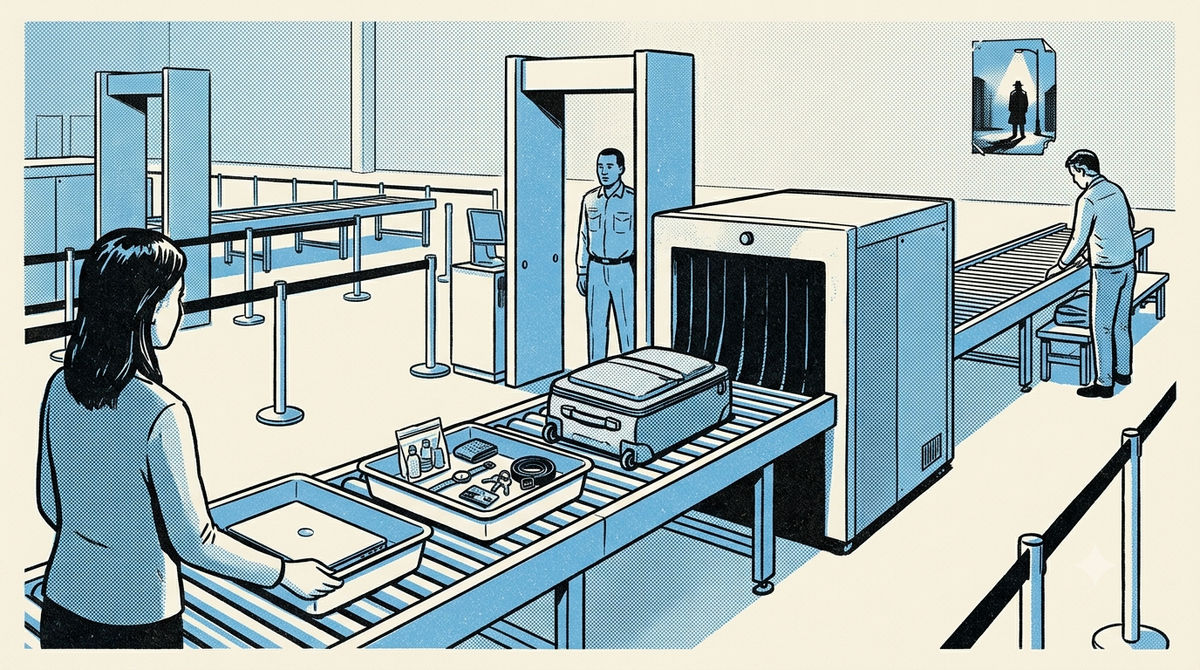
When you reach the security tray, this is what comes out, in this order, in under 30 seconds:
- Laptop (separate tray)
- Tablet, large electronics (same tray as laptop, or separate if asked)
- Liquids bag (clear ziploc, bottles 100 ml or less, total 1 litre)
- Belt (if buckle is metal)
- Watch, wallet, phone, coins, keys (single small tray or pouch)
- Outer jacket or blazer
- Cabin bag flat on the belt, wheels up
- Personal item (handbag or laptop bag) flat on the belt
- Shoes only if asked or if you are wearing boots, heels, or thick soles
Then walk through. Wait for the clear signal. Collect your trays. Move two steps to the side. Re-pack there, not at the conveyor exit.
Why this rule exists
Security screening is a throughput problem. An X-ray scanner processes about 200 trays per hour. The bottleneck is not the machine. It is the speed at which travelers prepare and re-pack.
Every traveler who arrives with the laptop still bagged, belt still on, water bottle in the backpack, costs the queue 30 to 90 seconds. Multiply by 200 travelers an hour and you get one to five minutes of queue time added per slow person.
This is why airports across the world have moved to standardized tray instructions. Indian airports (BCAS-regulated) follow the same broad protocol as TSA, EU, and ICAO standards. The rule exists for the system to function, not for any single passenger.
What happens if you don't follow it
Your tray gets pulled aside. A CISF officer manually re-screens the laptop, the liquids, or the belt. That adds two to eight minutes for you, and delays everyone behind you.
Liquids over 100 ml: confiscated. Power banks in checked baggage: removed before boarding. Power banks fly cabin only. Lighters above the per-passenger allowance: confiscated. E-cigarettes and vapes are banned on Indian flights under the 2019 Act, cabin or checked.
Socially, you are the person making the queue slow. The 200 people behind you have less patience for it than they used to.
Quick reference
Before the belt, in the queue:
- Laptop and tablet in hand
- Liquids bag in hand
- Belt loosened or off
- Watch, wallet, phone, coins in a side pouch
- Outer layers off
On the belt:
- Tray 1: laptop alone
- Tray 2: liquids bag, watch, wallet, phone, keys, coins, belt
- Cabin bag flat, wheels up
- Personal item flat, jacket on top
At the exit:
- Step aside before re-packing
- Belt and watch on first
- Laptop into bag
- Move
Always allowed in cabin: medicines (prescription if liquid over 100 ml), baby formula or breast milk in reasonable quantity, diabetic supplies, mobility aids.
Cabin only, never checked: power banks, spare lithium batteries.
Never allowed anywhere: firecrackers, large aerosol cans, e-cigarettes on Indian flights.
The tray dance is the rare civic skill where personal and social benefit align. You move faster. The queue moves faster.
Quick check
1. You're at the security belt. You have a laptop, a tablet, an iPad, a phone, a watch, a belt, a small toiletries bag with a 60ml shaving cream and a 200ml shampoo, and a 1-litre water bottle (refilled at the lounge water station). What do you do BEFORE putting anything on the belt?
Select an answer.