Deplaning: rows in front go first, this is a known law
TL;DR
- Rows in front go first. It's the one queue rule that needs no enforcement, only patience.
- Stay belted until the sign goes off. Use the taxi minutes to repack your things.
- Standing early doesn't open the door sooner. It just fills the aisle.
- Türkiye now fines passengers who stand before the aircraft parks. The etiquette is becoming law.
Contents
The moment
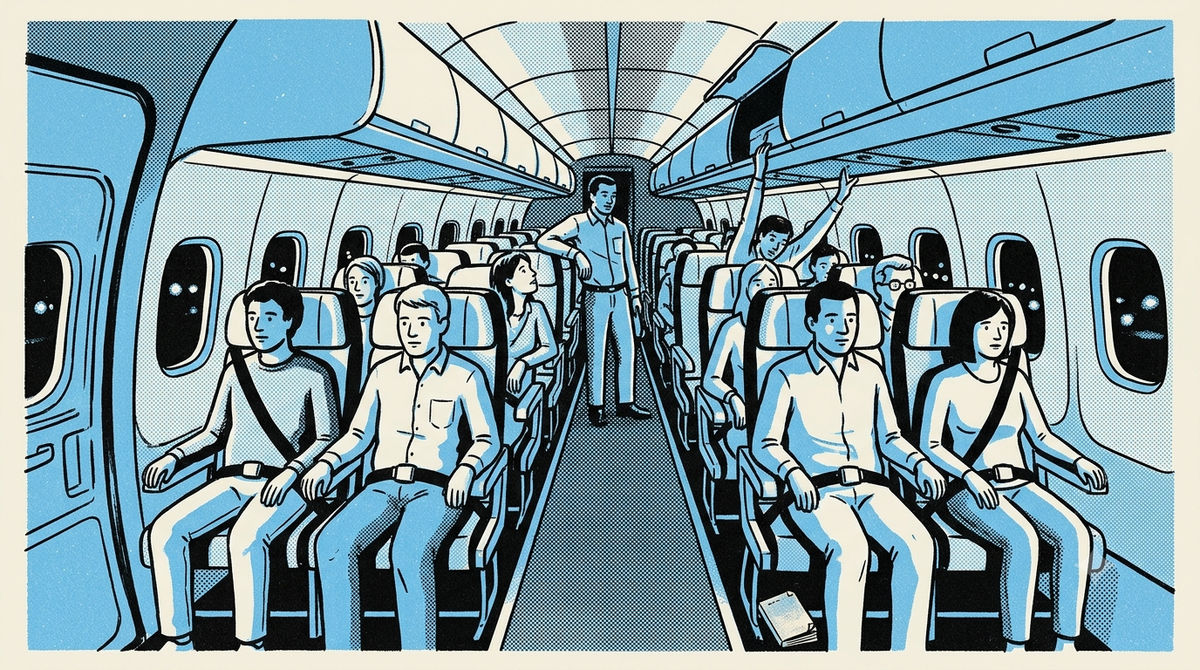
Wheels down in Mumbai, 11:40 pm. The aircraft is still braking when the first seatbelt clicks open somewhere behind you. By the time it turns onto the taxiway, the man from 31C is in the aisle, bag already down, elbow parked on the headrest of 24D. The plane stops. The door stays shut. The jet bridge hasn't even reached the fuselage, and twenty people are standing in a queue that goes nowhere.
What's actually happening
Deplaning is a one-pipe problem. One aisle, one door, one jet bridge. The door opens when the ground crew is ready, not when the aisle is full. Standing during taxi moves nobody; it converts a seated wait into a standing one, with a shoulder in someone's face.
The rush feels like strategy, but it is anxiety in a hurry. Nobody deplanes before the door opens, and your checked bag is not persuaded by any of it; the carousel runs on its own clock. The man from 31C reaches the belt and stands there, like everyone else.
Some regulators have stopped treating this as a quirk. Türkiye's civil aviation authority now fines passengers roughly $70 for unbuckling, standing, or opening bins before the aircraft reaches its parking position and the sign goes off. Violators are reported through a Disruptive Passenger Report (Source: Euronews, May 2025). In India, DGCA's unruly-passenger rules already treat not following crew instructions as reportable behaviour (Source: DGCA CAR, Section 3, Series M, Part VI).
What works better
Stay belted until the ping. Use the taxi minutes to repack: phone, charger, book, all back in the bag, so you're not doing pocket archaeology while a queue waits.
When the sign goes off, stand if you're on the aisle, open the bin, bring your bag down, and wait. The row ahead goes first. Then you. That is the entire protocol, and it is self-enforcing: if each row simply waits for the one ahead, nobody needs to police anything.
If someone pushes through from five rows back, let them pass. You don't need to build a wall; one sprinter doesn't break the system. It breaks when the second and third decide the first had a point.
Genuinely tight connection? Tell the crew before landing. They can announce it and walk you forward, which works far better than self-awarded priority.
Why it matters
Run the math on the overtake. Pushing past two rows saves you the seconds those rows take to clear. The cost lands on thirty rows behind you, as jostle, blocked bins, and a slower total exit. Rows-in-front-first is the rare queue that needs no marshal, no token, no barricade. It only needs each person to do the obvious thing for ninety seconds.
Try this next time
Next landing, don't touch the buckle until the sign goes off. Repack during taxi, then watch your cabin exit in row order. When your turn comes, you'll be out in one motion, and the whole aircraft will have moved faster than the one where everyone stood.
Quick check
1. The seatbelt sign goes off at the gate. You're in 22B, middle seat. The aisle fills, and a passenger from row 27 is pushing forward past your row. What's the move?
Select an answer.
2. You're on a flight to Istanbul. The plane lands and starts taxiing. Your neighbour unbuckles and stands to open the bin. What does he risk under Türkiye's 2025 rules?
Select an answer.