Bassinet seats, child meals, and entertainment
TL;DR
- The bassinet is free, bulkhead-mounted, and goes to whoever requested it first. Ask at booking.
- Baby and child meals are pre-orders. The window closes about 24 hours before departure.
- Download kids' entertainment offline and pack child headphones. The rhymes stay inside them.
- If the crew ask you to swap seats so a bassinet can mount, take the swap gracefully.
Contents
The moment
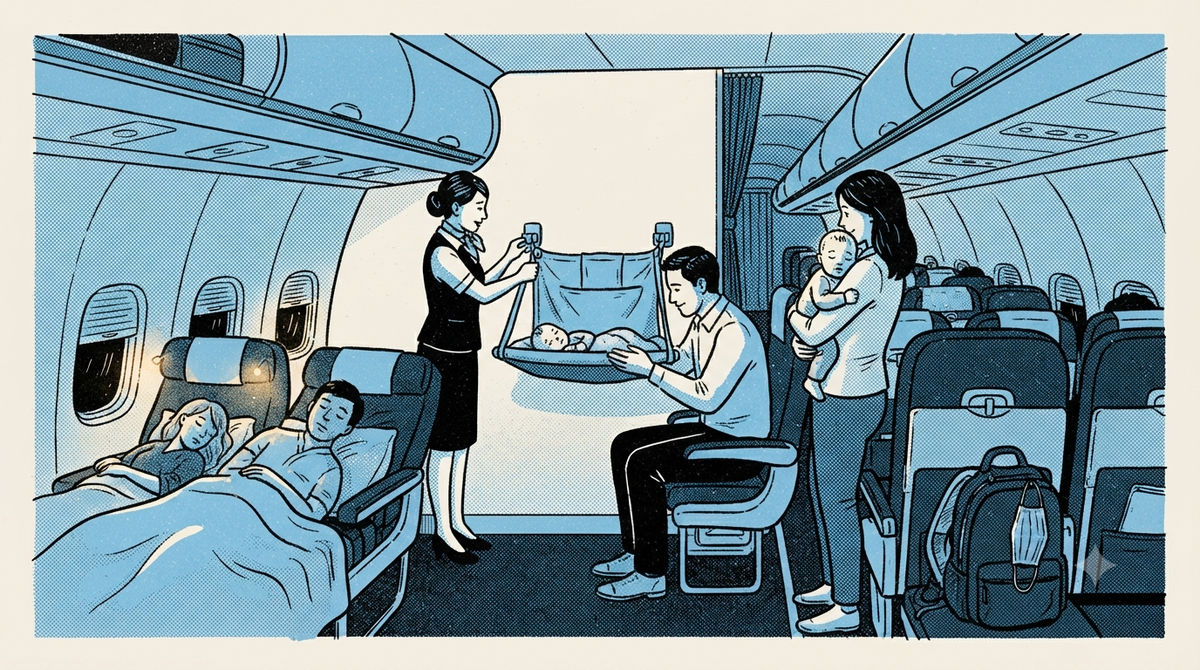
The 1:50 am queue at a Delhi to London boarding gate. You're holding a five-month-old who has decided that sleep is for other people. Ahead of you, a family with a similar-sized baby settles into the bulkhead row, where the crew clips a small cot to the wall. Their baby will sleep flat tonight. Yours will sleep on your shoulder, in forty-minute shifts, for nine hours. Nobody told you the cot existed. Nobody told you it was free.
What's actually happening
Every long-haul aircraft carries a small stock of parent infrastructure: bassinets on the bulkhead wall, baby and child meals in the galley, a kids' rail on the seatback screen. None of it is allocated by need. All of it is allocated by request, made days before anyone boards.
Air India's rules are typical of the system. Bassinets are free, fitted at bulkhead rows on wide-body aircraft, and given on request at booking or check-in, subject to availability (Source: Air India, Travelling with Children FAQs). An infant is a baby over seven days and under two years, but bassinets also have weight and length limits, so a solid one-year-old may not fit. Meals run on the same clock. Baby and child meals are special-meal orders, and the window closes about 24 hours before departure (Source: Air India, Special Meals on Board). Ask at the cart instead, and the honest answer is "we have what we have."
What works better
Make every request the day you book, in one sitting.
Bassinet first. Request it while booking, then reconfirm at check-in. It is first-request infrastructure, not first-need. On a domestic narrow-body there is usually no bassinet at all, so plan the lap and the feed instead.
Meals by the 24-hour mark. Order the baby or child meal at booking, or set a reminder for the day before. Child meals usually arrive before the main service, which is its own small mercy.
Entertainment offline. The seatback kids' rail exists on long-haul; a budget domestic carrier gives you no screen at all. Either way, download the backup at home and pack child-sized headphones. The rhymes stay inside the headphones; the cabin did not choose the playlist.
The bulkhead swap. Bassinets mount only on bulkhead walls. If you're seated there without an infant and the crew asks you to move so a cot can go up, that is the system working, not a demotion. Take the swap gracefully.
Why it matters
A bassinet baby sleeps flat, so the parents' arms and the cabin's ears both get a break. A pre-ordered meal lands in front of a child before hunger becomes a performance. Three requests, made in advance, quietly remove most of what makes a kids' row hard, for the family and for the six rows around it.
Try this next time
Booking a flight with an under-two? Before you close the tab: request the bassinet, order the baby or child meal, and set a reminder for 24 hours before departure to reconfirm both. Three minutes at booking buys nine hours in the air.
Quick check
1. You're flying Mumbai to Frankfurt with a seven-month-old. When do you ask for the bassinet?
Select an answer.
2. Your four-year-old wants her rhymes on the tablet. You're in a full economy cabin. What's the setup?
Select an answer.