Beach trash: the receipt of your visit
TL;DR
- Carry in, carry out. Whatever you brought to the beach leaves with you, in a bag you packed for the job.
- Burying waste in sand is not disposal. The Solid Waste Management Rules, 2026 name burying and water bodies in the same breath.
- Glass is the one thing that must never go under the sand. The next person to find it will be barefoot.
- Before you leave, walk the square you occupied once, slowly. Everything on it arrived with you.
Contents
The moment
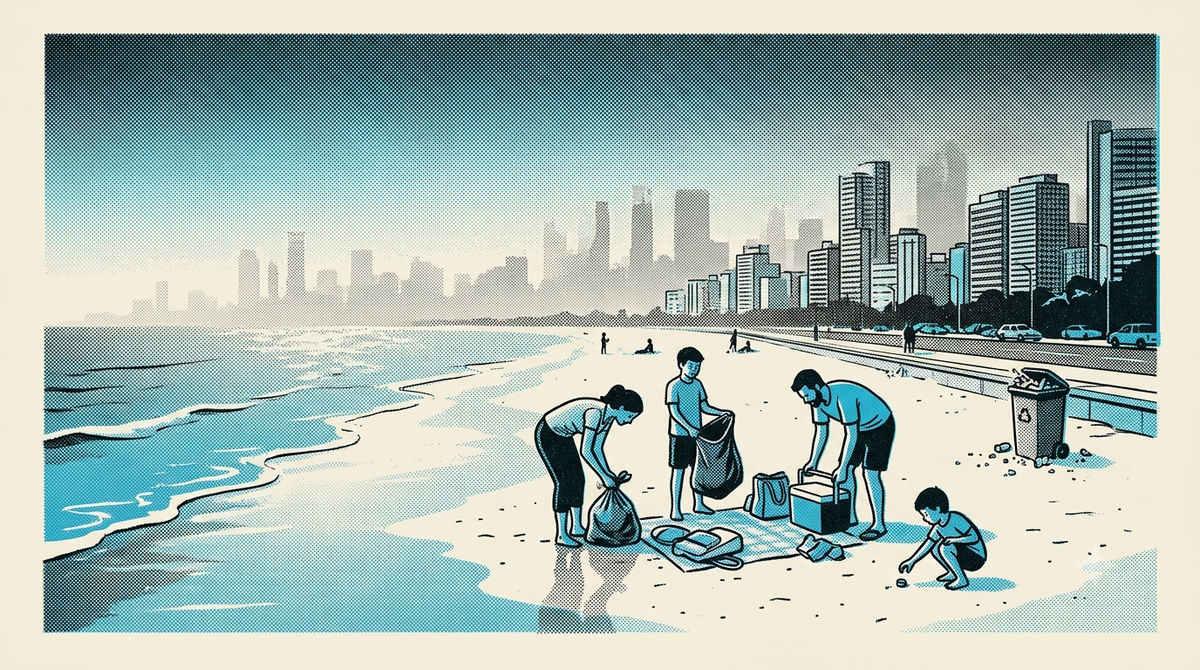
Juhu, a Sunday in January, ten past seven. A family of nine is packing up after four hours on the sand. The mats roll. The cooler goes back in the boot. What stays behind is a tidy pile: eleven paper plates, two thermocol boxes, a knot of carry bags, four bottles. Someone scoops sand over it with the side of a foot, the way you cover something you would rather not look at. High tide is at eight.
What's actually happening
Nobody in that group thinks of themselves as a litterer. The nearest bin is two hundred metres back near the road, and it was full by four. A municipal crew does come in the morning. So the pile reads less like dumping and more like leaving it for the system.
The system is real, and on a Sunday it is undersized. That part is not on you. But the collection method the family actually picked was the sea, and the sea runs one way, outward. Sand holds nothing for long. By nine the foil is in the water, and the thermocol has begun the slow break-up it will finish somewhere else.
What works better
Carry in, carry out. Whatever came with you leaves with you, in a bag you packed for that job.
Two bags in the beach kit, one for dry waste and one for food waste. The rules ask for four streams at home. Two is the honest field version.
Glass never goes under the sand. A buried bottle becomes an ankle-height blade under a foot of beach, and the person who finds it will be barefoot.
Butts and bottle caps count. They are small, which is exactly why they survive the walk to the water.
A gathering of more than a hundred people at an unlicensed place is no longer a picnic in the eyes of the rules. That needs three working days' notice to the local body, and segregation on site.
Why it matters
The law names this exact move. The Solid Waste Management Rules, 2026 came into force on 1 April. Rule 5(1)(f) says a waste generator shall not throw, burn or bury solid waste on open public spaces outside their premises. Nor dispose of it in a water body. Bury is in the text. So is water body.
The scale is not industrial. In 2024, cleanup volunteers worldwide recorded 17,820,206 items. The top three, in order, were food wrappers, plastic drink bottles and cigarette butts. That is one afternoon's carry, multiplied a few million times.
India's numbers say it from the other end. One campaign in September 2024 pulled more than 60 tonnes off more than 80 stretches of Indian coast. A cleanup is a receipt, and somebody else pays it.
Try this next time
Put an empty bag under the mat before you sit down. When you leave, stand up and walk the square you occupied, once, slowly, the way you check a hotel room for a charger. Everything on that square arrived with you.
Be the group whose square looks the way it did when they found it.
Quick check
1. You are leaving a beach at dusk. The one bin at the entrance overflowed hours ago and there is a heap around its base. You have a bag of plates, bottles and food scraps. What is the move?
Select an answer.
2. Your group of about thirty is planning a full-day beach picnic with a music system, cooked food and a small bonfire. Which part of that plan is the one the waste rules speak to most directly?
Select an answer.