Queueing in international contexts: the global default
TL;DR
- The international-default queue is single-file, one metre apart, quiet. The system holds your place; you don't have to.
- When a new counter opens, wait for the marshal to direct people from the front of the existing queue. Don't race over.
- Phone usage is silent. Texting and scrolling are fine; speakerphone and video sound are not.
- In the UK and most international queues, a polite 'excuse me, the queue starts back there' is the local enforcement norm.
Contents
The moment
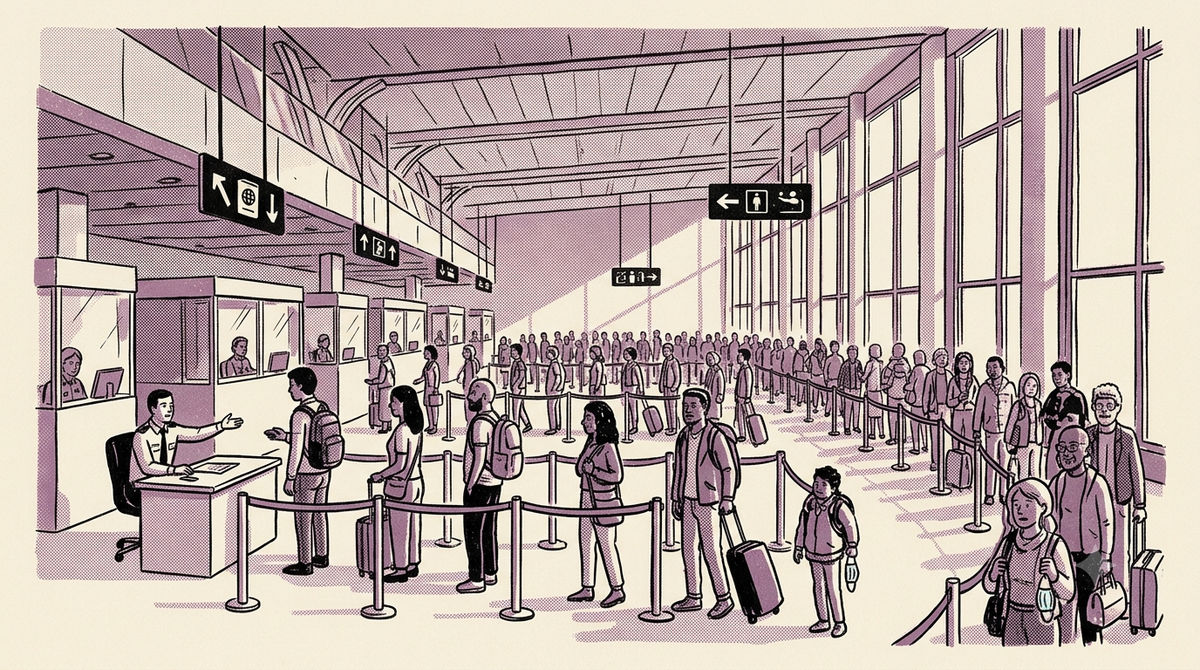
You've landed at Heathrow Terminal 5. The immigration hall is full. The queue snakes through stanchions for what looks like 200 metres. The line is single-file, perfectly spaced, with about a metre between each person. Nobody's on a phone with the volume up. Nobody's standing on someone's heels. When a new desk opens, the marshal calls "next person please" and the front of the line walks over without confusion. The whole hall moves. You've just arrived from Delhi where the line at the boarding gate was a scrum.
What's actually happening
You are observing the international-default queue: single-file, well-spaced, quiet, predictable. This is not a British phenomenon. It is the standard at virtually every airport, train station, government counter, and supermarket in most countries Indians visit.
The mental model is different. In a low-trust queue, physical position guards your turn, so you stay close to the person in front. In a high-trust queue, the queue itself is trusted to hold. Your turn is recorded by your position in the line, not by your physical pressure on it.
For the Indian traveler abroad, the lesson is that the trust holds. You can step back. You can leave a metre of space. You will not lose your place.
What works better
Four rules for queueing internationally.
Rule 1: Single-file, never two-abreast. Even with family, queue in single file. Two-abreast queueing is universally read as queue-jumping or space-hogging.
Rule 2: One metre back from the person in front. Indian default is 10-30 cm, international default is 60-100 cm. The wider spacing signals respect for the queue's integrity.
Rule 3: Phone usage is silent. Texting and scrolling are fine. Speakerphone, video sound, and video calls are not. Most international queues operate at a conversational hush.
Rule 4: When a new counter opens, wait for direction. The marshal will call the front of the existing queue. Do not race over from your spot. Stay where you are; the marshal will redirect.
For specific contexts:
Boarding gates: Group/zone boarding is enforced more strictly than at Indian carriers. Wait for your group; do not stand at the gate before it's called.
Immigration: Single file behind the yellow line. Approach the desk only when called. Have passport and visa documents in hand.
Restaurants: "Please wait to be seated" is a real instruction. Most full-service restaurants require a host, even if tables look empty.
Buses and public transport: Queue at the stop. First arrival boards first; socially enforced in most European, East Asian, and Australasian cities.
Why it matters
International queues work because everyone in them follows the same rules. The rules are fewer than they look. Single file, metre apart, quiet, wait for direction. When your behaviour matches the local norm, the queue stays calm and you become invisible in the best way.
The rules are also learnable in one read, and they are the same across most countries you are likely to travel to. The investment pays back on every trip.
Try this next time
For your next international trip, deliberately queue international-style throughout. At the boarding gate, wait for your group. At immigration, single-file, metre back, phone silent. At the carousel, metre back from the belt. At the breakfast buffet, single-file at each station.
Two things will be true at the end of the trip. You will not have lost any time to the discipline, and you will have a small new habit that travels with you.
Quick check
1. You're at the Singapore Changi airport immigration. There's a single queue with stanchions, currently 60 people deep. A new immigration counter opens to the side. What do you do?
Select an answer.
2. You're at a London bus stop. You arrived 5 minutes ago, you're at the head of an informal queue of about 8 people. The bus pulls up. A man who arrived 30 seconds ago walks straight to the door, ignoring the queue. What do you do?
Select an answer.