Public toilets globally: how to find, how to use
TL;DR
- There is no single rule for abroad. Some cities charge and some do not, so carry coins and check the city's own map before you need it.
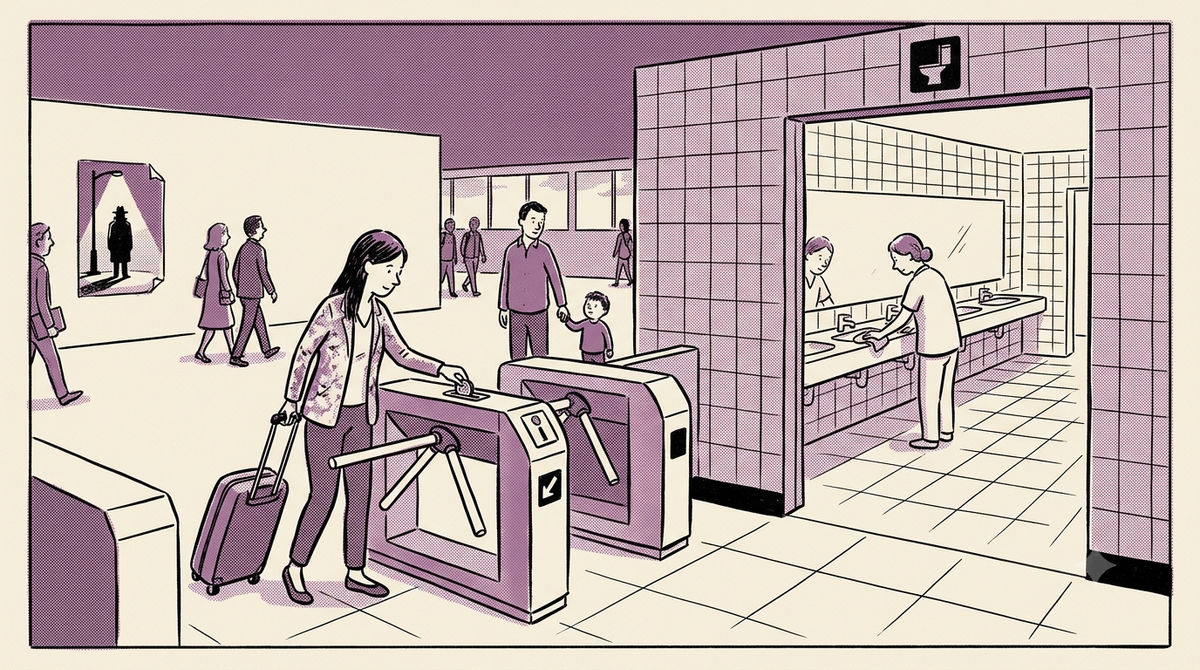
- At German stations the Sanifair turnstile costs one euro, takes coins only, and hands back a fifty-cent voucher for the station shops.
- Paris runs 435 street sanisettes that have been free since 2006, and Japan's tourism board points to free public washrooms in stations and other venues.
- A cafe toilet comes with the smallest coffee on the menu. That is the price of entry, not a trick.
Contents
The rule
Find the toilet before you need it, carry coins, and leave the cubicle in the state you would want to walk into.
Why this rule exists
Outside India, a public toilet is usually a funded service, and the funding model decides your afternoon.
At Nürnberg Hauptbahnhof, Deutsche Bahn's own station page puts the Sanifair turnstile at one euro, coins only. A fifty-cent shop voucher comes back with it, and entry is free for children and for people with disabilities. The fee pays the attendant, and the attendant is why it is clean.
The opposite model runs on the same continent. Paris operates 435 self-cleaning street sanisettes, mapped on the city's own site and free to use since 2006, each running a thirty-second clean between users. Japan sits at that end too. Its tourism board points to widespread hygienic, free-to-use public washrooms in stations and other venues, with the route often marked by tactile paving and Braille.
So there is no single rule for abroad. There is a coin in your pocket for the places that charge, and a map check for the places that do not.
What happens if you don't follow it
Immediate. A coin-only turnstile and a card-only wallet make for a bad two minutes.
Practical. The dependable free options, a museum you hold a ticket for, a department store, a library, all shut earlier than the street does.
Social. A cafe toilet comes with the smallest coffee on the menu. Walking in, using it and walking straight out is the move the staff remember.
Downstream. Paid or free, somebody cleans it. What you leave behind is what they and the next person walk into.
Quick reference
- Carry a euro or two in coins in Europe. Some turnstiles take nothing else.
- Check the city's own map first. Paris publishes its sanisettes and many cities do the same.
- Free and dependable: airports past security, museums you hold a ticket for, department stores, large bookshops, public libraries.
- "Toilet" and "WC" are understood almost everywhere. "Bathroom" and "restroom" are American usage.
- Squat pans are not an India-only design. Japan still has them at some stations and older bars.
- Where a bin stands beside the pan, paper goes in the bin. That is plumbing, not preference.
- Take the voucher when a machine gives you one. At German stations it is worth fifty cents in the shops.
- Leave the seat dry, flush, and look at the floor before you open the door.
Quick check
1. You are changing trains at a large German station with twenty minutes to spare. You need the toilet and you have a card, a phone and one twenty-euro note. What is the realistic read?
Select an answer.
2. A friend tells you to budget a euro per toilet visit for a two-week trip across Europe. Is that the right plan?
Select an answer.