Public noise: the universal speakerphone-is-rude rule
TL;DR
- Your audio stays inside your head. That one rule covers calls, reels, music and video in nearly every country you will travel to.
- This is not only etiquette. UK railway byelaws make sound that annoys another passenger an offence, and Singapore's transit rules carry a standalone passenger-nuisance provision.
- No earphones on you? Hold the phone to your ear and drop your voice. Held flat in your palm is still speakerphone.
- Pack a cheap wired pair in the bag you actually carry. It is the smallest piece of travel kit with the biggest effect on the room.
Contents
The moment
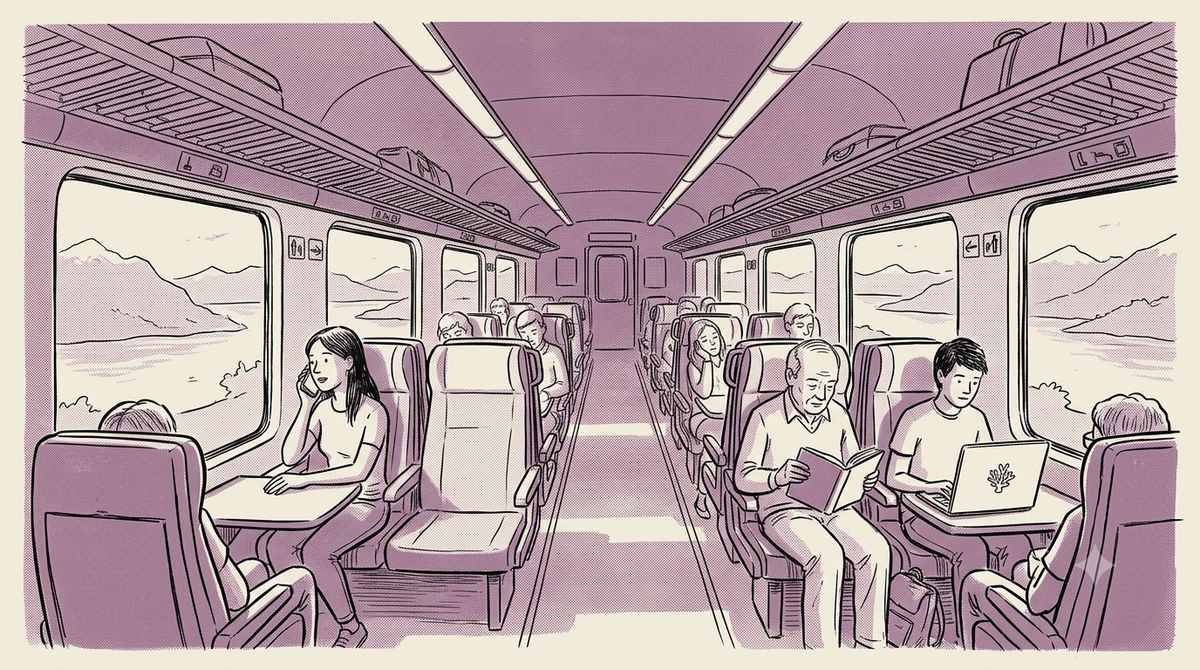
You are on the 09:12 train from Zurich to Milan, second class, half empty. Your mother calls. You answer the way you always do at home, phone flat in your palm, speaker on. Her voice carries down the carriage. You are four sentences in when the man across the aisle taps his own ear and points at your phone. Nobody says a word. Nobody needs to.
What's actually happening
You have just met the most portable rule in international public space. Your audio stays inside your head.
This is not a politeness code you had to guess at. It is written down, in more places than most travellers expect. The Transport for London Railway Byelaws cover it directly. Using any equipment to produce or reproduce sound on the railway, to the annoyance of any person, is an offence (Byelaw 7). Singapore's Rapid Transit Systems Regulations give passenger nuisance its own standalone provision (Regulation 17). India's own Noise Pollution Rules, 2000 set ambient limits for exactly the same reason.
So the rule is not different abroad. The cover is. In a carriage where nobody else is talking, a call on speaker has nothing to hide behind, and every word of it is legible to every row. In a coach with twenty conversations already running, the same call disappears into them. Same behaviour, different backdrop.
The arithmetic is not small either. Thirty people within earshot and six minutes on speaker is three hours of other people's attention, spent on your hotel booking. Nobody was asked, and it cost you nothing.
What works better
Earphones settle almost all of it. A wired pair costs about ₹200 and fits in any pocket. Plug in and the rule is met permanently, without you thinking about it again.
No earphones on you? Phone to your ear, voice down. This is the fallback and it works everywhere. Holding the phone flat in your palm is still speakerphone, whatever you tell yourself.
Video calls carry a camera as well as a speaker. Earphones fix the audio. They do not fix the passengers behind you, who are now in frame on someone else's screen. Voice on the train, video once you are off it.
Reels, music and games follow the same rule. Entertainment gets no separate allowance. If the row behind can hear it, it is too loud.
If you must take it on speaker, buy distance. Step off at the next stop, or find a stretch with nobody seated near it. Byelaw 7 covers the whole railway, so you are buying space from people, not a loophole.
Why it matters
Transport for London ran a poster campaign across its services in 2025, asking passengers to put headphones on for calls, music and video. TfL's own passenger research on loudspeaker audio sat behind it. That tells you something useful. The quiet is not automatic and it is not smugness. It is a norm that gets actively topped up, in a city with plenty of noise elsewhere.
So you are not being asked to meet a foreign standard. You are being asked to hold up a rule that most Indian commuters would also prefer on their own line.
Try this next time
Before your next trip, put a cheap wired pair of earphones in the bag you actually carry, not the one in the cupboard. Then take every call of the first travel day on them, including the two-minute ones.
By day two it stops being a decision. That is the whole upgrade, and it weighs about fifteen grams.
Quick check
1. You are on a London Underground train. Your office calls with something urgent and you have left your earphones in the hotel. The carriage is quiet. What do you do?
Select an answer.
2. You are on the Singapore MRT with twenty minutes of your journey left. Your sister video-calls. You have earphones with you and the coach is fairly full. What is the right move?
Select an answer.