Buffet etiquette globally
TL;DR
- The serving spoon belongs to the dish, not to you. It goes back into the dish, never onto your plate and never near your mouth.
- Take a fresh plate each trip. A used plate carries whatever was on it back to a counter that two hundred people are sharing.
- A tall plate is a food safety problem before it is a waste problem, because hot food is meant to be held above 60 degrees and yours is now at room temperature.
- Buffets are the largest contributor to food waste in hotels, and small plates with more trips is the fix that costs you nothing.
Contents
The moment
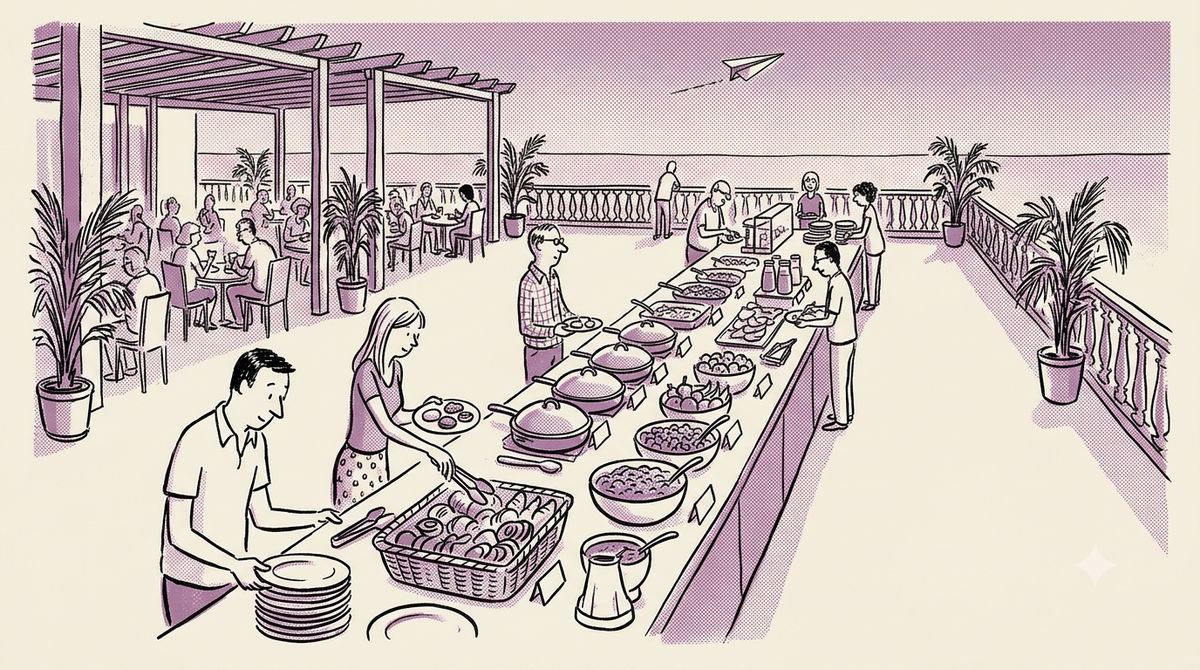
It is the breakfast buffet at a hotel in Dubai, at 8:40 am. You are at the third station along. The serving tongs for the pastries are not in the basket where they should be. The person ahead of you carried them to the next dish and left them there. Someone else has given up and is using their fingers. Two dishes down, a plate stands about four inches tall, and its owner is still adding.
What's actually happening
A buffet is a shared serving system pretending to be a private one. Two hundred strangers handle that counter in ninety minutes. It works only because each dish keeps its own spoon and each diner keeps their own plate.
That is one rule, not two. The serving spoon is the boundary between the communal dish and your plate. The moment it crosses, it stops being a serving spoon.
The tall plate is a separate problem, and it is not mainly about greed. Hong Kong's Centre for Food Safety advises that hot dishes be held above 60 degrees and cold dishes at 4 degrees or below. It also tells diners to eat food as soon as possible after taking it. A plate loaded for fifteen minutes of eating spends fourteen of them at room temperature. It also ends up in the bin. The WWF and AHLA toolkit is blunt: buffets are the largest contributor to food waste in hotels.
What works better
Three moves, and none of them slow you down.
Move 1: The spoon goes back into its own dish. Not onto your plate, not into the next dish, not into your mouth. If a spoon is missing, ask a server rather than improvising with your own cutlery.
Move 2: Fresh plate each trip. A used plate carries whatever was on it back to the counter. The stacks of clean plates at the start of the line exist for this reason. The Centre for Food Safety tells diners to check their tableware and ask for a change if it is not clean.
Move 3: Small plate, more trips. Take three or four items, eat them, then decide. At a live counter with a queue, take one serving per trip so the cook can serve the person behind you.
Why it matters
The waste argument is real and it is large. UNEP puts global food waste at roughly 1.05 billion tonnes a year, with food service one of the three tracked sectors.
The interesting finding is how little resistance there is to fixing it. In WWF's guest surveys, 80% of guests favoured or did not mind signage on a buffet encouraging less wasteful consumption. Some guests in the same research cautioned that such messaging has to be crafted carefully, or it reads as shaming. That is a fair warning, and it is the whole spirit here. Nobody is judging your appetite. Take a second helping, and a third. Take it on a second plate.
Try this next time
At your next hotel breakfast, run one experiment. Fill your first plate no more than half, with four items at most, and go back for anything you still want.
Two things will be true at the end. You will have eaten the hot food hot, and you will have left nothing on the plate for someone to scrape off.
Quick check
1. You are at a hotel breakfast buffet and the serving spoon for the scrambled eggs is missing from the dish. You have your own fork on your plate. What is the right move?
Select an answer.
2. A friend at a hotel brunch argues that one tall plate is more efficient than four trips, since the food gets eaten either way. What is the strongest counter?
Select an answer.