Tourist site etiquette: the Louvre, the Eiffel, Stonehenge
TL;DR
- Every big European site publishes its own rules, and the person stopping you at the door is reading from a document you could have read the night before.
- The Louvre lets you photograph the collection and refuses your selfie stick, your flash and any bag over 55 x 35 x 20 cm. Any exit is final.
- The Eiffel Tower is a non-smoking monument with sizing frames on the forecourt, no cloakroom, and a rules list that reaches down to spitting over the balustrades.
- Nobody touches, leans on or climbs the Stonehenge stones. That is a 1979 Act and a 1997 regulation, and English Heritage says breaking them can bring prosecution.
Contents
The moment
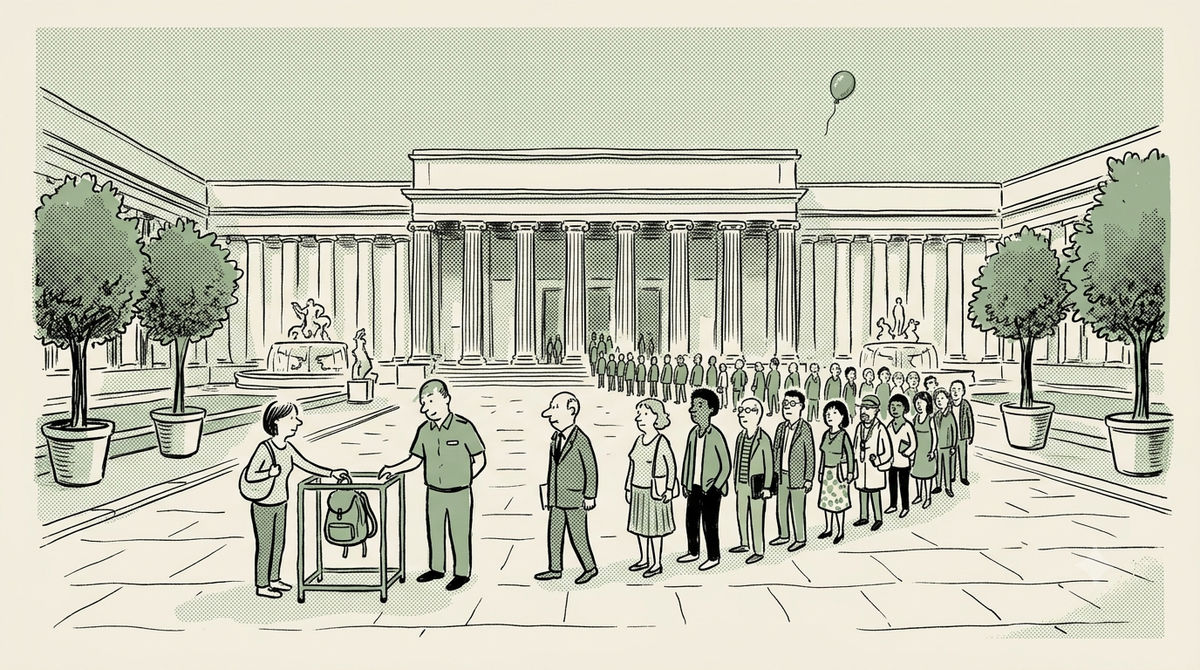
It is 10:40 on a Tuesday at the Louvre's pyramid entrance. You have a cabin-sized backpack, a selfie stick clipped to the strap, and a plan: the paintings, lunch, the Eiffel Tower at four. The attendant points at your bag, then at the metal sizing frame beside him. The queue behind you keeps arriving.
What's actually happening
Nothing here is being improvised. Every big European site publishes its rules, and the person stopping you is reading from a document you could have read the night before.
The Louvre refuses anything over 55 x 35 x 20 cm, and suitcases do not come in at all. Free lockers take the smaller things. Photos and videos are fine in the permanent collections if they are for personal use. Selfie sticks, flash and lighting are not. In the exhibition rooms you do not eat, drink, smoke, run, touch the works or make a lot of noise. One line matters most: any exit is final.
The Eiffel Tower is a non-smoking monument, top to bottom. Sizing frames sit in four places on the forecourt and again at the security check, and there is no cloakroom anywhere on site. Its rules also cover running, sitting on the stairs, group picnics, carrying children on your shoulders, and spitting on the ground or over the balustrades. Once you leave, you do not come back in on the same ticket.
Stonehenge is the least negotiable of the three. Nobody touches, leans against, stands on or climbs the stones. That comes from the Ancient Monuments and Archaeological Areas Act 1979 and the Stonehenge Regulations 1997, and English Heritage says plainly that breaking them can bring criminal prosecution.
What works better
Pack to the smallest bag limit on your itinerary. The Louvre publishes a number. The Eiffel gives you a frame and no cloakroom.
Leave the selfie stick at the hotel. The Louvre permits your photograph and refuses your pole. The ban is on the equipment, not the picture.
Treat "no re-entry" as real. Water, toilet, and the thing you forgot all happen before you go in.
Keep your hands off the object. Stone, frame, plinth, rope. This is the one rule that is identical at all three sites.
Photograph for yourself, not for sale. English Heritage welcomes personal photos at Stonehenge and asks for written permission before anything commercial. Posting is fine, selling is not.
Why it matters
These rules are boring on purpose. A site admitting very large crowds every day cannot run on judgement calls at the door, so it writes the judgement down and applies it identically to everyone. That is also what protects you. The attendant at the frame is not assessing you, he is measuring a bag.
Reading the page rather than asking the person is the real adjustment. At home, the rule at a counter is often whatever the person at the counter says today. Here the published document outranks the attendant.
The other half is the object itself. A flash and a fingertip are invisible one at a time and not invisible at scale. That is why the Louvre bans your flash while permitting your photograph. It is also why a 1997 regulation stands between an ancient monument and the hand of every visitor who ever wanted to feel it.
Try this next time
The night before a big site, open its own visiting-rules page. Note three things: the maximum bag size, whether re-entry is allowed, and what the photography line says. Then pack to the smallest number on your list.
Quick check
1. You reach the Louvre with a 60 x 40 x 25 cm backpack, a selfie stick, and a plan to step out at 1 pm for lunch and come back for the afternoon. Which part of that plan survives contact with the museum's published rules?
Select an answer.
2. At Stonehenge a fellow visitor says the no-touching rule is just an English Heritage house policy, and that anyone who books the Stone Circle Experience gets to lay hands on the stones. What is the accurate correction?
Select an answer.