Queueing the British way: the formality and the limits
TL;DR
- Britain runs two queues. The formal one, where jumping is close to unforgivable, and the invisible one, where the line has gone but arrival order has not.
- One sentence solves most of it: 'Sorry, are you in the queue?' Asking costs nothing and marks you as someone paying attention.
- Bus stops no longer form orderly lines. People mass at the stop, so let whoever was already waiting board ahead of you.
- If someone cuts in, say something once and politely. Debrett's is explicit that simmering in silence is the wrong answer.
Contents
The moment
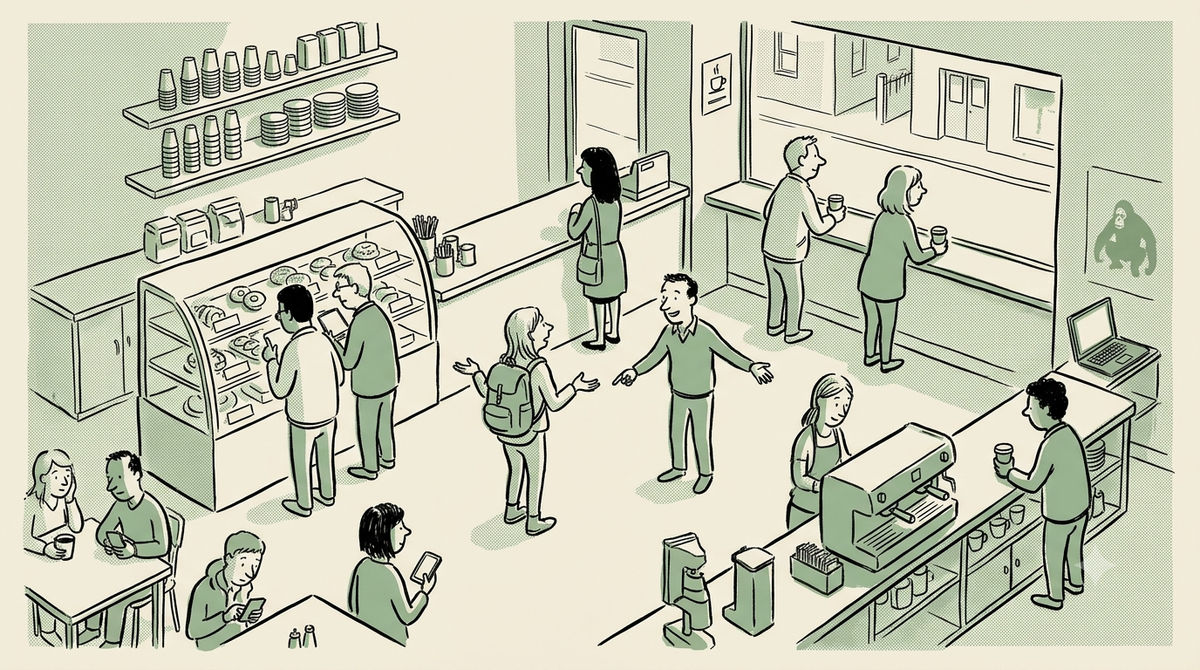
Twenty to nine on a Tuesday in London, and you want a coffee before the meeting. There are eleven people in the shop and no line anywhere. Two are studying the pastry case. Two are at the window with cups. One is paying. You cannot tell who is waiting and who is browsing. In most shops you would just step forward and find out. Here, stepping forward feels like it might be the wrong move, and you could not say why.
What's actually happening
Britain runs two queues, and nobody tells you which one you are standing in.
The first is formal to a degree that surprises visitors. Debrett's calls jumping it "the worst queuing solecism". Even holding a place counts: one person keeping a spot for one other is roughly tolerated, but a whole group arriving to claim a single placeholder is read as cheating.
How formal can it get? Take the lying-in-state of Queen Elizabeth II in September 2022, when people queued to pay their respects. Parliament's guidance had Westminster Hall open around the clock for four and a half days. It warned them they would "stand for many hours, possibly overnight, with very little opportunity to sit down, as the queue will keep moving". Coolers, folding chairs, sleeping bags and blankets were on the security ban list.
The second queue is the one that has quietly dissolved. Debrett's is blunt about bus stops: orderly lines there are "a thing of the past", and passengers now mass around the stop and board in random order.
So the line is gone in places. The order is not. That is the whole distinction.
What works better
Ask instead of guessing. "Sorry, are you in the queue?" That one sentence does more work than any amount of watching, and it almost never reads as rude.
Stand further back than feels natural, then keep up. Do not breathe down the neck of the person in front. Equally, do not let a big gap open, because a gap reads as an invitation.
Correct once, politely. Debrett's warns against silent resentment and supplies the words: "I'm so sorry, I'm in the queue. You'll find the end over there."
At a bus stop, track arrivals, not position. If people were there before you, they board before you. Older passengers, parents with pushchairs and anyone with mobility needs go ahead of everyone.
Why it matters
None of this is national character. Debrett's traces the habit to crowded industrial cities and then to wartime rationing, when waiting your turn became a patriotic duty. That is history, not temperament. A queue is cheap infrastructure that works only while it stays predictable.
Which makes this a portable skill, not a British one. An Indian bank counter with a token machine and one without are also two different systems, and reading which you are in is the same move. Britain simply gives you a sharper version of the test, because the formal queue and the vanished queue can be fifty metres apart.
Try this next time
For the first three days of any UK trip, use one sentence in every space where you cannot see a line. Ask "Sorry, are you in the queue?" Sometimes there is a queue you could not see. Sometimes there is not. You lose nothing either way, and by day four you will be reading the room without asking.
Quick check
1. A colleague says the British queue is a myth people exaggerate. You mention the September 2022 lying-in-state queue at Westminster Hall. What did Parliament's own visitor guidance tell people to expect?
Select an answer.
2. You have been waiting at a London bus stop for six minutes. There is no line, just eight people standing about. The bus arrives and someone who turned up thirty seconds ago heads straight for the door. What is the read?
Select an answer.