Cover your mouth: the lesson COVID taught and we forgot
TL;DR
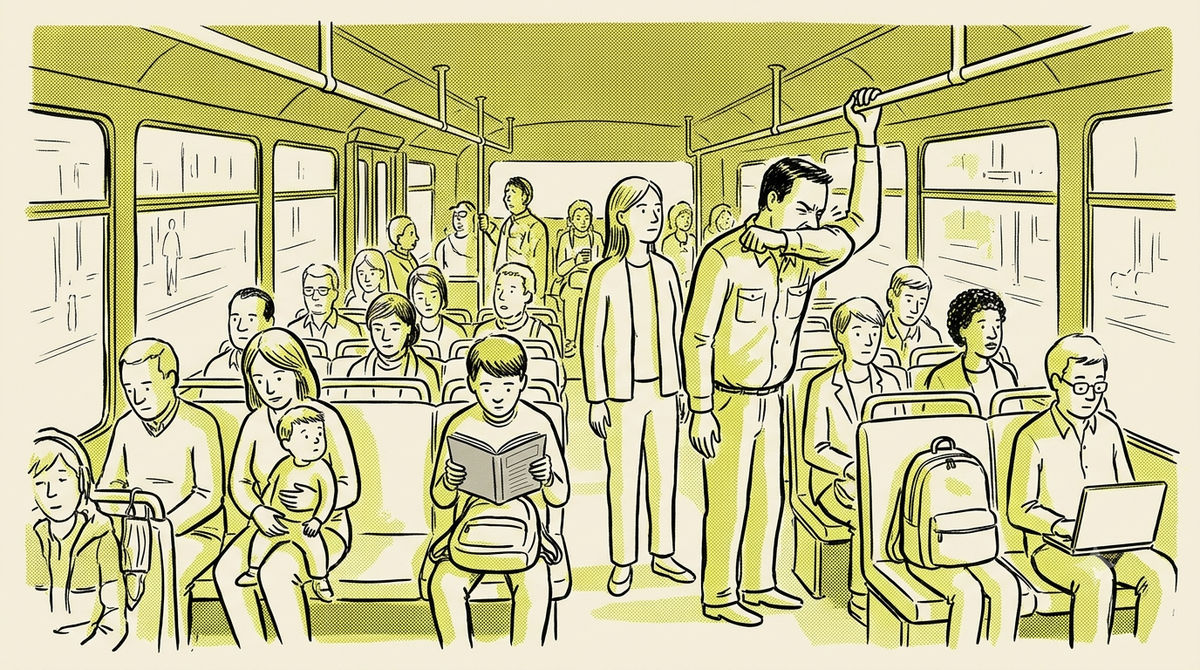
- Tissue first, upper sleeve second, hands never. Your hand is going to the grab rail next; your sleeve is going nowhere.
- Then clean your hands. The CDC lists coughing and sneezing alongside blowing your nose as a key time to wash or sanitise.
- Shared indoor air is not a metaphor. Tuberculosis is airborne, and WHO counted 10.7 million people falling ill with it worldwide in 2024.
- Nobody is fined for an uncovered cough and no inspector is checking. This one runs entirely on you, which is what makes it a civic act.
Contents
The rule
Cover your mouth and nose with a tissue when you cough or sneeze. If there is no tissue, use your upper sleeve, never your hands. Then clean your hands.
Why this rule exists
The hand is the problem. Your hand is about to touch the grab rail, the lift button, the door handle, the shared serving spoon. Your sleeve is going nowhere. That is the entire logic, and the CDC states it in one line: tissue, or upper sleeve, not your hands.
The second reason is that shared indoor air is not a metaphor. Tuberculosis is airborne. WHO's Global tuberculosis report 2025 counted 10.7 million people falling ill with it worldwide in 2024. India is among the eight countries that together carry two thirds of that total. That is not an accusation and no single cough is a diagnosis. It is why the courtesy is not merely decorative.
Through the COVID years, covering a cough was ordinary here. Some of it was mandated and much of it was simply what the people around you did. The habit faded afterwards because the reason faded from view, not because it stopped working. That is how habits without a visible reason behave, and it is not something anyone needs scolding for.
What happens if you don't follow it
Immediately, whatever left your mouth is on your palm, and then on the rail, the button and the door. The cough you thought you contained, you relocated.
Legally, next to nothing. No inspector is checking and nobody is fined for an uncovered cough. Public spitting carries a section and a municipal fine; a cough into a carriage does not, in any practical sense. This rule runs entirely on you, which is what makes it a civic act rather than a compliance exercise.
Socially, an uncovered cough in a meeting room or a lift is the detail people remember about you. That is a small relationship cost for a move that takes no time.
And you do not know the room. Someone two seats away may have a newborn at home, or a parent on treatment that suppresses immunity. You cannot tell by looking, and neither can they about you. That is the argument, and it does not require anyone to be at fault.
Quick reference
- Tissue first. Upper sleeve second. Hands never.
- Bin the tissue immediately. Do not pocket it.
- Clean your hands afterwards, every time. The CDC lists this among its key times for soap or sanitiser.
- Turn away from people and from food before you cough, not after.
- If you have a real cough and a crowded commute, a mask is the shortest path. It costs about ten rupees and it does the job of remembering for you.
Quick check
1. You are standing in a packed metro carriage with one hand up on the grab rail, and a cough is arriving. There is no tissue in your pocket. What is the right move?
Select an answer.
2. You have used a tissue for a sneeze, binned it properly, and you are about to sit down to lunch with three colleagues. Is there a step left?
Select an answer.