Nose-blowing across cultures: the tissue, the napkin, the elbow
TL;DR
- Countries disagree about the noise and about whether your cloth gets washed or thrown away. They agree on the rest: turn away, contain it, clean your hands.
- The elbow is for a sneeze that arrives without warning. It holds almost nothing, and what it holds you carry into the next room.
- The table napkin is never the answer. Somebody picks it up by hand and carries it away.
- Blow gently. Nose blowing generates far more pressure than a cough or a sneeze does, enough to push fluid up into the sinuses.
Contents
The cultural moment
You have a cold. You are in a room with other people, and something in your nose needs to leave. Three tools are usually within reach: a tissue, the napkin on the table, and your own elbow. Only one of the three is a real answer, and the reason is not the one most people expect.
How it shows up across contexts
| Context | What is normal | Why it works there |
|---|---|---|
| India, urban office or metro | A cloth handkerchief used quietly, or a tissue when one is handy. | Close seating and shared indoor air. The handkerchief is discreet and always on you. The trade is that it comes home with you. |
| India, smaller towns and outdoors | Clearing your nose outdoors, well away from other people, passes without comment. | Open air disperses it and nobody is trapped beside you. The same act indoors reads completely differently. |
| Japan | Sniffing in public, blowing your nose in private. Not a rule, and not universally kept. | The noise is read as an intrusion on people who cannot leave the carriage. |
| Western Europe and North America | Blowing into a tissue at a desk or a table is unremarkable. Sustained sniffing is the rude option. | The reasoning inverts. Getting it over with quickly counts as the considerate move. |
| Aircraft and long-distance trains | Tissue, then sanitiser, then back to what you were doing. | Nobody can step outside for six hours, and every armrest and tray table is shared. |
The translation move
The columns disagree about two things: how much noise is acceptable, and whether the cloth gets washed or thrown away. Strip those out and a narrower rule survives everywhere.
Turn away from people and from food. Contain it in something. Then clean your hands, which is the step almost everyone skips. The CDC lists blowing your nose alongside coughing and sneezing as a moment for soap or sanitiser.
A handkerchief contains it perfectly well. It simply goes back into your pocket, which is why the hand-cleaning step matters more if that is what you carry, not less.
Two things fail in every column.
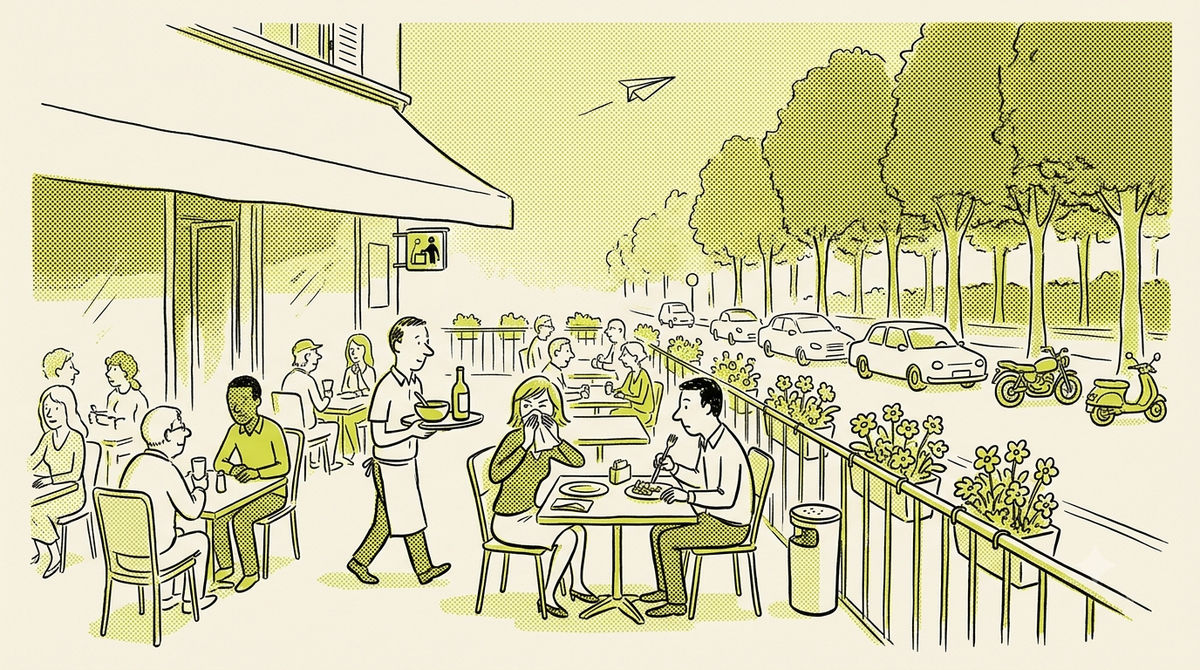
The napkin is not a container. The cloth or paper napkin on a restaurant table gets picked up by hand and carried away by somebody. A used one makes that a different job for a person you will never meet.
The elbow is not one either. The elbow is for a sneeze that arrives without warning while your hands are full. It holds almost nothing, and what it does hold you carry into the next room and the next meeting. It is a stopgap, not a tool.
Then blow gently. A 2000 study in Clinical Infectious Diseases measured the pressure inside the nose during a blow at around ten times that of a cough, and more still against a sneeze. Enough, the authors found, to push nasal fluid up into the sinuses. Force is doing something, but not the thing you want.
Try this next time
If you carry a handkerchief, keep carrying it and add sanitiser. If you carry nothing, a pocket pack of tissues is ten rupees for ten sheets and lives where your phone lives.
Then default to the sequence that travels: turn away, contain it, clean your hands. It reads as correct in every column of that table, which is not a claim you can make for the elbow.
The honest gap is the bin. Indian streets do not have one every hundred metres, so the unglamorous half of this is a used tissue in your pocket until you find one.
Quick check
1. You are halfway through dinner at a restaurant with four colleagues. Your nose has been running since the soup arrived. The cloth napkin is on your lap, tissues are in your bag on the back of the chair, and the washroom is thirty seconds away. What is the move?
Select an answer.
2. You are blocked up and blowing hard, several times an hour. A colleague suggests going gentler. Is there anything behind that beyond the noise?
Select an answer.