The buffet plate: how much, how often, how respectful
TL;DR
- Multi-trip eating with small plates wastes less and lets you actually taste each item.
- Take what you'll eat, not what looks impressive on the plate.
- At live counters with queues, take one serving per trip so the cook can serve the next person.
- The hotel cooks for some waste; the diner-driven waste is separate, and it is the part you can control.
Contents
The moment
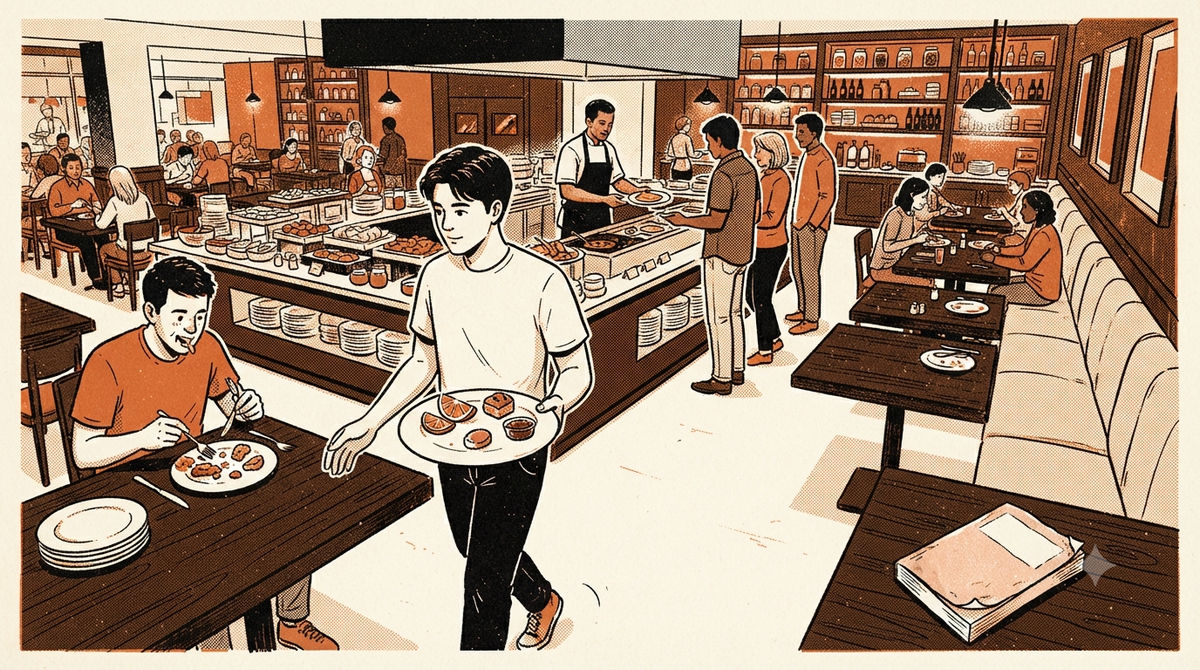
You're at the brunch buffet at a 5-star property in Bengaluru. ₹2,500 a head, alcohol included. The spread is enormous: a sushi station, a tandoor, a roast carving, three live counters, a chaat corner, a dessert table. Your first plate is a stack. Lamb, three pieces of sushi, butter chicken, biryani, pasta, salad on top, two pieces of paneer tikka jutting off the side. You sit, you eat what fits comfortably (about 60% of what's on the plate), the rest goes to waste. The waiter clears without comment. You go for round two. Same pattern.
What's actually happening
The buffet is designed for excess. Visual abundance signals value, so the hotel cooks more than it expects to serve. The spread has to look full at the end of service. The hotel expects some waste and prices for it.
Within that, the diner has a real choice between two mental models.
The first: I paid for it, so taking more is getting my money's worth. The food I do not eat is the hotel's problem.
The second: I paid for access. What I take should approximate what I will eat. Taking more than I eat is waste regardless of who pays.
The first is common at Indian sit-down buffets and hotel breakfasts across Asia. The second is what buffet economics actually relies on. The hotel's expected waste is baked into the price; the diner-driven waste on top of it is separate, and it is the part you can influence.
What works better
Two principles, both simple.
Principle 1: Multiple smaller trips, not one large plate.
The "one plate, all-the-things" approach is the most wasteful pattern in buffet eating. The plate looks impressive, but most people eat 50-70% of a tower plate; the remainder gets cleared. Take 3-4 items instead, eat them, evaluate hunger, decide if you want more. The buffet does not run out.
Principle 2: Take what you'll eat, not what looks impressive.
If you're full after 2 trips, stop. Don't take 6 desserts and eat 1.
If something is unfamiliar (a Japanese pickle, an unusual cheese), take a tiny portion to try. Decide if you want more. Don't take a full serving on speculation.
Why it matters
The UNEP Food Waste Index 2024 puts annual global food waste at around 1.05 billion tonnes, with the food service sector as one of the three main contributors. FSSAI's Save Food, Share Food initiative specifically targets restaurant and hotel waste in India through awareness and surplus food recovery.
The argument that "the hotel cooks for waste anyway" is partly true and partly evasion. The hotel's expected waste is back-of-house. The diner-driven waste (food on the plate, not eaten, cleared) is on top of that.
Beyond the waste argument, there is a courtesy argument. In a shared buffet, the live counter, the chaat station, the dosa cook all serve one person at a time. Taking three when one would do slows everyone behind you, including the staff. Multi-trip eating is also queue-courtesy.
Try this next time
For your next buffet, do two things. Limit your first trip to 3-4 items, half a plate at most, and go back only if you still want more. At any live counter, take one serving per trip so the queue behind you keeps moving.
You will eat less, enjoy each item more, and the table next to you can use the buffet without queueing behind your tower-plate.
Quick check
1. You're at a Sunday brunch buffet, alcohol-inclusive, ₹3,000 a head. You're hungry, and the spread is impressive. What's the best plate strategy?
Select an answer.
2. You're at the live dosa counter at a Sunday brunch. There are 12 people in line behind you. The cook makes one dosa at a time, about 90 seconds each. You want to try the masala, the rava, and the mysore. What's the right move?
Select an answer.