Hoarding food: why it lands as the loudest civic violation abroad
TL;DR
- The empty tray is a refill-cycle gap, not a shortage. Ask the staff; more is coming.
- Take a first share, never the last-tray sweep. Half now, come back for the rest.
- Plates parked at the table for later go cold, then go to the bin. Take what you'll eat now.
- Abroad the buffet contract is often printed and priced: leftovers can be weighed and billed.
Contents
The moment
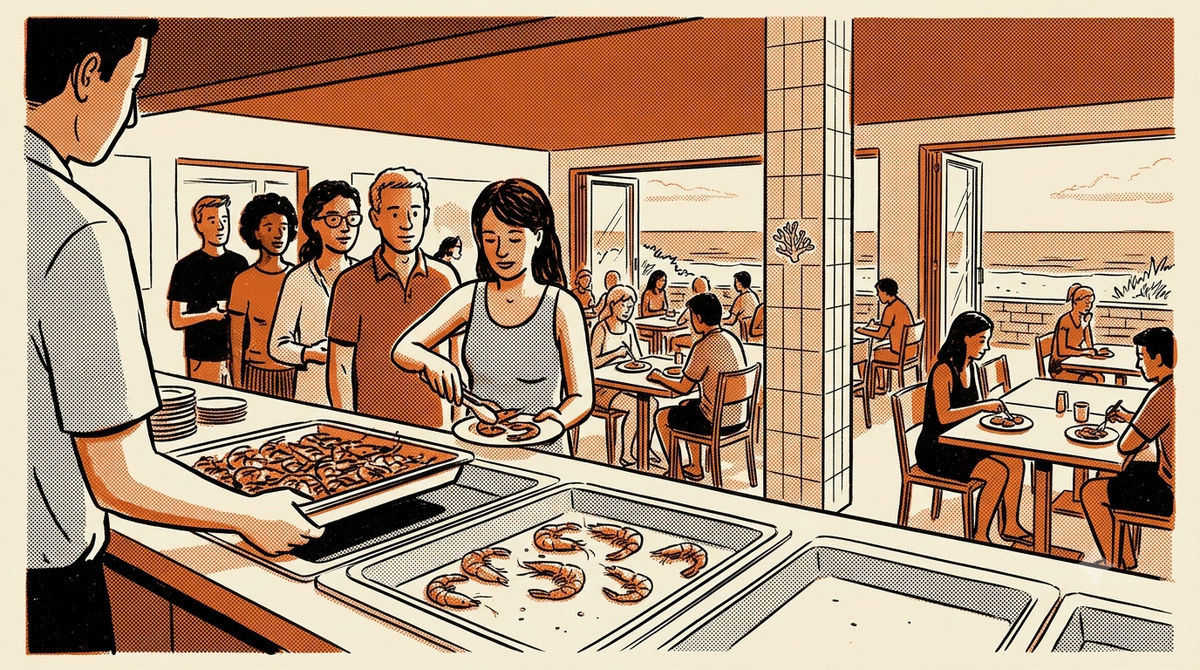
You're at the breakfast buffet of a beach resort in Goa. It is 8:40 am and the bacon tray has just gone empty. A fresh one is two minutes away, but the queue doesn't know that. When it lands, the man in front of you takes eleven slices. You feel the same pull: take extra, take now, the tray might not come back. Your plate leaves the counter with double what you'll eat, plus two pastries for the table that nobody asked for. By 9:10, your table looks like a small exhibition of abandoned food.
What's actually happening
The empty tray triggers something old. The brain reads scarcity and the hand starts collecting. But a buffet is not a shortage economy; it is a refill cycle. The kitchen holds more trays than the counter can display. The gap you're seeing is timing, not supply.
Hoarding is also a different act from over-serving. Over-serving (the tower plate) is misjudging your appetite. Hoarding is taking to hold: sweeping the last of a tray, parking plates at the table for later, collecting food so others cannot reach it first. Over-serving is a private miscalculation at your own table. Hoarding happens at the counter, in front of the queue, and everyone behind you absorbs it. That is why it reads louder than any other buffet mistake.
What works better
Trust the cycle. If the tray you want is nearly empty, ask the counter staff when the refill comes. The answer is almost always a number of minutes, not a no.
Take a first share, never the last sweep. If six pieces remain and you want four, take two and come back.
Do not stock the table. Food parked for later goes cold, and cold parked food goes to the bin. One plate in play per person is the working rule.
Why it matters
The world wasted around 1.05 billion tonnes of food in 2022, and food service is one of the three main contributing sectors (Source: UNEP Food Waste Index 2024). In India, FSSAI's Save Food, Share Food initiative targets exactly this hospitality-sector waste (Source: FSSAI).
Abroad, the buffet contract is often explicit. Some buffet restaurants print a wastage charge on the table card: leave too much behind and it appears on the bill. In Singapore, large new commercial buildings, including hotels and malls, must segregate their food waste and report it under the Resource Sustainability Act (Source: NEA Singapore). What your table leaves is not invisible; somewhere, it is being weighed.
The rule itself is identical in Goa and in Singapore: take anything, finish what you take. Hoarding breaks it at the most public spot in the room, at the counter, with a queue for witnesses.
Try this next time
Run two checks at your next buffet. At the counter: if the tray is low, take half of what you planned and ask about the refill. At the table: no new plate lands until the last one is finished. The kitchen's trays will keep coming. Your only job is to make sure the queue behind you never waits on your fear of missing out.
Quick check
1. The live counter has six tandoori prawns left and the cook has stepped away. You want four. Five people are waiting behind you. What's the move?
Select an answer.
2. You're at a resort dinner buffet with family. Your cousin suggests loading a spare plate of kebabs for the table, for later, so nobody has to get up again. What's the right call?
Select an answer.