Kids at restaurants: the survival kit and the social contract
TL;DR
- Order your child's food with the drinks, not after the adults finish debating the menu.
- Pack a quiet bag: crayons, one small toy, a sticker book, one snack for the kitchen gap.
- First wobble: one adult, one child, two minutes outside. It resets almost everything.
- Screens are the backup, not the opener. Volume zero or headphones, always.
Contents
The moment
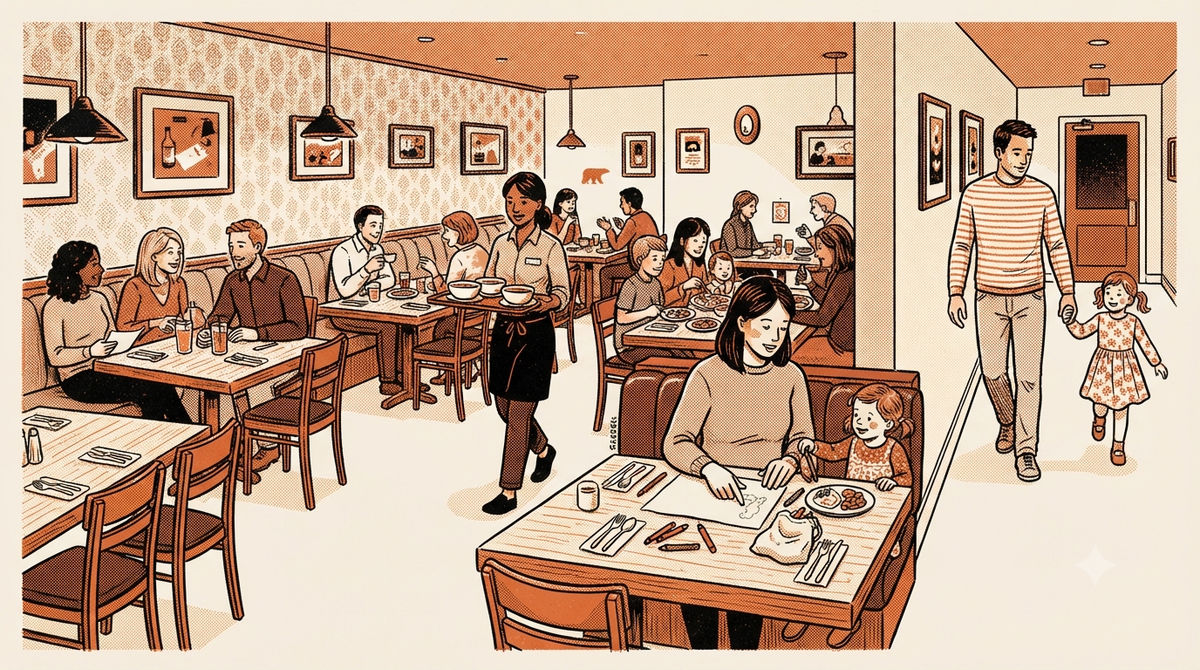
Saturday, 8:30 pm, a family restaurant in Pune. You're out with your four-year-old. The starters took twenty minutes, the crayons died at minute twelve, and the spoon has become a drum kit. Now your child has discovered that the aisle between tables is a runway. A server carrying a tray of hot soup does a quiet side-step. Two tables away, a couple exchanges the look.
What's actually happening
Three clocks are running at different speeds: the kitchen's clock, your dinner clock, and a four-year-old's patience clock, which is the shortest in the building. The child is not misbehaving. A restaurant asks small children to sit still, stay quiet, and wait, the three things small children are built not to do.
The room's real complaint is rarely "there is a child here." Children belong in public; restaurants are where they learn restaurants. The complaint is "nobody is managing the blast radius." That distinction is the whole social contract. You bring the tools and manage the radius; the room extends its patience. Staff cannot do this part for you. No server can parent your child, and none will say so out loud.
What works better
Order the child's food with the drinks, first, not after the adults have debated the menu. The twenty-minute gap is where meltdowns are born.
Pack a quiet bag: paper and crayons, one small toy, a sticker book, one snack for the gap. Ration it item by item. A bag emptied at once buys five minutes; a bag rationed buys forty.
Use the two-minute reset. At the first wobble, one adult takes the child outside or to the entrance, counts autos, watches the traffic, comes back. It resets the child and the room.
Keep the aisle sacred. Trays of hot food travel at elbow height, which is exactly toddler height. If your child needs to move, move with them, away from the service lanes.
Screens are the backup, not the opener. If the wheels have truly come off, a cartoon can rescue the evening, at volume zero or with headphones. The room did not order the audio.
And if the meltdown is the real kind, ask to pack the mains. A calm exit beats a forty-minute siege.
Why it matters
WHO's guidance for under-5s recommends no more than an hour of sedentary screen time a day for 2-4-year-olds, with less being better (Source: WHO, 2019). The AAP's current media guidance points the same way. Young children learn best from real-world interaction, and mealtimes are its first suggestion for screen-free family time (Source: AAP). A restaurant table is the practice ground for both.
The mess has its own etiquette. A floor of flung rice is ten minutes of someone's shift. Stack what you can, and tip for the rest.
Try this next time
Before leaving home, pack the quiet bag. At the table, order the child's meal with the drinks. At the first wobble, take the two-minute walk. You will still not get a quiet three-course dinner. You will get a manageable one, which at four years old is the actual win.
Quick check
1. The mains are ten minutes away and your three-year-old has started the pre-meltdown wobble: squirming, whining, sliding under the table. What's the best first move?
Select an answer.
2. You've used the reset walk twice and the food still hasn't arrived. You decide it's cartoon time. What's the civic way to deploy the screen?
Select an answer.