Hotel check-in: the front-desk dance
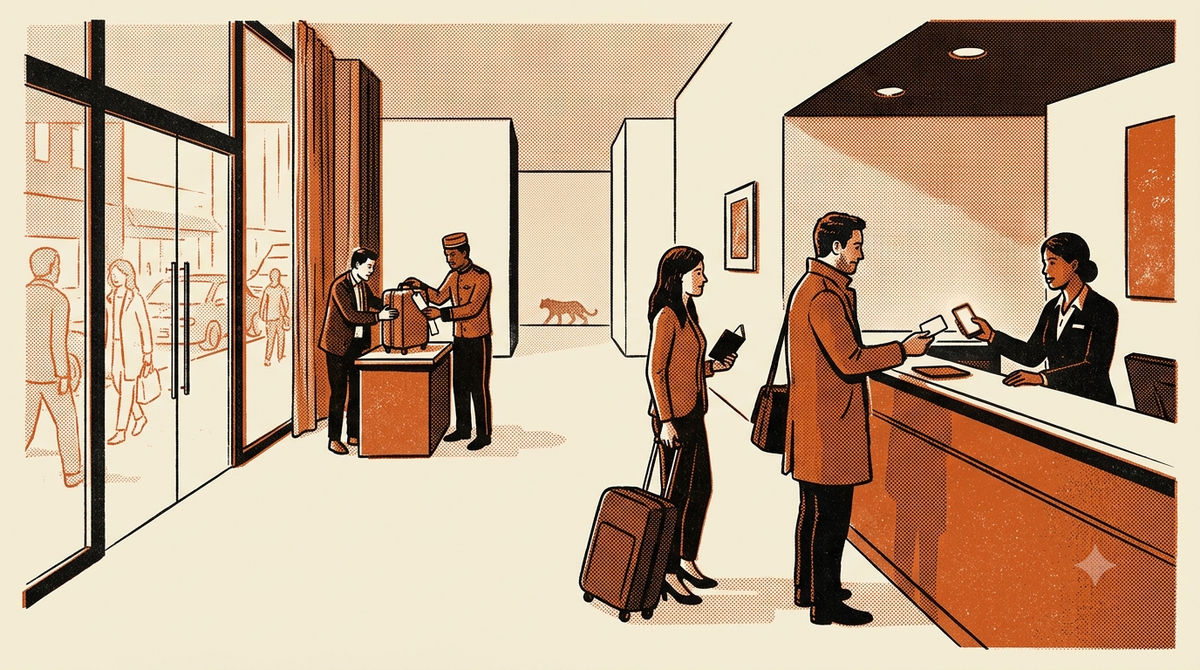
TL;DR
- Load your booking and take out your photo ID before you reach the counter. Abroad, that means your passport.
- The ID request is law, not nosiness. Hotels must record who stays, and report foreign guests to the FRRO within 24 hours.
- Check-in is usually 2pm because the last guest left at noon and the room needs cleaning. Early check-in is a favour, not a right.
- If your room isn't ready, leave your bags with the bell desk and go. Keep the desk for checking in, not for complaints.
Contents
The moment
You reach the hotel at eleven in the morning, off an overnight train, running on four hours of sleep. There is a small queue at the front desk. The guest ahead of you is arguing, loudly, about why the room they were given is not an upgrade. Your turn comes. Now you are hunting for the booking email you never loaded, and your ID is somewhere at the bottom of your bag. Two more travellers wait behind you.
What's actually happening
Check-in is not an obstacle course. It is three quick verifications: who you are, what you booked, and how you will pay. The desk needs a photo ID, your reservation, and a card. Two things slow the line: guests who arrive unprepared, and guests who treat the desk as the complaints counter.
The ID request is the part people bristle at. It is not the clerk being nosy. Hotels are required by law to record who stays with them. For a foreign guest, the hotel must also report the stay to the government within a day. Handing over your ID is routine, not surrender.
What works better
Do the homework before the counter. Load your booking confirmation and take out your photo ID while you are still in the queue. Abroad, that ID is your passport. The dance is smooth when the paperwork is already in your hand.
Treat the registration as routine. Your ID goes into a register, and for a foreign guest, into a government report filed within twenty-four hours. Hand it over and let the clerk work.
Keep the desk for checking in. If you have a complaint or a big upgrade request, let the check-in finish first, or step aside so the queue keeps moving. The person behind you booked a room, not a front-row seat to your negotiation.
Arrive early with a plan. Standard check-in is usually two in the afternoon, because the last guest left at noon and the room has to be cleaned. If yours is not ready, leave your bags with the bell desk and go. Asking is fine; demanding a clean room that does not yet exist only stresses the one person who cannot make it appear.
Why it matters
The registration rule is real law, not red tape. A hotel that hosts a foreign national must report the stay to the FRRO within twenty-four hours of arrival. That comes from the Registration of Foreigners Rules, 1992, made under the Foreigners Act, 1946 (Source: Registration of Foreigners Rules, 1992; Foreigners Act, 1946). A missing or borrowed ID does not make you look clever; it stalls the desk and can put the hotel in breach.
The early-arrival math is simpler. A room turns over from a noon checkout, gets cleaned, and is ready by early afternoon. Turning up at eleven does not conjure a clean room three hours early. It only moves your impatience onto the clerk, who would give you the room if one existed.
Try this next time
Before you reach the counter, load your booking and take out your ID, your passport if you are abroad. Assume a two o'clock check-in; if you are early, store your bags and go explore. Keep the desk for checking in, and save any complaint for after the key is in your hand.
Quick check
1. You check in and the desk asks for your photo ID. You are an Indian citizen travelling within India, and the request feels a bit much. What is the accurate way to see it?
Select an answer.
2. Your overnight journey gets you to the hotel at 11am. Check-in is at 2pm and your room is not ready. What move respects the desk and your own morning?
Select an answer.