Supermarket counters and the express-lane question
TL;DR
- The express counter is a deal: small baskets, quick exit. A full trolley in that lane quietly breaks it.
- Read the counter sign before you join. More than ten items, take the regular till.
- A longer line of big trolleys often clears faster than a short line of many small baskets.
- Keep your payment ready, and never park your trolley to go fetch one more thing.
Contents
The moment
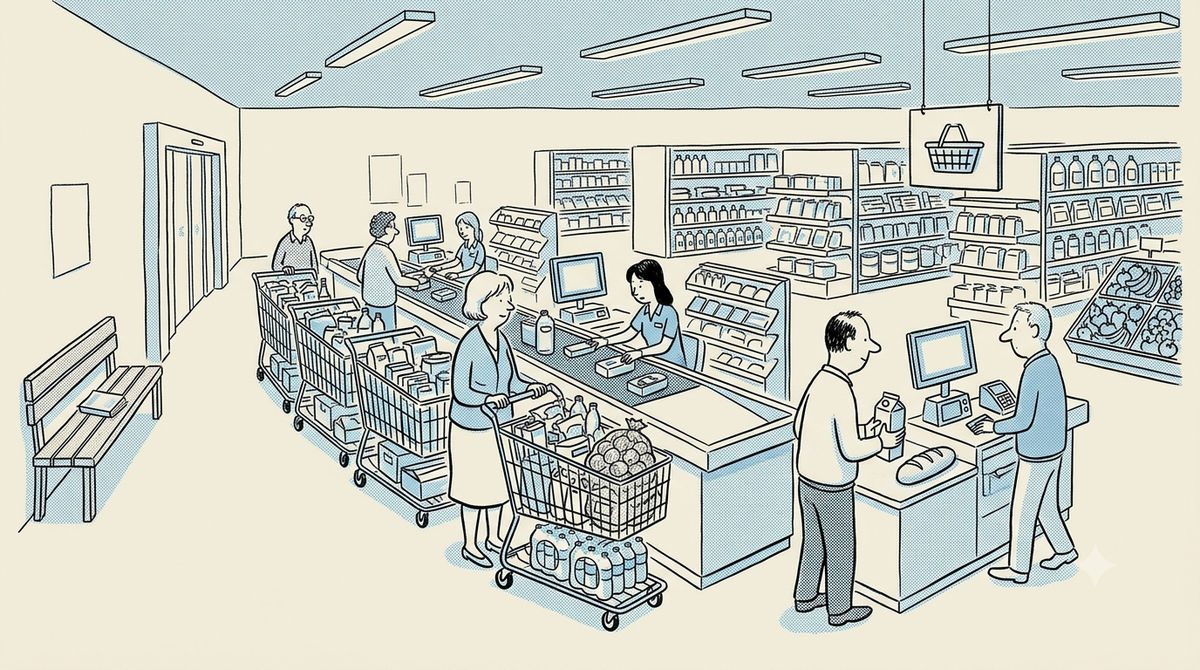
It's a Sunday evening at a big supermarket in your city. Two billing counters are open. One is marked "Express, 10 items or less." Your trolley holds about forty items: a week of groceries, two crates of water, a bag of onions. The express line is shorter, so you steer into it. Behind you, a man holding a single carton of milk and a packet of bread does the math, sighs, and joins the longer regular line.
What's actually happening
The express counter is a deal the shop makes with its customers. Small baskets move fast, so the shop opens a lane that promises a quick exit for people buying three or four things. The promise only holds if everyone keeps it.
Your forty-item trolley is not a small basket. Taking it to the express counter is not against any law. It quietly breaks the deal. The man with the milk and bread, the exact customer the lane was built for, now waits longer than you do.
This is rarely deliberate. Most of us scan for the shortest line and join it. The "10 items" sign reads as a suggestion, partly because nobody enforces it, partly because shorter-line-wins is a deep habit.
The structural bit is real: many Indian supermarkets do not staff or label express counters clearly, and the billing software is identical at every till. So the line blurs. But the blur does not change who pays for your shortcut.
What works better
Read the counter sign before you join the line. If it says express or "10 items or less," it is not for a full trolley. Take the regular counter, even if its line looks longer.
That longer line is often faster for a big trolley anyway. The slow part of billing is the per-customer steps: greeting, scanning, bagging, payment, receipt. A line of three full trolleys can clear quicker than a line of eight small baskets, because eight customers means eight rounds of those steps.
If the supermarket uses a single snake-style queue feeding several tills, just join the back. That one-line design is not an accident. It is about the fairest queue there is, and you never have to gamble on which counter moves faster.
Keep your payment ready while you wait. Card out, UPI app open, or cash counted. Do not park your trolley at the counter and wander off for one forgotten item. The whole line behind you freezes while you go.
Why it matters
A billing line is a small shared system, and the express counter is the clearest test of whether you will take a benefit that costs someone else. Queue research has a name for what makes people angriest in a line: not the wait itself, but the unfairness of someone served out of turn (Source: Larson 1987). The express lane, used with a full trolley, is exactly that unfairness, made polite by a trolley.
The fix costs you nothing except the shorter-looking line. The man with the milk gets the lane built for him. The shop's deal holds for the next person too.
Try this next time
On your next supermarket run, count your items before you pick a counter. More than ten, take the regular till. Three or four, use the express lane and move briskly: items on the belt, payment ready, bags packed, gone. Be the rare shopper who reads the sign and honours it.
Quick check
1. You have a trolley with about thirty items. Two counters are open: a regular one with four people in line, and an 'Express, 10 items or less' counter with just one person. What's the right move?
Select an answer.
2. A single 'snake' queue feeds four billing counters, and next to it are four separate lines, one per counter. Which is the better system for everyone waiting, and why?
Select an answer.