Reservations, walk-ins, and the host stand
TL;DR
- The host stand is a live queue, not a counter. The host is running two queues at once: reservations and walk-ins.
- That empty table is almost never free. It is reserved, being reset, or held back so the kitchen does not get buried.
- Give your real name and real party size, take the quoted wait, leave a number, and step away. Hovering does not move you up.
- If you booked and your plans change, cancel. A ten-second call hands a table to the next person.
Contents
The moment
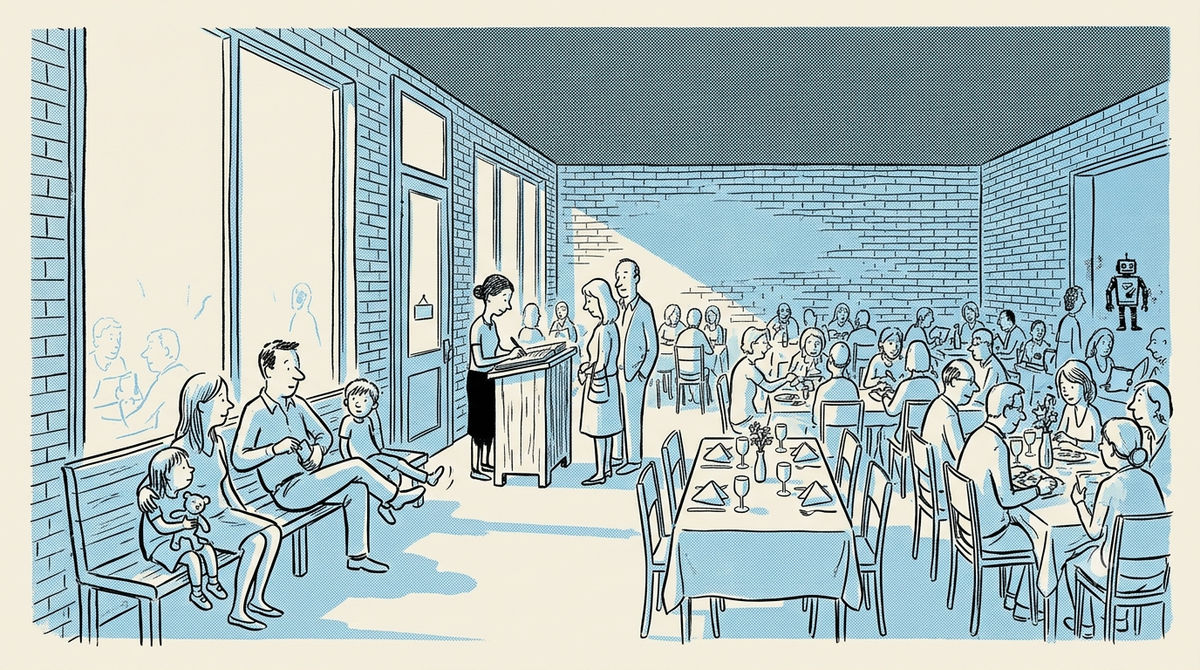
It's 8:40 pm on a Saturday at a popular restaurant. A small crowd has gathered around the host stand. A family of five walks in, no booking, and asks for a table right now. The host says the wait is about 40 minutes. The family points at a table near the window that is clearly empty. "But that one is free." It is not free. It is reserved for 9 pm. Two steps away, a couple who booked for 8:30 is still waiting. The table they were promised is being held by a party that booked, never showed, and never called.
What's actually happening
The host stand is not a counter. It is a live queue, and the host is running it. Two queues feed one floor: people with reservations, who were promised a specific time, and walk-ins, who join a waitlist in order of arrival.
The "empty" table you can see is almost never available. It is reserved for a later slot, being reset and cleaned, or held back on purpose. A kitchen cannot fire six new tables at once. If it does, every order on the floor arrives late.
Crowding the host, asking again every five minutes, and sending one person ahead to "hold a table" all do the same thing. They slow down the one person whose job is to seat everyone, including you.
What works better
If you know your plans, book ahead. A reservation is a small contract: you get a held time, the restaurant gets a predictable floor.
If you are walking in, give your real name and real party size, take the quoted wait, and leave a phone number that works. Then step away from the stand. Wait outside, at the bar, or on the bench. The host will call you.
Give your honest party size. If you say four and arrive as seven, the table no longer fits, and the people behind you pay for it.
Most places will not seat a party until everyone has arrived. That is not rudeness. A half-seated table holds a table the next diner could have used.
And honor a booking you make. If your plans change, cancel it. A two-second call frees the table for someone else.
Why it matters
No-shows are the quiet tax on eating out. A booked table that seats nobody on a Saturday is pure loss for the restaurant and a closed door for the next diner. This is why more Indian restaurants now ask for a card or a small deposit to hold a table. It is usually credited to your bill, or refunded if you cancel in time. The deposit is not greed. It is a response to a habit.
The host stand works the way every queue works. Respect the order, state your size honestly, and free what you are not going to use.
Try this next time
The next time you book and your plans fall through, make the cancellation call. It takes ten seconds and it hands a Saturday-night table to someone who wanted it. If you are walking in, give your name, accept the wait, and step away from the stand. Be the rare guest the host remembers for making the floor easier to run.
Quick check
1. You walk into a busy restaurant with no booking. The host quotes a 30-minute wait, but you can see two empty tables across the room. What is the right read?
Select an answer.
2. You booked a table for six on Saturday, but your plans have fallen through and nobody is going. It is now Saturday afternoon. What do you do?
Select an answer.