Your bag is not a passenger
TL;DR
- On a full bus or metro, a bag on the seat beside you keeps a real person standing.
- Default your bag to your lap, your feet, or the overhead rack the moment seats get scarce.
- One bag per occupied seat is the only no-thought rule you need.
- Move the bag before anyone has to ask. Make it a non-event.
Contents
The moment
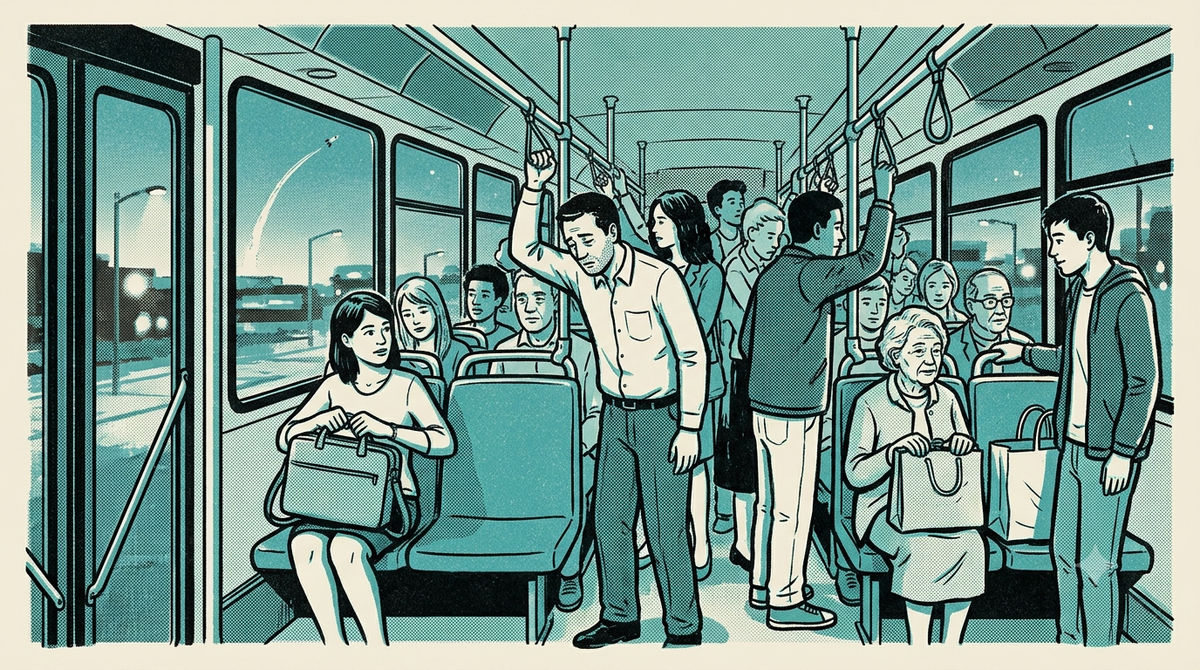
It's 6:15 pm. You got a seat on the bus, a small win after a long day. Your laptop bag sits on the empty seat beside you, where it's been since you boarded. At the next stop, eight people get on. They stand, packed into the aisle, hands on the overhead rail. A man glances at your bag, then at you, says nothing, and reaches for the rail. The seat under your bag stays "taken" for the next six stops.
What's actually happening
Your bag did not pay a fare. You're not a villain here; the bag is just an extension of your space that you stopped noticing the moment you sat down. That's the whole problem. It's invisible to you and very visible to the eight people standing.
On a near-empty bus, a bag on the next seat costs nobody anything. On a full one, it's simple arithmetic: one bag on a seat is one person standing who didn't have to. A 40-seat bus running ten bags-on-seats at peak is ten fewer people seated, for no reason anyone chose.
The reason nobody says anything is the same reason the bag stays put. Asking a stranger to move their bag feels like an accusation. So people stand instead, and quietly note who made them.
What works better
The rule is one line: one seat, one passenger. Your bag is not the passenger.
The moment seats get scarce, the bag comes off the seat. Onto your lap, between your feet, or up on the overhead rack if the bus or train has one. A backpack you're wearing comes off your shoulders too, but that's a different lesson; here, the seat is the point.
You don't wait to be asked. You read the aisle. The second someone is standing, the seat beside you is theirs, not your bag's.
Why it matters
A bus or train has a fixed number of seats, and its whole job is to move as many people as comfortably as it can. Transit planners measure this as effective capacity, and seat occupancy is part of it. A bag on a seat quietly lowers the number of people the vehicle actually serves.
Delhi Metro's passenger guidance asks riders to keep belongings clear of seats and aisles and not to take up more room than they need. It's not a fineable offence on most systems. It's the kind of rule that holds only because most people honour it without being told.
Try this next time
Build one default: when you sit down, the bag goes on your lap or at your feet, not on the seat. Do it on the empty bus too, so it's automatic by the time the bus fills.
If you've already got the seat-hogging habit, make the fix invisible. Move the bag the instant the bus starts filling, before a single person has to stand and wonder whether to ask. The kindest version of this courtesy is the one nobody had to request.
Quick check
1. You're on a half-empty metro with your gym bag on the seat next to you. Three stops later the coach fills up and people start standing. Nobody has asked you to move the bag. What's the right move?
Select an answer.
2. A bus has overhead luggage racks. You board with a large bag and find a seat. The bus isn't full yet but it's a known busy route. Where does the bag go?
Select an answer.