Token vs smart card vs UPI: the 30-second decision
TL;DR
- The metro gives you three ways to pay, built for three different riders.
- Ride often? Get a smart card, keep it topped up, tap and go. It is also cheaper per trip than a token.
- Ride occasionally? Buy a QR ticket on the metro's official app or via UPI before you reach the gate.
- Decide your payment at home, not at the counter with a queue behind you.
Contents
The moment
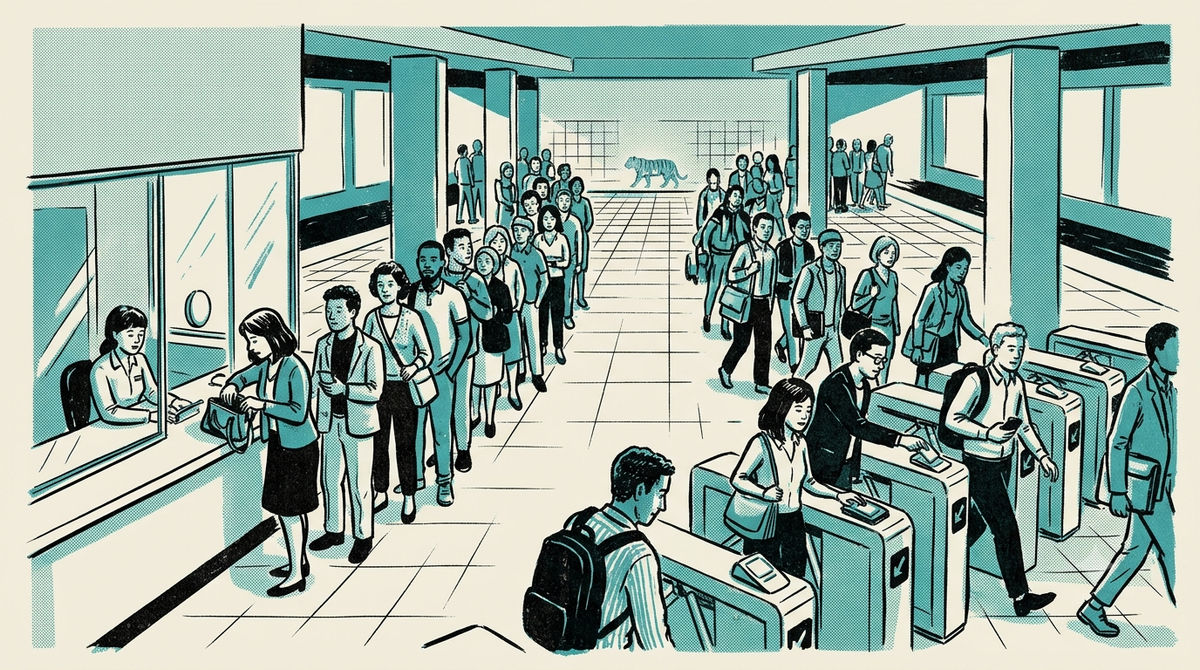
You reach the metro at 9:10 am, already a little late. Forty people are clustered at the token counter. You join the queue. When you finally reach the window, you realise you have only a 500 rupee note. The man behind the glass wants change. You fumble, tap a destination on the machine, and collect the token. Ninety seconds gone, and the fifteen people behind you each lose those ninety seconds too. Meanwhile three colleagues walked straight through the smart-card gate without breaking stride.
What's actually happening
The metro gives you three ways to pay, and they are built for three different riders.
The single-journey token (or paper QR) is priced and designed for the occasional, one-off trip. It is the slowest option, because you buy it fresh at a counter or machine every single time.
The stored-value smart card sits in your wallet, holds a balance, and opens the gate with a tap. On the Delhi Metro, as on most Indian metros, a smart-card trip is also priced below a token trip.
The newest option is a QR ticket on your phone, bought through the metro's official app or via UPI before you reach the gate. Most large Indian metros now offer this.
The friction in the scene is not really the queue. It is that a daily rider is using a one-off rider's payment method, and re-joining that counter queue every morning.
What works better
Match the payment to how often you ride. The 30-second decision is which rider you are, and you make it once, at home, not at the window with a line behind you.
If you ride this metro more than a couple of times a month, get a smart card or an NCMC-enabled card. Keep it topped up (set auto-recharge or recharge online) and tap through. You skip the counter entirely.
If you ride occasionally but carry a smartphone, buy the QR ticket on the official app or via UPI while you walk in, not at the gate.
Keep the token for what it is for: a genuine one-off, when you have no card and no app.
Whatever you pick, top up or buy before you reach the gate. The gate is for tapping, not for deciding.
Why it matters
A metro counter at peak is a single-file bottleneck. Every cash fumble and every "which station again?" at the window is multiplied by everyone behind you. Twelve people each held up by ninety seconds is eighteen minutes of collective waiting, created at one window.
The smart card and the QR ticket move the slow part (deciding, paying, getting change) off the counter and onto your own time. That is the whole trick. The metro already built the fast lane. Using it is the civic upgrade.
Try this next time
If you have queued for a token more than twice this month, treat that as your signal. On your next trip, spend five minutes getting a smart card or setting up the metro's official QR ticket. From then on you walk past the counter queue instead of into it.
Be the rider who decided at home. The line behind you is shorter because you are not standing in it.
Quick check
1. You take the same metro to work and back five days a week, and you still buy a token each way. Mornings, the counter queue regularly makes you late. What's the change with the biggest payoff?
Select an answer.
2. You're an occasional rider with a smartphone, heading to the metro for a one-off trip across town. The token counter has a long queue. What's the smoothest move?
Select an answer.