Stand right, walk left: the rule and its exceptions
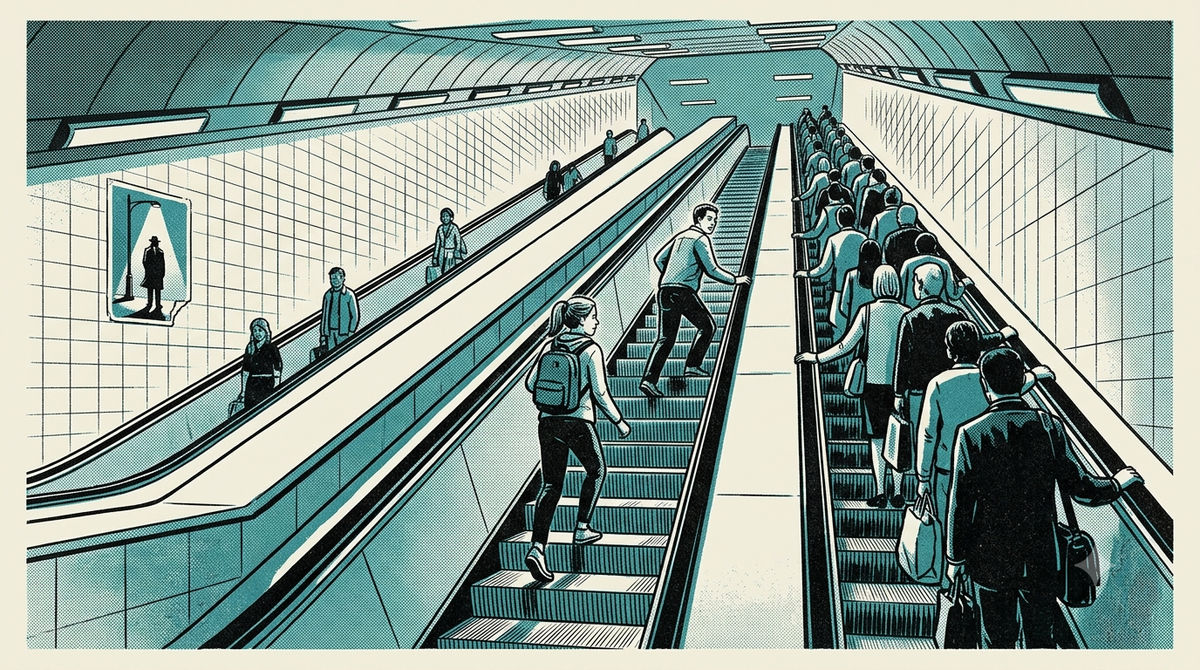
TL;DR
- Stand on the right, walk on the left. Standers right, walkers left.
- Don't block the walking lane or stand two-abreast on a moving escalator.
- Stand right when you're with kids, carrying heavy bags, or unsteady on your feet.
- One polite 'single-file please' resolves most blockages.
Contents
The rule
On a moving escalator: stand on the right side, walk on the left.
Standing still? Stand right. Want to walk faster? Walk left. Don't block the left by standing on it, and don't barge up the right past standers.
This is the convention across most of the world (UK, India, Singapore, Hong Kong, much of the EU). Parts of continental Europe and Japan vary by city. Indian metros follow the same stand-right-walk-left convention, signposted on escalators and in DMRC's training material.
Why this rule exists
An escalator is a hybrid: a moving stairway (you stand) and a stair (you walk). Mixing the two by convention, standers on one side and walkers on the other, clears passengers efficiently and adds a bypass lane for people in a hurry.
The "stand right, walk left" rule is the coordination point that makes this work. Without it, the escalator becomes a stairway with random blockers, and walkers have to weave through standers.
What happens if you don't follow it
Practically: you become the person blocking the walking lane. The commuter running for a connection, the person late for an interview, the kid catching a bus, all have to stop behind you or push past. Across 100 walkers, throughput drops measurably.
Socially: the convention only works if people follow it. When too many stand on the left, the rule erodes. The next person assumes "I guess we're not doing the rule anymore" and stands wherever. The bypass function disappears.
One caveat: Transport for London's 2015-2016 Holborn pilot found that at peak, having ALL passengers stand (no walking lane) raised throughput by 30%. That holds for very tall escalators at very crowded stations. For most escalators, the standard convention wins.
Quick reference
Stand right if you:
- Are standing still (no rush)
- Are with kids who shouldn't walk on escalators
- Are carrying heavy bags
- Are unsteady on your feet
- Are with someone who needs you next to them
- Are on an escalator where walking is explicitly prohibited (some short escalators in malls, marked accordingly)
Walk left if you:
- Are in a hurry
- Are physically capable of walking up moving steps without losing balance
- Are not pulling heavy bags
Special cases:
- Down escalators: Same rule. Stand right, walk left. Walking down moving stairs requires more care; many people prefer to stand.
- Spiral escalators (some malls): Stand on the inside (slower) curve. Walking on outside is dangerous due to step-width variation. These are rare.
- Long escalators (deep metro stations like Delhi's Rajiv Chowk or Bengaluru's Cubbon Park): stand-right matters most here. Don't stand left.
Don't:
- Stand two-abreast and block both lanes
- Have a conversation that occupies both lanes
- Set down luggage that takes both lanes
- Move backwards or sideways on a moving escalator
- Sit on escalator steps (yes, this happens; no, it shouldn't)
The civic upgrade is small and instant: stand right from the moment you step on.
Quick check
1. You step onto an escalator with two heavy shopping bags, one in each hand. You'd prefer to stand still. Where do you stand?
Select an answer.
2. You're on the Delhi Metro escalator at Rajiv Chowk during peak hour. The left lane is fully occupied by walkers, the right lane by standers, but a single person ahead of you on the right is standing two-abreast with their friend on the left. The walking lane is now blocked. What do you do?
Select an answer.