E-scooters and shared bikes: parking, lanes, helmets
TL;DR
- A shared ride has two civic moments: how you ride it, and where you leave it.
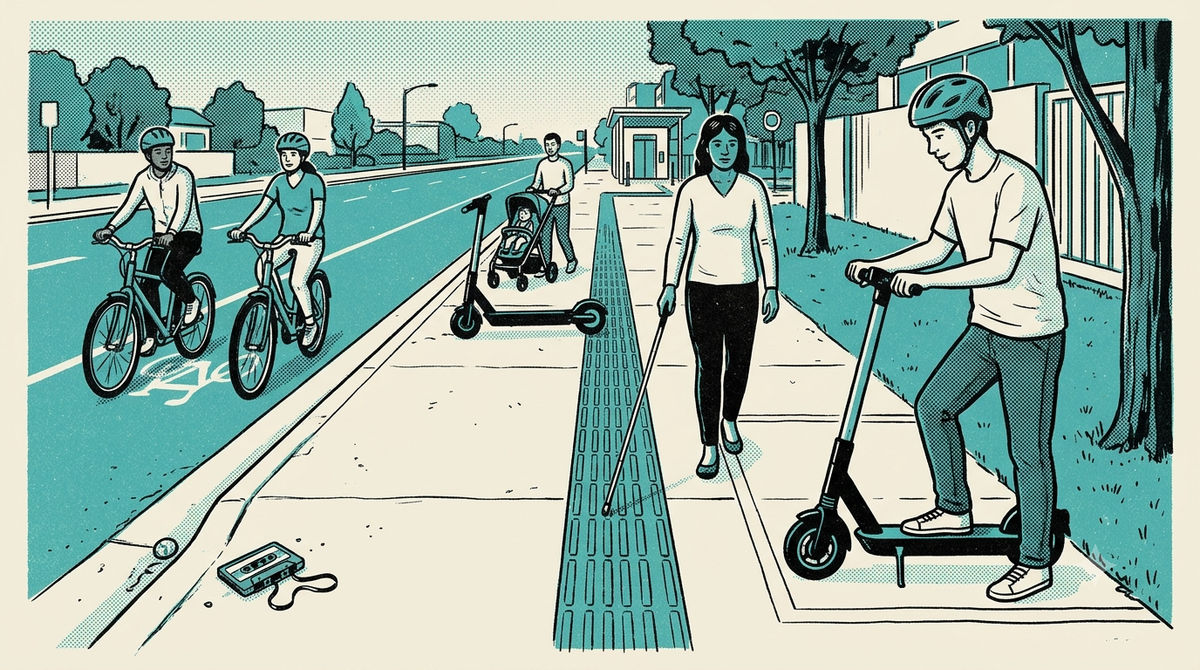
- Park parallel to the footpath edge, clear of ramps, tactile paving, and entrances; pass the wheelchair test.
- Ride in the cycle lane or road edge, with the traffic, and slow right down near people on foot.
- Wear the helmet; on faster electric two-wheelers it's the law, and at any speed it's your head.
Contents
The moment
You hop off the shared e-scooter right outside the metro gate. You are seven minutes late, so you just leave it resting on its stand in the middle of the footpath and walk off. It took two seconds. For the next hour, until someone moves it or rides it away, that scooter is a small wall on a path other people need.
What's actually happening
The ride felt like it ended when you stepped off. It did not. A shared vehicle has two civic moments, not one: how you ride it, and where you leave it. The second one outlives you.
The footpath is the only safe strip for a lot of people. Someone using a white cane. A parent pushing a pram. An older person who cannot step into traffic to go around. A scooter dropped across that strip does not inconvenience them mildly. It blocks the one route they have. You will never see this happen, because you are already inside the station.
There is a rider's version too. Weaving down a crowded footpath, riding the wrong way up a one-way, skipping the helmet because it is a short hop. Each one borrows safety from someone else and calls it convenience.
What works better
End the ride properly. Park at the edge of the footpath, parallel to it, never across it. Use the marked parking zones if the app shows them. Keep the scooter clear of ramps, tactile paving, bus stops, and entrances. The test is simple: could a person in a wheelchair pass without stopping?
Ride where you are meant to. Use the cycle lane or the road edge, not the footpath. Go with the traffic, not against it. Slow right down near people on foot. You are the fast, heavy thing in that meeting.
Wear the helmet. On a faster electric two-wheeler the law actually requires it. On a slow shared scooter it may not, but your skull does not know the difference between a legal speed and an illegal one when it meets the road.
Why it matters
Footpaths are not a grey zone. The Rights of Persons with Disabilities Act, 2016 treats access to public spaces, including barrier-free footpaths, as a right and not a nicety. A scooter dumped across the path turns one person's two-second saving into a barrier for someone who has fewer options than you do.
Helmets are not a grey zone either. Where a shared vehicle is fast enough to count as a motor vehicle, Section 129 of the Motor Vehicles Act, 1988 makes a helmet mandatory. Many shared scooters are low-speed and sit outside that rule, but the head injury they can cause is the same. The law is the floor here, not the ceiling.
Try this next time
When you end your next shared ride, take five extra seconds. Stand the vehicle at the edge of the path, parallel to the kerb, out of everyone's way, and look back once before you leave. Ask the wheelchair question. If the answer is "they would have to step onto the road," move it. Those five seconds are the whole civic act.
Quick check
1. You finish a shared e-scooter ride right outside a busy metro gate and you're running late. Where do you leave it?
Select an answer.
2. You're about to take a quick shared ride on a faster electric two-wheeler, and a helmet is sitting in the box. You're only going two minutes down the road. What's the call?
Select an answer.