Where the wrapper goes when there's no bin
TL;DR
- When there's no bin nearby, carry the wrapper in your bag, pocket, or hand until you find one. The discomfort is small.
- Carry a small ziploc for 'waste in transit'. Keeps wrappers from staining your bag. Costs nothing.
- Indian urban waste is roughly 160,000 tonnes per day. About 25-30% never reaches a formal collection system. Your wrapper is a small contribution to that share.
- The Solid Waste Management Rules, 2016, Section 4, defines littering as a violation. Municipal fines range ₹100-₹500.
Contents
The moment
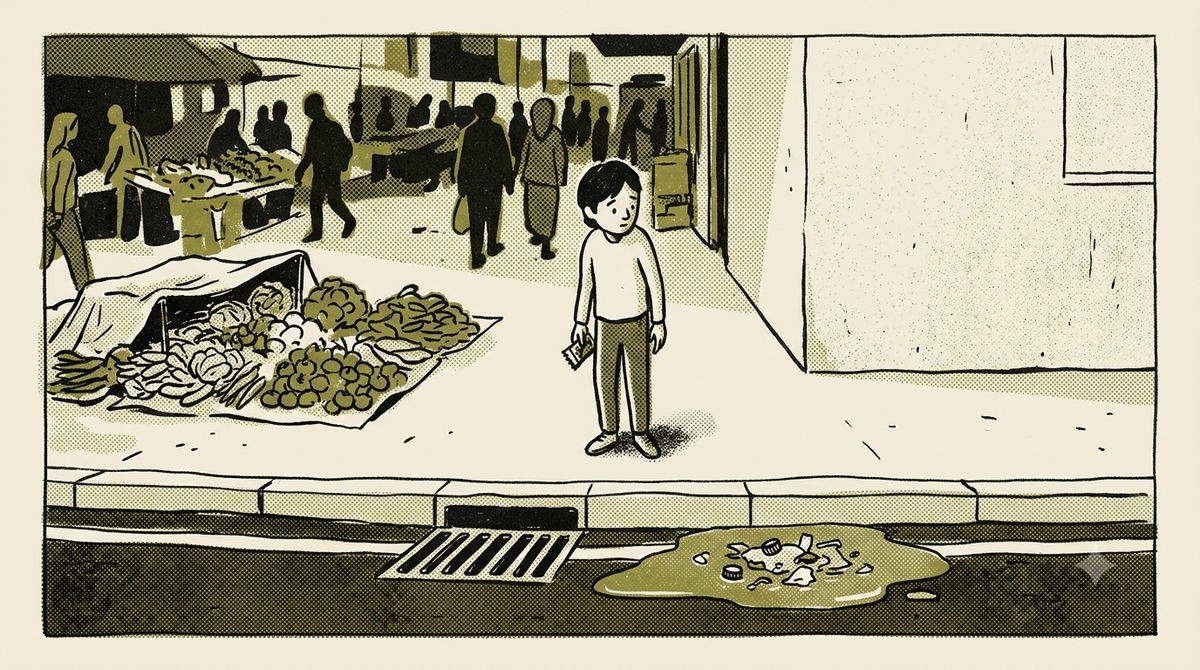
You're walking down Brigade Road eating a bar of chocolate. You finish it. The wrapper is still in your hand. You scan for a bin. There isn't one, and hasn't been for the last three blocks. Your bag has laptop and lunch; you don't want a sticky wrapper in it. The drain at the kerb is right there, the bare wall behind you, a hawker's pile to the left. The choice is becoming uncomfortable.
What's actually happening
This is one of the most common civic friction moments in urban India. Every Indian adult has been here. You did the right thing (carried the wrapper). The city failed you (no bin). The next 8 seconds are the small daily test of who you want to be.
The structural failure is real. India has roughly 1 public bin per several thousand urban residents in most cities, far below the international working ratio. The SWM Rules, 2016 mandate adequate bins; most municipalities don't provide them. Swachh Bharat has improved this in some cities (Indore, Mysore, Surat) and moved the needle little elsewhere.
Structural failure does not answer "where does the wrapper go." Three options remain. Two externalize your waste onto someone else. One doesn't.
What works better
Carry it. The wrapper goes in your bag, pocket, or hand until you find a bin. Yes, it's mildly inconvenient. Yes, the bag will smell faintly of chocolate. The discomfort is small.
A few small habits make this easier:
Carry a small ziploc or paper bag for "waste in transit". Keeps the wrapper from staining the bag interior. Costs nothing.
Plan your snack stops near places with bins. Coffee shops, metro stations, malls, larger restaurants. Eat the chocolate before leaving the bin-zone.
Combine errands. If you're carrying a wrapper for 20 minutes, the next stop becomes "find a bin" by default. Metro stations, petrol pumps, and chain coffee shops have bins, even if you don't buy anything.
For larger waste (the takeaway box, the styrofoam plate from a wedding), the same rule applies but the carrying becomes deliberate. Pack it back into the bag it came in. Drop it at home or at a municipal bin (not a small shop's overflow).
Why it matters
Indian urban waste generation is approximately 160,000 tonnes per day. Of that, an estimated 25-30% never reaches a formal collection system. It ends up in drains, on streets, in lakes, on the periphery of every Indian city.
The wrapper you didn't drop is the smallest possible contribution to that 30%. Carrying it does not fix the system. It does not make it worse, either. Across millions of small daily choices, this matters.
The Solid Waste Management Rules, 2016, Section 4, explicitly defines littering by individuals as a violation. Most cities have municipal littering fines of ₹100-₹500 per offence. Enforcement is rare; the rule still exists.
Try this next time
For one week, carry every piece of waste you generate outside your home until you reach a bin. Not someone else's bin (the shop's, the auto's, the gutter). A municipal bin or your home bin. Notice three things:
How often you generate droppable waste. How often you look for a bin. How often you find one within 5 minutes.
The exercise tells you about your snack habits and your city's bin density. You can change the first; you can lobby for the second by filing a municipal request for more public bins on your routes. They sometimes act.
Quick check
1. You're at a wedding reception, the food is in disposable plates, and the only available bins are overflowing. People around you are dropping plates on the lawn. What's the right move?
Select an answer.