Parking lots are actually public spaces, treat them as such
TL;DR
- A parking lot is a shared public space with pedestrians and safety infrastructure, not your private patch.
- Park fully inside one marked bay. The lines exist for a reason: a car space is planned at 13.75 sq m for a purpose.
- Never park on the hatched strip or block a ramp. That strip is usually the fire-tender lane, kept clear by law.
- Drive the lot at the speed of the slowest walker, and if you ding a car, leave a note with your number.
Contents
The moment
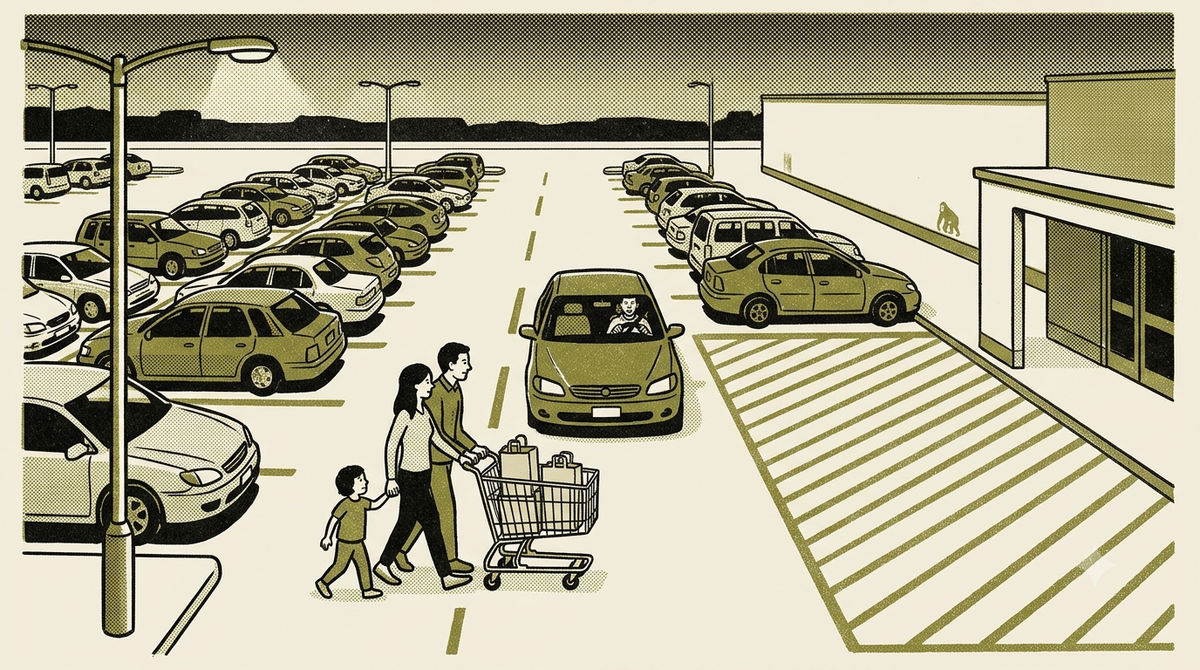
It is 7 pm at a market parking lot. You have circled twice for a space. One car is parked crooked across two bays. A family walks down the middle of the lane pushing a loaded trolley, a small kid trailing behind. A car reverses fast out of a bay without looking. Near the entrance, two scooters sit on a painted hatched strip. Someone idles in the lane ahead, blocking everyone, waiting for a space to open. You have not even parked yet, and the place already feels like a scramble.
What's actually happening
A parking lot feels private. It is just where cars go, so people treat it like a no-rules zone. But it is a shared public space, dozens of strangers, kids on foot, poor sightlines between tall vehicles, and actual safety infrastructure running through it.
The crooked two-bay park, the blocked fire lane, the fast blind reverse: each one moves a small cost onto the next person. The structural failure is real. Indian cities under-provide parking and design lots badly, dim lighting, no walking paths, faded markings. That failure explains the chaos. It does not dissolve your choice inside it.
What works better
Park fully inside one marked bay. The lines are not decoration. A car bay is planned at roughly 13.75 square metres for a reason (Model Building Bye-laws, 2016). Taking one and a half bays quietly costs the next driver theirs.
Never park on a hatched strip or across a ramp. That paint usually marks the fire-tender lane, which the law requires to stay clear (National Building Code, 2016, Part 4). A blocked lane is invisible until the day a fire truck cannot reach the building.
Treat people on foot as having right of way. Drive the lot at the speed of the slowest walker. Do not idle-block a lane hunting for a space, loop instead. Return your trolley. If you scrape a car, leave a note with your number.
Why it matters
A parking lot is one of the few places where cars and people mix at close range with blocked sight lines. The fast reverse and the walking-pace child meet here. Fire lanes are the difference between a contained incident and a trapped crowd. Urban parking also sits on some of the most expensive shared land in the city, land the public heavily subsidises for private cars (Centre for Science and Environment, 2019). How you use it is a civic act, not a private one.
Try this next time
Next time you park, run a three-second check before you walk away: fully inside the lines, not on any hatching, not blocking a ramp or a lane. Then, while driving through, pick the slowest walker in sight and match their pace until you are out. Two small habits, and the scramble has one less person in it.
Quick check
1. The lot is full. Near the entrance you spot a painted hatched strip, empty. You are only running in for ten minutes. Park there?
Select an answer.
2. You return to find a car parked so close along the line that it slightly blocks your driver door. It is annoying but you can just about get in. Best move?
Select an answer.