What happens to your trash after the truck
TL;DR
- Your trash is not gone when the truck takes it. It becomes a waste picker's problem, a landfill's problem, and eventually the city's problem.
- Mixing wet and dry waste destroys value. Dal-soaked paper and greasy plastic go to landfill; clean and dry, they get recycled.
- From 1 April 2026, the Solid Waste Management Rules, 2026 make four-way segregation mandatory: wet, dry, sanitary, and special-care waste.
- In practice it is two habits: keep wet separate from dry, and keep a small box for batteries, bulbs, and medicines.
Contents
The moment
The municipal truck arrives at 7:40 am. You hand over one bag: last night's dinner scraps, a broken slipper, three plastic wrappers, and a dead battery, all knotted together. The truck swallows it. You go back inside, tea getting cold. As far as you are concerned, the trash is now gone.
It is not gone. It has become someone else's problem, and the shape of that problem depends on what you did in the ten seconds before you knotted the bag.
What's actually happening
Your one bag joins the roughly 1,50,000 tonnes of municipal waste that Indian cities collect every day. A little over half gets processed. The rest travels to a dumpsite on the city's edge, the ones you smell before you see.
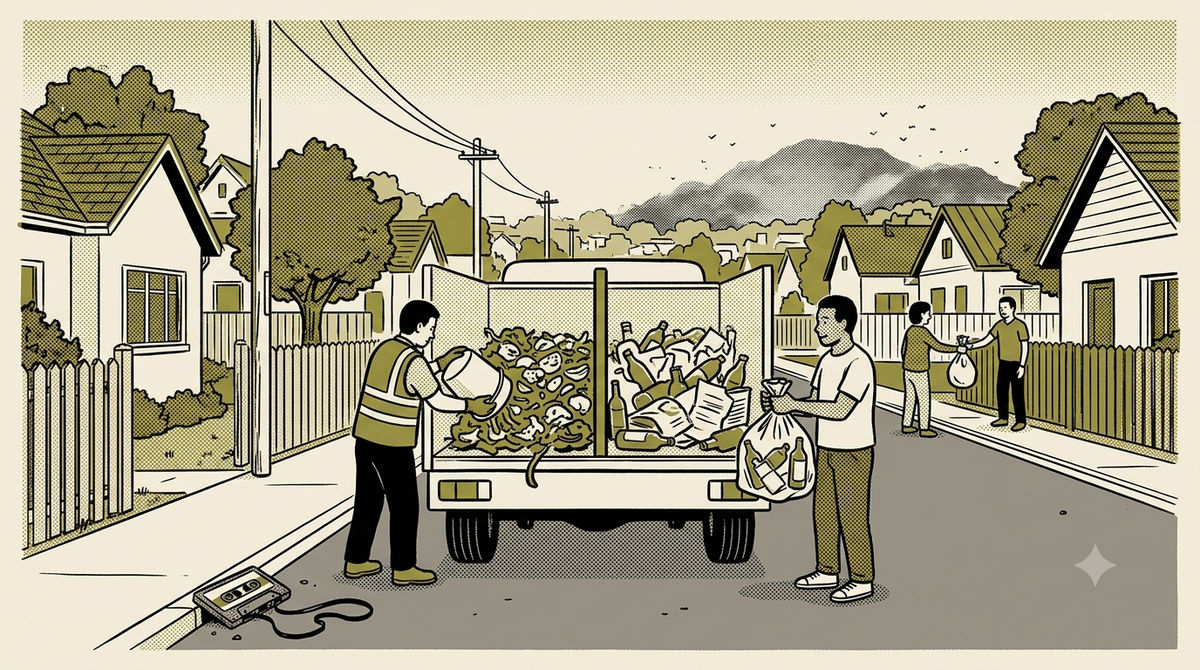
Here is the part most people never picture. When wet food waste and dry recyclables ride in the same bag, the paper turns to pulp, the cardboard rots, and the plastic gets greasy. A clean plastic bottle is worth money to a recycler. A bottle soaked in dal is worth nothing. By mixing, you convert a recyclable into landfill.
Somewhere downstream, a waste picker sorts your bag by hand. Much of India's recycling runs on an informal workforce estimated in the millions. They pull out what still has value. Mixed, wet waste makes that work slower, dirtier, and more dangerous. The dead battery and the broken glass are now their hazard, not yours.
What works better
Segregate at source. From 1 April 2026, the Solid Waste Management Rules, 2026 make four-way segregation mandatory across India. The four streams are wet (kitchen and food), dry (plastic, paper, metal, glass), sanitary (diapers and pads, securely wrapped), and special-care (batteries, bulbs, medicines, paint).
Four streams sounds like a lot. In practice it is two habits. Keep wet separate from dry, and you already recover most of the value. Then keep a small box for sanitary waste and one shelf corner for the battery-and-bulb pile that leaves the house maybe once a month.
Never hand mixed waste to the collector. Never burn it, never drop it in a drain. Both are now offences that carry environmental compensation under the polluter-pays principle.
Why it matters
A mixed bag pushes a small cost onto three people you will never meet. The waste picker who sorts it. The resident who lives beside the dumpsite. And the version of you in ten years, breathing the methane it gives off.
Segregation does not fix the dumpsite. It does keep your share out of it. A large part of Indian municipal waste still never reaches proper processing. Your bag is one unit of that number, in whichever direction you push it.
Try this next time
Tonight, use two containers instead of one. Wet in the vessel that goes to compost or the wet-waste truck; dry, clean, and loose in the other. Do it for one week.
You will notice your dry bin is mostly packaging you could have refused at the shop. That noticing is where the next civic habit starts.
Quick check
1. It is 7:40 am, the truck is here, and you are holding a clean plastic bottle and last night's rice in the same hand. What is the right move?
Select an answer.
2. From 1 April 2026, how many streams does the law require you to segregate household waste into?
Select an answer.