Wet waste vs dry waste: the 30-second guide
TL;DR
- Three streams, not two: wet waste that rots (green), dry waste that recycles (blue), and a small third pile for sanitary and hazardous items.
- The 30-second test: does it rot? Green. Does it not rot but could be recycled? Blue. Is it a pad, blade, battery, or medicine? Third stream, wrapped and marked.
- Keep dry waste dry. A rinsed container gets recycled; a food-smeared one goes to landfill.
- Even if your city still mixes the bins at collection, segregating protects the people who sort waste by hand, and earns you the standing to demand better.
Contents
The moment
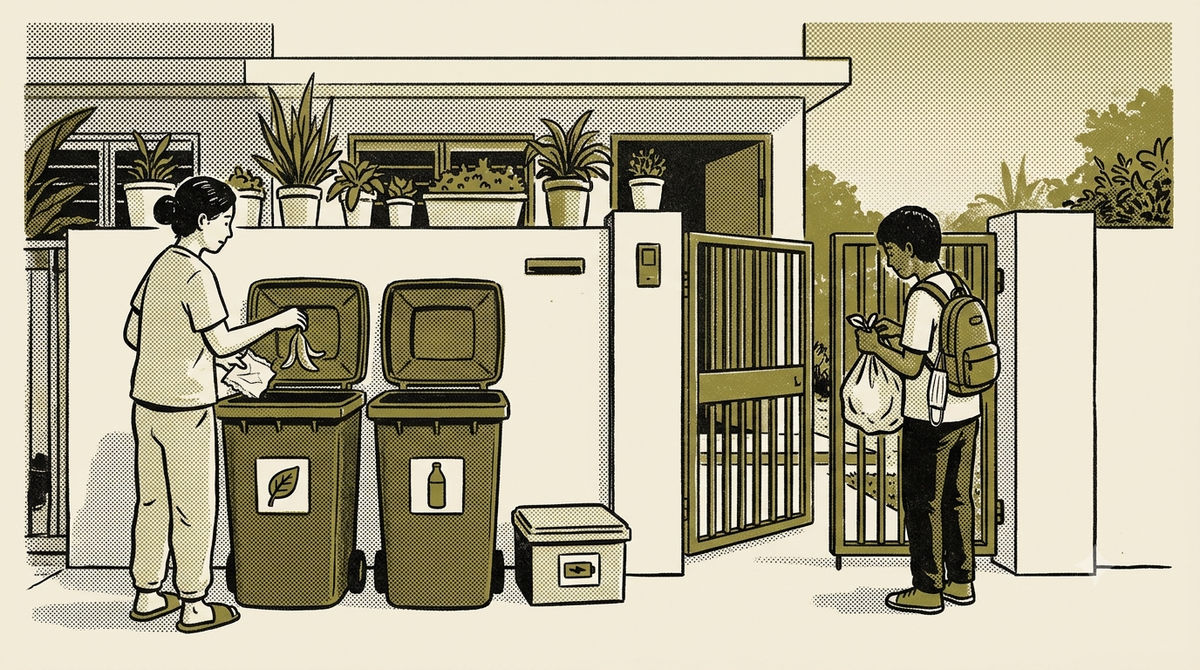
It is Sunday morning and your building has just switched to two-bin collection. Green bin, blue bin. You are standing at the gate holding a banana peel in one hand and an empty chips packet in the other. For a second you genuinely do not know which goes where. Behind you, someone shrugs and drops both into the same bag. The system is new, nobody explained it, and the easiest thing is to mix.
What's actually happening
Source segregation is not a municipal nicety. It is a citizen duty under the Solid Waste Management Rules, 2016, Section 4, which asks every household to separate waste before it leaves the house (Source: SWM Rules, 2016).
The streams are simpler than they look. Wet waste is anything that rots: kitchen scraps, peels, leftovers, garden trimmings. Dry waste is anything that does not rot and could be recovered: paper, plastic, glass, metal, packaging. The third stream is domestic hazardous and sanitary waste: used pads and diapers, blades, batteries, expired medicines, bulbs, e-waste. This last stream is small, but it is the one that hurts people if it goes in the wrong bin.
Here is the honest part. In many cities the segregated bins are still tipped into one mixed truck. That failure is real, and worth complaining about. It does not cancel the value of segregating. Clean, dry recyclables are only recoverable if they were never soaked in wet waste. And the person who sorts the city's dry waste does it by hand. A loose blade or a leaking battery in that bin becomes their injury, not an abstraction.
What works better
Use the 30-second test. Does it rot? Wet bin, green. Does it not rot and could it be recycled? Dry bin, blue. Is it sanitary, sharp, a battery, a medicine, or a bulb? Third stream: wrap it, mark it, keep it out of both other bins.
Keep dry waste dry. Rinse the curd container before it goes in the blue bin. A clean packet gets recycled; a food-smeared one goes to landfill (Source: CPHEEO Manual).
Wrap sanitary and sharp waste in newspaper or a marked bag before disposal, so no one handling it is cut or exposed (Source: SWM Rules, 2016).
When you are unsure about an item, default to dry, then check your city's list. Wet contamination is the more expensive mistake.
Why it matters
India generates roughly 160,000 tonnes of municipal waste a day, and more than half of it is wet, compostable material (Source: CPCB). When wet and dry are mixed, almost none of it is easily recoverable, and most goes to a landfill your city is running out of room for.
Segregation is the highest-leverage thing a household can do. Thirty seconds of attention decides whether a peel becomes compost or a methane problem, and whether a bottle gets a second life or gets buried.
Try this next time
Set up two bins at home this week, green for wet and blue for dry, plus a small third container for sanitary and hazardous items. For one week, sort as you go instead of at the end. By day three it stops being a decision and becomes a reflex. Then, if your city still mixes the streams at collection, file one complaint asking why. Segregating at home earns you the standing to ask.
Quick check
1. You've finished a cup of curd and the plastic container still has a little curd stuck inside. Which bin, and any prep first?
Select an answer.
2. You're clearing a drawer and find two dead AA batteries, an expired strip of medicine, and a used razor blade. Where do these go?
Select an answer.